
| |||||||
|
The Problem With Your Problem by Mitchell Ditkoff
Hugh Moore had a problem. The year was 1908 and Hugh was trying to make a buck with his "bright idea" - a vending machine that dispensed a drink of water for 1¢. But sales were slow - especially since people at that time could get water for free by using tin dippers at public drinking troughs. As fate would have it, however, a national health crusade soon began - one that warned the general public against the hazards of the dreaded communal tin dipper. This, as fate would have it, proved to be very good timing for Hugh. In less time than you could say "entrepreneur" he realized that he'd been trying to solve the wrong problem. It wasn't water he should be selling, but the disposable drinking cup! Joining forces with a friend, Hugh took his newly hatched idea (and some handmade samples) to New York City and secured a $200,000 loan. Soon his cup runneth over and his fledgling company branched into the soda industry and the rapidly expanding world of ice cream. (Does the name Dixie Cup mean anything to you?)
Multi-tracking to the max, few of us ever pause long enough to accurately define the problems that end up consuming our days and nights. How can we? We don't have the TIME - or think we don't have the time. Is there way out of this madness? Of course there is. And it begins by realizing that the answers, insights, and breakthroughs you need will come much more quickly when the problem you are wrestling with has been clearly defined. If not, you'll end up like my good friend, Vinny, looking for his lost car keys under a street light. "Hey, Vinny," I said, "why are you looking for your keys under the street light when you dropped them in the woods." "I know, I know," he replied, "but there's no light in the woods."
|
 |
Top News & Offerings
MitchDitkoff.com
 Click here for the simplest, most direct way, to learn more about Idea Champions' semi-fearless leader, Mitch Ditkoff. Info on his keynotes, workshops, conferences, and more.
Storytelling for the Revolution
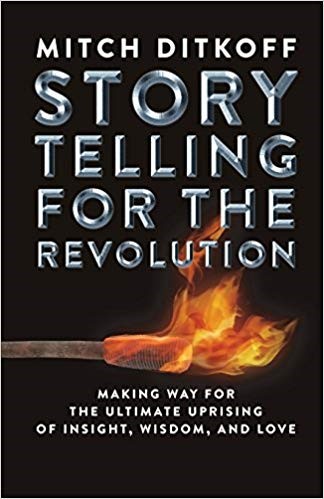 Storytelling for the Revolution is Mitch Ditkoff's newly published book about the power of personal storytelling to elevate the conversation on planet Earth. Provocative. Evocative. And fun. YOU have stories to tell. This book will help you tell them.
Storytelling at Work
 "The world is not made of atoms," wrote the poet, Muriel Rukeyser. "It's made of stories." Learn how to discover, honor, and unpack the stories of yours that show up "on the job" in Mitch Ditkoff's award-winning 2015 book, Storytelling at Work.
 
Workshops & Trainings
 Highly engaging learning experiences
that increase each participant's ability to
become a creative force for positive change
Highly engaging learning experiences
that increase each participant's ability to
become a creative force for positive change
Brainstorm Facilitation
 High impact certification training that teaches
committed change agents how to lead
groundbreaking ideation sessions
High impact certification training that teaches
committed change agents how to lead
groundbreaking ideation sessions
Cultivating Innovation
 Your "best and brightest" are the future leaders of your company, but unless they know how to foster a culture of innovation, their impact will be limited. A one-day workshop with us is all they need to begin this journey.
Our Blog Cabin
 Our Heart of Innovation blog is a daily destination for movers and shakers everywhere — gleefully produced by our President, Mitch Ditkoff, voted "best innovation blogger in the world" two years running.
Team Innovation
 Innovation is a team sport. Brilliant ideas go nowhere unless your people are aligned, collaborative, and team-oriented. That doesn't happen automatically, however. It takes intention, clarity, selflessness, and a new way of operating.
 If you're looking for a powerful way to jump start innovation and get your creative juices flowing,
Awake at the Wheel is for you.
Written by Mitch Ditkoff, Co-Founder and President of Idea Champions.
If you're looking for a powerful way to jump start innovation and get your creative juices flowing,
Awake at the Wheel is for you.
Written by Mitch Ditkoff, Co-Founder and President of Idea Champions.
 The world's first interactive business blues band.
A great way to help your workforce go beyond complaint.
The world's first interactive business blues band.
A great way to help your workforce go beyond complaint.
"In tune with corporate America." — CNN |
|||||
| |||||||
 Download this article
 Hugh Moore was fortunate. Early in the game, he was able to recognize that he was working on the wrong problem. Thousands of other aspiring innovators, however, are not as fortunate - nor as perceptive. They waste countless time and money working on problems that wouldn't exist if only they were able to step back and redefine their challenge. For example, is it another meeting you need or is it a better way of communicating what you want to say that would eliminate the need for meetings? Good question. As Charles Kettering, the noted British inventor put it, "A problem well-stated is a problem half-solved." Or how about Alfred North Whitehead's take on it? "It's not that they can't see the solution. They can't see the problem."