The 10 Personas of a Good Brainstorm Facilitator

Allow me to make a wild guess. You have participated in more than a few brainstorm sessions in your life. Yes?
And allow me to make another wild guess. Many of those sessions left you feeling underwhelmed, over-caffeinated, disappointed, disengaged, and doubtful that much of ANYTHING was ever going to happen as a result of your participation.
Yes, again? I thought so.
There's a ton of reasons why most brainstorming sessions under-deliver, but the main reason -- the Mount Olympus of reasons (drum roll, please....) is the brainstorm facilitator.
Armed with a short list of ground rules, a flipchart marker, and a muffin, most brainstorm facilitators miss the mark completely.
The reason has less to do with their process, tools, and techniques than it does with their inability to adapt to what's happening, real-time, in the room.
In an all-too-professional attempt to be one-pointed, they end up being one-dimensional, missing out on a host of in-the-moment opportunities to spark the ever-mutating, collective genius of the group.

If only our well-intentioned brainstorm facilitators could abide by the words of Walt Whitman, when he confessed that he "contained multitudes."
Translation? If you or anyone you know is going to lead a diverse group of time-crunched, opinionated, multi-tracking, people through a process of originating breakthrough ideas, DON'T BE A ONE TRICK PONY! Be a multitude -- or, at the very least, be multi-faceted. Let it rip. Hang ten. Pull out the stops.
Use your right brain and your left. Let all the cats out of the proverbial bag -- and by so doing, exponentially increase your chances of sparking brainpower, brilliance, and beyond-the-obvious ideas.
OK. Enough bloggy pep talk. Let's get down to business.
Take a few minutes now to rate yourself, on a scale of 1-10, for how skillful you are at embodying the following personas of a high flying brainstorm facilitator
Then tune into your biggest strength and ask yourself how you can amplify that quality. Then identify your biggest weakness and figure out how you can improve in that arena.

1.CONDUCTOR
A skilled brainstorm facilitator knows how to orchestrate powerfully creative output from a seemingly dissonant group of people. In the conductor mode, the facilitator includes everyone, evokes even the subtlest contributions from the least experienced participant, and demonstrates their commitment to the whole by offering timely feedback to anyone who "gets lost in their own song."
2.ALCHEMIST
A good brainstorm facilitator is able to transmute lead into gold -- or in modern terms -- knows how to help people "get the lead out." This talent requires an element of wizardry -- the ability to see without looking, feel without touching, and intuitively know that within each brainstormer lives a hidden genius just waiting to get out.
3.DANCER
Light on their feet, brainstorm facilitators move gracefully through the process of sparking new ideas. Able to go from the cha-cha to the polka to the whirling dervish spinning of a brainstorm group on fire, savvy facilitators take bold steps when necessary, even when there is no visible ground underfoot. "The path is made by walking on it," is their motto.
4. MAD SCIENTIST
Skillful brainstorm facilitators are bold experimenters, often taking on the crazed (but grandfatherly) look of an Einstein in heat. While respecting the realm of logic and the rational (the ground upon which most scientists build their homes), the enlightened facilitator is willing to throw it all out the window in the hope of triggering a "happy accident" or a quantum leap of thought. Indeed, it is often these discontinuous non-linear moments that produce the kind of breakthroughs that logic can only describe, never elicit itself.

5.DIAMOND CUTTER
Fully recognizing the precious gem of the human imagination (as well as the delicacy required to set it free), the high octave brainstorm facilitator is a craftsman (or craftswoman) par excellence -- focused, precise, and dedicated. Able to get to the heart of the matter in a single stroke without leaving anything or anyone damaged in the process.
6. ACTOR
Brainstorm facilitators are "on stage" whether they like it or not. All eyes are upon them, as well as all the potential critical reviews humanly possible. More often than not, the facilitator's "audience" will only be moved to act (perchance to dream) if they believe the facilitator is completely into his or her role. If the audience does not suspend this kind of disbelief, the play will close early and everyone will be praying for a fire drill or wishing they were back home eating a grilled cheese sandwich.
7.ENVIRONMENTALIST
Brainstorm facilitators are the original recyclers. In their relentless pursuit of possibility, they look for value in places other people see as useless. To the facilitator in full mojo mode, "bad ideas" aren't always bad, only curious indicators that something of untapped value is lurking nearby.
8. OFFICER OF THE LAW
One of the brainstorm facilitator's most important jobs is to enforce "law and order" once the group gets roaring down the open highway of the imagination. This is a fine art -- for in this territory speeding is encouraged, as is running red lights, jaywalking, and occasionally breaking and entering. Just as thieves have their code of honor, however, so too should brainstormers. Indeed, it is the facilitator's task to keep this code intact -- a task made infinitely easier by the ritual declaration of ground rules at the start of a session.''
9.SERVANT
Some brainstorm facilitators, intoxicated by the group energy and their own newly stimulated imagination, use their position as a way to foist their ideas on others -- or worse, manipulate the group into their way of thinking. Oops! Ouch! Aargh! Brainstorm facilitating is a service, not a personal platform. It is supposed to be a selfless act that enables others to arrive at their own solutions -- no matter how different they may be from the facilitator's.
10. STAND-UP COMIC
Humor is one of the brainstorm facilitator's most important tools. It dissolves boundaries, activates the right brain, helps participants get unstuck, and shifts perspective just enough to help everyone open their eyes to new ways of seeing. Trained facilitators are always on the lookout for humorous responses. They know that humor often signals some of the most promising ideas, and that giggles, guffaws, and laughable side-talk frequently indicate a rich vein of possibility to explore. Humor also makes the facilitator much more "likable" which makes the group they are facilitating more amenable to their direction. Ever wonder why the words "Aha!" and "Ha-Ha" are so similar?
Want to learn how to facilitate breakthrough brainstorming sessions? Click here.
Illustration
Illustration
Photo
Illustration
Photo
Painting
Posted by Mitch Ditkoff at 12:11 AM | Comments (3)
March 29, 2012What Lens Are You Looking Through?

Holmes and Watson are on a camping trip. In the middle of the night Holmes wakes up and gives Dr. Watson a nudge. "Watson," he says, "look up in the sky and tell me what you see."
"I see millions of stars, Holmes," says Watson.
"And what do you conclude from that, Watson?"
Watson thinks for a moment, "Well," he says, "astronomically, it tells me that there are millions of galaxies and potentially billions of planets. Astrologically, I observe that Saturn is in Leo. Horologically, I deduce that the time is approximately a quarter past three. Meteorologically, I suspect that we will have a beautiful day tomorrow. Theologically, I can see that God is all powerful, and we are small and insignificant. Uh, what does that tell you, Holmes?"
"Watson, you idiot! Someone has stolen our tent!"
Right on, Holmes!
For those of you trying to figure out why your business isn't more innovative, consider the above joke. The answer is in the punchline.
Your CEO looks up and sees the Board. Your CFO looks up and sees Wall Street. Your CIO looks up and sees Blackberries. Your HR Director looks up and sees diversity. And your workforce? They don't look up -- overwhelmed as they are with the tasks they've been given to deliver on next quarter's results.

The beauty of the Holmes/Watson joke (excerpted from Thomas Cathcart's and Daniel Klein's delightful book, Plato and a Platypus Walk Into a Bar...) is that it cuts to the core of the issue in very few words.
Humor does that. Which is why the Court Jester was the one who had the King's ear.
HAHA and AHA are two sides of the same coin. The same thing that triggers laughter triggers insight.
It's all about a momentary shock to the system -- the unexpected...a surprise... delightful discontinuity. And when that happens -- when we are momentarily boggled by an input that does not fit with our logical expectations, VOILA! Breakthrough! And along with it, a jolly good time.
Unfortunately, the sound of laughter in the workplace is often interpreted by managers as proof of a slacker workforce -- as if laughing and working were mutually exclusive.
Nothing could be further from the truth. "If you lose the power to laugh, you lose the power to think" explained Clarence Darrow.
Or how about this from Carl Jung? "The creation of something new is not accomplished by the intellect, but by the play instinct arising from inner necessity. The creative mind plays with the object it loves."
Or this from Isaac Asimov: "The most exciting phrase to hear in science, the one that heralds new discoveries, is not 'Eureka!', but 'That's funny.'"
OK. These two innovation consultants walk into a bar...
Posted by Mitch Ditkoff at 03:24 AM | Comments (0)
March 28, 2012The Joy of Outlandishness

Posted by Mitch Ditkoff at 04:32 PM | Comments (0)
Does Laughter Enable Thinking?
Posted by Mitch Ditkoff at 09:37 AM | Comments (0)
March 27, 2012The Beauty of Bad
Posted by Mitch Ditkoff at 12:35 AM | Comments (0)
March 23, 2012Thomas Edison on Making Mistakes
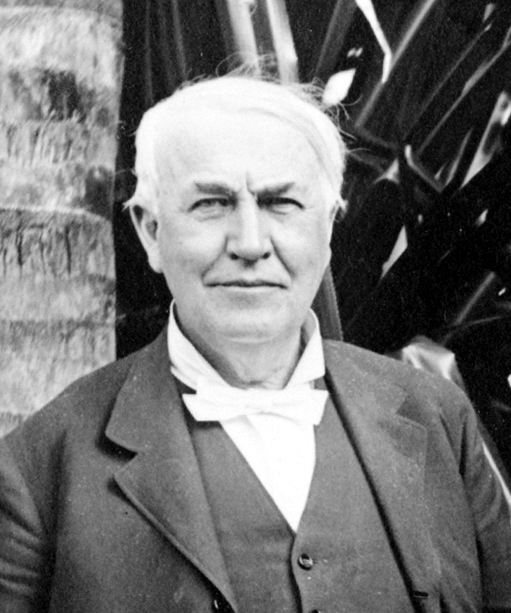
"I make
more
mistakes
than anyone
else
I know,
and sooner
or later,
I patent
most of them."
- Thomas Edison
Rethinking Failure
Risk taking quotes
Innovation keynotes
Posted by Mitch Ditkoff at 06:46 PM | Comments (0)
March 21, 2012Don't Let This Happen to You!

This poor guy just read
the next game changing
business book:
"The Six Habits of the Five Principles
of the Ten Ways
to Be 300% More Effective
While Doing Less
and Having More."
Is it just me, or do you also think
there are way too many
FREAKING BUSINESS BOOKS
these days,
pawning themselves off
as the 12 Irrefutable Laws
about saying the same thing
over and over again
in order for the ghost written author
to one day,
get hefty keynote speaking fees.
Posted by Mitch Ditkoff at 09:09 PM | Comments (0)
March 20, 2012Why Good Leaders Pause

It's often the case that people expect their leaders to be decisive -- able to make difficult decisions quickly. Indeed, this kind of behavior is interpreted as one of the hallmarks of good leadership.
The reality is different, however.
The "rush to judgment" mindset creates undue pressure on leaders -- the kind of pressure that causes them to prematurely choose a path forward even when confronting a complex problem.
To be truly effective, leaders need to balance the need to quickly converge on a single solution with the conflicting requirement that multiple perspectives be considered.
Yes, spending time to gain an understanding of the thought processes behind conflicting perspectives slows down the decision-making process. But it also creates a rich opportunity for much more robust solutions.
Slowing down is not necessarily a sign of procrastination or indecision. More accurately, it is a sign of impending wisdom about to be applied.

Tolerating this period of pause requires leaders to exhibit two qualities that seem to be in short supply these days:
1. Self-confidence (not bravado).
2. Patience (not procrastination).
Unfortunately, as external pressures from above and below increase, leaders experience an increasing tendency to internalize these pressures, causing self-doubt, stress, and a relentless need to prove their worth.
The result? Leaders end up adopting pre-existing solutions not well-suited to the challenges at hand. They decide fast, but the decisions they make are all too often fatally flawed.
Being able to resist mounting pressures to act quickly requires great intestinal fortitude. It requires leaders to keep themselves and others passionately engaged in the process of finding a way through the uncertainty instead of grasping at known "solutions" which only make the problem worse.
This phenomenon is similar to the classic story of the drunkard looking for his car keys under a streetlight even though he knows it's not where he dropped them.
"I know my keys aren't there," he confesses, "but that's where the light is."
It's not easy searching in the dark. Nor is it easy convincing others to join you in the search.
Which is precisely why being an authentic leader is so difficult these days.
- Barry Gruenberg
Here's another one of Barry's fine articles.
Posted by Mitch Ditkoff at 11:39 AM | Comments (0)
March 19, 2012iPhone, Therefore I Am?

I just had a realization. Well, maybe "realization" is too fancy a word. Make that more of an insight. Nah... "insight" sounds just a tad too self-congratulatory.
For want of a better word, let's call my little moment a semi-embarrassing wake up call -- the kind of learning experience I claim is good for me, but I really don't want to have.
It's a moment I've had a hundred times before, but not until two days ago, in Newark Airport, as I was exiting Flight #1140 from LA, did the whole thing really dawn on me.
There I was, merrily walking through Terminal "C", glad to be heading home after a three-day business trip, when I reached into my pocket for my trusty iPhone only to discover it wasn't there.
My iPhone wasn't there! Gone. It was gone. My iPhone was gone!
Gone, as in missing. Gone, as in not in my pocket. Gone, as in WHERE IN THE WORLD WAS MY FREAKING IPHONE with all those apps and appointments and contacts?

No, I wasn't in Kansas anymore. Neither was I in New Jersey. I was in a sudden state of panic -- as far away from samadhi as a person could be, Woody Allen on steroids -- my former digital life flashing before my eyes.
Where just a minute ago I was a conscious human being firmly rooted in a deep experience of peace, now I was wildly slapping every pocket I could find like some kind of poster boy for Tourette's Syndrome
This ridiculous outtake from a movie that will never be made took less than five seconds (me having blissfully located the "missing iPhone" in my suit jacket pocket), but those five seconds were very revealing -- me (Mr. Been-On-The-Path-For-40-Years) so easily discombobulated by a (temporarily) missing phone.
Which, I guess, is a good thing -- as it popped, once again, the bubble of my own pitiful self-image of being so together -- that shiny golden calf I all-too-often worship at.
My little airport experience reminds me of that classic Zen story of the young monk who -- after ten years of deep practice in the mountain monastery -- is invited by his Master to give the morning talk at the local village temple.
The young monk's discourse was impeccable that day, his Master astounded by his protege's ability to quote from the most esoteric of Zen doctrine.
But when the talk was over and it was time for the young monk to begin his long trek back up the mountain, he could not find his sandals.
Apparently, in his excitement at having been asked to speak, he'd forgotten where he put them.
Unsmiling, his Master shot him a stern glance and pointed to the mountain top.

"Ten more years, young friend. Ten more years."
And that's exactly how long it took the monk to be asked again to give the morning talk at the village temple.
The good news? On that day he remembered exactly where his sandals were.
Posted by Mitch Ditkoff at 12:34 AM | Comments (0)
March 18, 2012Einstein on Stupidity

"Everybody
is a genius.
But if you
judge a fish
by its ability
to climb a tree,
it will live
its whole life believing
that it is stupid."
- Albert Einstein
Posted by Mitch Ditkoff at 09:44 PM | Comments (0)
50 Awesome Quotes on the Power of Your Ideas
1. "If at first, the idea is not absurd, then there is no hope for it." - Albert Einstein
2. "If you do not express your own original ideas, if you do not listen to your own being, you will have betrayed yourself." - Rollo May
3. "An idea that is not dangerous is unworthy of being called an idea at all." - Oscar Wilde
4. "Ideas are like rabbits. You get a couple and learn how to handle them, and pretty soon you have a dozen." - John Steinbeck
5. "The way to get good ideas is to get lots of ideas and throw the bad ones away." - Linus Pauling
6. "There is one thing stronger than all the armies in the world, and that is an idea whose time has come." - Victor Hugo
7. "Ideas won't keep. Something must be done about them." - Alfred North Whitehead
8. "A new idea is delicate. It can be killed by a sneer or a yawn; it can be stabbed to death by a quip and worried to death by a frown on the right man's brow." - Ovid

9. "All achievements, all earned riches, have their beginning in an idea." - Napoleon Hill
10. "You can have brilliant ideas, but if you can't get them across, your ideas won't get you anywhere." - Lee Iacocca
11. "No grand idea was ever born in a conference, but a lot of foolish ideas have died there." - F. Scott Fitzgerald
12. "Nearly every man who develops an idea works it up to the point where it looks impossible, and then he gets discouraged. That's not the place to become discouraged." - Thomas Edison
13. "It is the essence of genius to make use of the simplest ideas."
- Charles Peguy
14. "Nothing is more dangerous than an idea when it is the only one you have." - Emile Chartier
15. "I had a monumental idea this morning, but I didn't like it." - Samuel Goldwyn

16. "An idea, like a ghost, must be spoken to a little before it will explain itself." - Charles Dickens
17. "Everyone is in love with their own ideas." - Carl Jung
18. "Why is it I always get my best ideas while shaving?" - Albert Einstein
19. "One's mind, once stretched by a new idea, never regains its original dimensions." - Oliver Wendell Holmes
20. "The air is full of ideas. They are knocking you in the head all the time. You only have to know what you want, then forget it, and go about your business. Suddenly, the idea will come through. It was there all the time." - Henry Ford
21. "Everything begins with an idea." - Earl Nightengale
22. "Capital isn't that important in business. Experience isn't that important. You can get both of these things. What is important is ideas." - Harvey Firestone
23. "A mediocre idea that generates enthusiasm will go further than a great idea that inspires no one." - Mary Kay Ash
24. "We often refuse to accept an idea merely because the tone of voice in which it has been expressed is unsympathetic to us."- Friedrich Nietzche
25. "I know quite certainly that I myself have no special talent. Curiosity, obsession and dogged endurance, combined with self-criticism, have brought me to my ideas." - Albert Einstein
26. "A pile of rocks ceases to be a rock when somebody contemplates it with the idea of a cathedral in mind." - Antoine St. Exupery
27. "If you want to kill any idea in the world, get a committee working on it." - Charles Kettering

28. "Right now it's only a notion, but I think I can get the money to make it into a concept, and later turn it into an idea." - Woody Allen
29. "Just because you're a musician doesn't mean all your ideas are about music. So every once in a while I get an idea about plumbing, I get an idea about city government, and they come the way they come." - Jerry Garcia
30. "I begin with an idea and then it becomes something else." - Pablo Picasso
31. "New ideas pass through three periods: 1) It can't be done; 2) It probably can be done, but it's not worth doing; 3) I knew it was a good idea all along!" - Arthur C. Clarke
32. "Almost all really new ideas have a certain aspect of foolishness when they are just produced." - Alfred North Whitehead
33. "Adults are always asking little kids what they want to be when they grow up because they're looking for ideas." - Paula Poundstone
34. "You do things when the opportunities come along. I've had periods in my life when I've had a bundle of ideas come along, and I've had long dry spells. If I get an idea next week, I'll do something. If not, I won't do a damn thing." - Warren Buffet
35. "If I have a thousand ideas and only one turns out to be good, I am satisfied." - Alfred Noble
36. "Take up one idea. Make that one idea your life. Think of it, dream of it, live on that idea. Let the brain, muscles, nerves, every part of your body, be full of that idea, and just leave every other idea alone. This is the way to success. That is way great spiritual giants are produced." - Swami Vivekananda
37. "Money never starts an idea; it is the idea that starts the money." - William J. Cameron
38. "No idea is so outlandish that it should not be considered."
- Winston Churchill

39. "If you are possessed by an idea, you find it expressed everywhere, you even smell it." - Thomas Mann
40. "The ability to express an idea is well nigh as important as the idea itself." - Bernard Baruch
41. "You can kill a man, but you can't kill an idea." - Medgar Evers
42. "After years of telling corporate citizens to 'trust the system', many companies must relearn instead to trust their people and encourage them to use neglected creative capacities in order to tap the most potent economic stimulus of all: idea power." - Rosabeth Moss Kanter
43. "The man with a new idea is a crank -- until the idea succeeds." - Mark Twain
44. "To turn really interesting ideas and fledgling technologies into a company that can continue to innovate for years, requires a lot of discipline." - Steve Jobs
45. "An idea is salvation by imagination." - Frank Lloyd Wright
46. "I can't understand why people are frightened of new ideas. I'm frightened of the old ones." - John Cage
47. "The great accomplishments of man have resulted from the
transmission of ideas of enthusiasm." - Thomas Watson
48. "The new idea either finds a champion or it dies. No ordinary involvement with a new idea provides the energy required to cope with the indifference and resistance that change provokes." - Tom Peters
49. "Our best ideas come from clerks and stockboys." - Sam Walton
50. "Daring ideas are like chessmen moved forward: they may be beaten, but they may start a winning game." - Goethe
Idea Generating Keynotes
Idea Champions
Free the Genie
Innovation Kit
Posted by Mitch Ditkoff at 05:20 PM | Comments (0)
March 16, 201220 Reasons Why People Get Their Best Ideas in the Shower

During the past 25 years, I've asked more than 10,000 people where and when they get their best ideas. I get all kinds of answers, but the one that has always fascinated me is "the shower" -- maybe because I also get so many of my good ideas there.
And so, at the risk of overstating my case, I hereby offer you 20 reasons WHY the shower is so conducive to new ideas.
1. Showering signals "a new day" or "new beginning."
2. You're usually alone, with time to reflect.
3. Interruptions are rare.
4. The rush of water creates a kind of "white noise" that makes concentration easier.
5. Shower stalls look like little incubation chambers.
6. Water is associated with "contemplation" (i.e. sitting near a river, lake, or ocean.)
7. Showering is a metaphor for "getting rid of the dirt" -- the stuff that covers up what's beneath.
8. Showering is a ritual. Lots of creative people like to have little rituals to get their head in the right place.
9. You can write your ideas on the walls with a water soluble pen.

10. There's not a lot of judgment or analysis going on in a shower.
11. A hot shower opens the pores -- and by extension, maybe the mind.
12. Showering wakes up you. It makes you more alert.
13. Showering is a relaxing and stress free experience. With nothing to stress about, your mind is free to roam new territories.
14. If you shampoo, you're massaging your head. That's gotta be good.
15. It's hard to check your iphone or Blackberry in a shower.
16. Albert Einstein did his best thinking near a shower. ("Why is it I always get my best ideas while shaving?")
17. Water is associated with "flow." Being in the "flow state" is often a precursor to creative thinking.
18. There is no deliverable expected of you.
19. If you shower with a friend, and he/she happens to be in a brainstorming mode, lots of great ideas get sparked.
20. Showering is easy. Not a lot of thinking is required to make it happen, which frees your mind to think about other things.
Any other possibilities come to mind?
Another catalyst for great ideas.
Photo
Photo
Idea Champions
Photo
Posted by Mitch Ditkoff at 11:48 AM | Comments (4)
March 14, 201220 Qualities of an Innovator

The word "innovate" can be traced all the way back to 1440. It comes from the Middle French word "innovacyon," meaning "renewal" or "new way of doing things".
Exactly what innovations actually happened in 1440 (rounder oxcart wheels?) is anybody's guess, but whatever they were, it's likely they improved the quality of life for more than a few people.
These days, the "innovation thing" is something of a no-brainer. Every company worth its low-salt lunch has identified innovation as a core competency needing to be developed.
Who in their right mind (or is it right brain?) can deny the value of improving things? Isn't this what human beings, those grand inventors of the microchip and the chocolate chip, are supposed to do?
True. But who has time?
And so begins the search for the magic pill -- the system, formula, or blueprint that will make innovation a done deal.
Innovation, unfortunately -- unlike audits, re-engineering, or your high school penmanship teacher -- is not given to systems, formulas, and blueprints. It is given to people -- restless, inspired, fascinated people with an almost cellular need to change things for the better.

And while it can certainly be supported by systems, it can never be reduced to systems.
If you want to ignite innovation in your organization, forget about slick formulas for a minute and pay attention to what's happening on the inside. Because that's where innovation starts. With the innovator -- the inspired individual, compelled to make a difference.
And the key to the innovator? The special blend of qualities that allows him or her to succeed while their co-workers are bitching and moaning on their way to their next unnecessary meeting?
Is it tools? Techniques? Metrics?
Sure, they're useful. But without the user of them having the right stuff, they're merely decoration -- like having a shiny set of new jumper cables, but no car.
And so... if you are one of the self-chosen few who are willing to stop blaming your organization, the economy, your boss, your industry, the government, HR, your mother, your astrological sign, the Board, and the bored, now's the time to start taking personal responsibility for innovating.
Now's your chance to kick things in high gear.

Now's the time to get the lead out -- to lead the revolution wherever you happen to be working at the time and make some magic.
Yes, it begins with you. But where does it begin with you?
With awareness.
In the words of the great psychologist, Fritz Perls, "awareness cures." Yes, it does.
Still with me?
If so, take a few minutes now to try the following exercise to get the party started.
All you need to do is rate yourself, on a scale of 1-10, for how much you manifest the following qualities in the workplace. Note which ones are your strengths -- and how can you build on them. Then note which ones are your weaknesses -- and how can you strengthen them.
You might even give them to your team and ask them to rate themselves. Then get together and talk about what you've all come up with.
And don't forget to floss.
20 Qualities of an Innovator
1. Challenges the status quo
2. Curious
3. Self-motivated
4. Visionary
5. Entertains the fantastic
6. Takes risks
7. Peripatetic (moves about)
8. Playful/humorous
9. Self-accepting
10. Flexible/adaptive
11. Makes new connections
12. Reflective
13. Recognizes patterns
14. Tolerates ambiguity
15. Committed to learning
16. Balances intuition and analysis
17. Situationally collaborative
18. Formally articulate
19. Resilient
20. Persevering
This posting is excerpted from It's AHAppening, a series of five, 16-page creative thinking guidebooks.
Idea Champions
Our values
Our clients
Our latest product
Posted by Mitch Ditkoff at 01:38 PM | Comments (0)
March 12, 2012POLL: Why Do You Want to Innovate?
If you read this blog, I know you want to innovate -- but I don't know WHY. Click here to take the poll. Results posted here in a few weeks.
Posted by Mitch Ditkoff at 01:19 AM | Comments (1)
March 11, 2012Where Einstein Got His Great Ideas
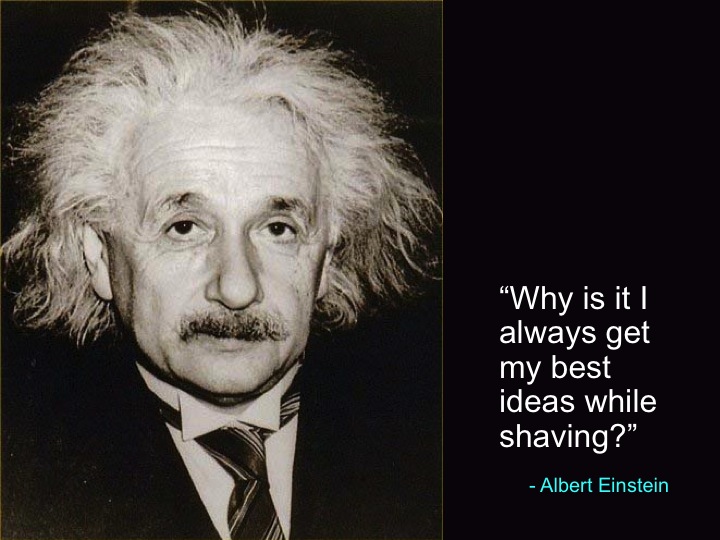
Einstein would have loved this guy
The patron saint of our webinar
Idea Champions
Posted by Mitch Ditkoff at 12:25 AM | Comments (0)
March 10, 2012Going Viral on the Cutting Edge
This is fabulous. Totally refreshing. And since it's all about razor blades, appropriately "edgy". Oh, it's already gotten more then 2.4 million views on YouTube. PS: How can you create a cool viral video that promotes your product or service?
Idea Champions
Get the juices flowing
Posted by Mitch Ditkoff at 07:54 AM | Comments (0)
March 08, 2012The Secret Realm of Great Ideas

Why you don't get your best ideas at work
Tapping into dreams
Idea Champions
Where AHAs come from
Posted by Mitch Ditkoff at 04:52 PM | Comments (0)
The 100 Lamest Excuses for Not Innovating
If people in your company are not innovating, their excuse is probably on the following list. So, take a look, note the ones that are most common, and start exploring ways to help people go over, under, around, or through them. (While you're at it, see if you any of YOUR excuses are on the list).
1. I don't have the time.
2. I can't get the funding.
3. My boss will never go for it.
4. Were not in the kind of business likely to innovate.
5. I've got too much on my plate.
6. We won't be able to get it past legal.
7. I'll be punished if I fail.
8. I'm just not not the creative type.
9. I'm juggling way too many projects.
10. I'm too new around here.
11. I'm not good at presenting my ideas.
12. No one, besides me, really cares about innovation.
13. There's too much bureaucracy here to get anything done.
14. Our customers aren't asking for it.
15. We're a risk averse culture. Always will be.

16. We don't have an innovation process.
17. We don't have a culture of innovation.
18. They don't pay me enough to take on this kind of project.
19. My boss will get all the credit.
20. My career path will be jeopardized if this doesn't fly.
21. I've already got enough headaches.
22. I'm no good at office politics.
23. My home life will suffer.
24. I'm not disciplined enough.
25. It's an idea too far ahead of its time.
26. I won't be able to get enough resources.
27. I don't have enough information.
28. Someone will steal my idea.
29. It will take too long to get results.
30. We're in a down economy.
31. It will die in committee.
32. I'll be laughed out of town.
33. I won't be able to get the ear of senior leadership.
34. If it ain't broke, don't fix it.
35. The concept is too disruptive.
36. I won't be able to get enough support.
37. I don't tolerate ambiguity all that well.
38. I'm not in a creative profession.
39. Now is not a good time to start a new project.
40. I don't have the right personality to build a team.
41. Our company is going through too many changes right now.
42. They won't give me any more time to work on the project.
43. If I succeed, too much will be expected of me.
44. Nothing ever changes around here.
45. Things are changing so fast, my head is spinning.
46. Whatever success I achieve will be undone by somebody else.
47. I don't have enough clout to get things done.
48. It's just not worth the effort.
49. I'm getting close to retirement.
50. My other projects will suffer.
51. Been there, done that.
52. I don't want another thing to think about.
53. I won't have any time left for my family.
54. A more nimble competitor will beat us to the punch.
55. Teamwork is a joke around here.
56. I've never done anything like this before.
57. I won't be rewarded if the project succeeds.
58. We're not measured for innovation.
59. I don't have the right credentials.
60. We need more data.
61. It's not my job.
62. It will hard sustaining the motivation required.
63. I've tried before and failed.
64. I'm not smart enough to pull this off.
65. I don't want to go to any more meetings.
66. It will take way too long to get up to speed.
67. Our Stage Gate process will sabotage any hope of success.
68. I'm not skillful at building business cases.
69. Summer's coming.
70. The marketplace is too volatile.
71. This is a luxury we can't afford at this time.
72. I think we're about to be acquired.
73. I'm trying to simplify my life, not complicate it.
74. The dog ate my homework.
75. Help! I'm a prisoner in a Chinese fortune cookie factory.
76. My company just wants to squeeze more blood from the stone.
77. My company isn't committed to innovation.
78. I don't have the patience.
79. I'm not sure how to begin.
80. I'm too left-brained for this sort of thing.
81. I won't be able to get the funding required.
82. I'm getting too old for this.
83. We're too competitive, in-house. Collaboration is a rarity.
84. Spring is coming.
85. I'm hypoglycemic.
86. That's Senior Leadership's job
87. I'm thinking of quitting.
88. Market conditions just aren't right.
89. We need to focus on the short term for a while.
90. Innovation, schminnovation.
91. What we really need are some cost cutting initiatives.
92. Six Sigma will take care of everything.
93. Mercury is in retrograde.
94. IT won't go for it.
95. Maybe next year.
96. That's my boss's job.
97. That's R&D's job.
98. I would if I could, but I can't, so I won't.
99. First, we need to benchmark the competition.
100.It's against my religion.
HOW TO GO BEYOND THESE LAME EXCUSES
1. Make a list of your three most bothersome ones.
2. Turn each excuse into a question, beginning with the words "How can I?" or "How can we?" (For example, if your excuse is "That's R&D's job," you might ask "How can I make innovation my job?" or "How can I help my team take more responsibility for innovating?"
3. Brainstorm each question -- alone and with your team.
4. DO something about it within the next 48 hours.
Other ways to go beyond. Or, hey, how about this. Or this or this.
Posted by Mitch Ditkoff at 08:53 AM | Comments (8)
March 07, 2012How to Capture the Wisdom of Your Organization's Elders

What do Clint Eastwood, Madeline Albright, Willie Nelson, Alan Alda, Desmond Tutu, Jane Goodall, Ravi Shankar, Edward Kennedy, Andrew Wyeth, Frank Gehry and a host of other creative movers and shakers have in common beside fame?
Wisdom!
Click here to see what they've learned in their long and very diverse lives... and get a glimpse of the fabulous Wisdom Project produced by Andrew Zuckerman.
If you work in an organization and are looking for a simple way to capture the wisdom of your senior people before they move on, here's a clue how to do it.
Honor the past, live in the present, be open to the future...
Posted by Mitch Ditkoff at 01:26 AM | Comments (0)
March 06, 2012ANNOUNCING! National Good Idea Day

Let me be the first to inform you that today is National Good Idea Day -- a day I am officially declaring without any approval from our dysfunctional government or any slick lobbying group attempting to hustle other people's products or services for a hefty commission.
As the official invoker of this fabulous new holiday, it is my honor to explain that the purpose of this way-better-than-groundhog-day extravaganza is for YOU to pitch your hottest new idea to someone you trust in the next 60 minutes. Got it? Good! Go! (And if anything comes of it, please let us know).
Posted by Mitch Ditkoff at 01:11 AM | Comments (0)
March 05, 2012Innovation from the Inside Out

These days, almost all of Idea Champions' clients are talking about the need to establish a culture of innovation.
Some, I'm happy to report, are actually doing something about it. Hallelujah! They are taking bold steps forward to turn theory into action.
The challenge for them is the same as it's always been -- to find a simple, authentic way to address the challenge from the inside out -- to water the root of the tree, not just the branches.
External systems and protocols, no matter how seductive they are to create, are simply not sufficient to guarantee real innovation. In the words of Oliver Wendell Holmes, "Systems die. Instinct remains."
This is not to say that organizations should ignore systems and structures in their effort to establish a culture of innovation. They shouldn't.
But systems and structures all too often become the Holy Grail -- much in the same way that Six Sigma has become the Holy Grail.
Unfortunately, when the addiction to systems and structures rules the day, an organization's quest for a culture of innovation degenerates into nothing much more than a cult of innovation.
Organizations do not innovate. People innovate. Inspired people. Fascinated people. Creative people. Committed people. That's where innovation originates -- from deep within the inspired individual who understands that his/her sustained effort is what's required to go beyond the status quo.

The organization's role -- just like the individual manager's role -- is to get out of the way. And while this "getting out of the way" will undoubtedly include the effort to formulate supportive systems, processes, and protocols, it is important to remember that systems, processes, and protocols are never the answer.
They are the context, not the content. They are the husk, not kernel. They are the menu, not the meal.
Ultimately, organizations are faced with the same challenge that religions are faced with. Religious leaders may speak passionately about the virtues their congregation needs to abide by, but sermons only name the challenge and remind people to experience something -- they don't necessarily change behavior.
Change comes from within the heart and mind of each individual. It cannot be legislated or evangelized into reality.
What's needed in organizations who aspire to a culture of innovation, is an inner change. People need to experience something within themselves that will spark and sustain their effort to innovate -- and when they experience this "something," they will be self-sustaining.
They will think about their projects in the shower, in their car, and in their dreams. They will need very little "management" from the outside. Inside out will rule the day -- not outside in. Intrinsic motivation will flourish.
People will innovate not because they are told to, but because they want to. Open Space Technology is a good metaphor for this. When people are inspired, share a common, compelling goal and have the time and space to collaborate, the results become self-organizing.
You can create all the reward systems you want. You can reinvent your workspace until you're blue in the face. You can license the latest and greatest idea management tool, but unless each person in your organization OWNS the need to innovate and finds a way to tap into their own innate brilliance, all you'll end up with is a mixed bag of systems, processes, and protocols -- the husk, not the kernel -- the innovation flotsam and jetsam that the next administration or next CEO or next key stakeholder will mock, reject or change at the drop of a hat if the ROI doesn't show up in the next 20 minutes.
You want culture change? You want a culture of innovation?
Great. Then find a way to help each and every person in your organization come from the inside out. Deeply consider how you can awaken, nurture, and develop the primal need all people have to create something extraordinary.
Posted by Mitch Ditkoff at 10:58 AM | Comments (10)
March 03, 2012WEBINAR #1: Ideation Jump Start

Idea Champions is happy to announce the launch of its new webinar curriculum for 2012 -- a series of high value 60-minute tutorials for companies wanting to foster innovation in a way that is encouraging, empowering, and enlightening.
Here's a brief description of the first one -- a webinar that has already been delivered nine times to Chubb Insurance.
IDEATION JUMP START is a powerful way to catalyze brilliance, creativity, and new ideas for individuals and teams at every level of your organization. It is especially beneficial for people who are committed to going beyond the status quo and originating elegant, new approaches to meeting pressing business challenges.
Prior to the webinar, we will help you define 1-3 challenges you want participants to address in the webinar.

WHAT YOU WILL LEARN:
1. How to access breakthrough ideas from your subconscious mind
2. Four mind-opening techniques to help you originate powerful, new ideas on and off-the-job
3. Five simple ways to increase the effectiveness of small group brainstorming
4. How to give and receive the kind of feedback that decreases naysaying and increases the odds of powerful, new ideas taking root in the organization
Bottom line, people who participate in an IDEATION JUMP START webinar have their "creative floodgates" opened and make a meaningful commitment to generating powerful, new ideas that will help their company grow.
Presented by Mitch Ditkoff, President of Idea Champions
For more info, contact Sarah Jacob (sarah@ideachampions.com)
Posted by Mitch Ditkoff at 11:24 PM | Comments (0)
March 02, 2012A Crash Course On How to Be a Great Consultant
Posted by Mitch Ditkoff at 12:44 AM | Comments (2)
March 01, 2012The Anti BS Book for PR Pros

Innovation, no matter how you define it, does not exist in a vacuum. It affects and is affected by every single aspect of your business.
No innovation-affecting business activity is more important than collaboration -- how people work together to accomplish a common goal.
The most crucial aspect of collaboration? Communication -- how we talk to each other -- a word, I just discovered, is derived from the Latin root communis, meaning "to share".
In this light, I'd like to recommend a newly published book on communication by a cohort of ours, PR consultant extraordinaire, Alan Cohen. It's called Tough Talks for PR Pros -- a book that is not only for PR people, but anyone who ever has the need to navigate the turbulent waters of tough conversations.

My favorite part of the book is Alan's Tough Talks Checklist.
Here's my own paraphrase of his 9-step model.
1. Share the facts and issues as you understand them.
Be brief, be clear, and be specific. Share the gap between what you see happening and what you want to see happening.
2. Share how this situation has affected you. Humanize the situation by talking like a human being to the person you are talking to without playing victim. What a concept!
3. Share your values -- especially those that express how you value the person you're talking to and your relationship with them. This is the time to tell someone "who you see them to truly be."
4. Invite a candid and honest response. "Stay curious." Listen for what is not being said.
5. Discuss the situation in order to reach understanding and agreement. Give and take -- as equals.
6. Find courageous solutions based on this understanding. Brainstorm! Be innovative! And feel free to step away from the conversation to think about possible solutions later.

7. Ask yourself which of possible solutions on the table would result in a win-win-win -- a win for the person you're talking to, a win for you, and a win for the relationship."
8. Choose one (or more) possible solutions and agree on specific action steps -- remembering to include a "by when" for each step.
9. Follow through and follow up. By so doing, you are demonstrating that the other person, your relationship with them, and the tough issues on the table are all important to you -- thereby reinforcing your own personal integrity.
While Tough Talks is loaded with insights and tips like these, Alan emphasizes that the key to unlocking the door to real communication is always understanding yourself.
Ultimately, it all comes down to taking personal responsibility for the state of one's relationship and communication with others.
-- Val Vadeboncoeur
Posted by Mitch Ditkoff at 05:49 AM | Comments (1)
Reframing Company PoliticsHere is a very refreshing take on a topic most of us are not very clear about -- company politics. If you want to be more influential in your organization, this a good place to start.
Posted by Mitch Ditkoff at 04:14 AM | Comments (0)