Sweeping the Path

As a middle class American male with a healthy dose of resistance to household chores, the broom has never been one of my favorite tools.
While I've certainly appreciated its timeless design and universal appeal, the act of sweeping has always felt like somebody else's job.
This belief radically changed for me one fine Spring day in 1980. That was the day I got word that Prem Rawat was coming to visit the house I was living in -- a funky old dwelling on Detroit Street in mile high Denver, Colorado.
Clearly, my housemates and I weren't ready. The kitchen was dirty. The bathrooms were a wreck. The lawn needed mowing. Mucho stuff needed to be done.
My task? To sweep.
Grabbing a broom like some kind of over-caffeinated Clint Eastwood on steroids, I pushed open the front door, surveyed the scene, and got busy.
The porch was a piece of cake. A few flicks of the wrist, a few energetic downward strokes in both directions and I was done -- leaves, twigs, and dust sailing over the edge onto the waiting lawn below.
Now it was time for the front walkway.
A sweep to the left. A sweep to the right. A sweep to the left again -- me a human metronome in tune with something beyond time. Whoosh. Whoosh. Whoosh.
I paused to view my handiwork. "Not bad, not bad at all," I thought to myself.
But though the porch and walk were much cleaner than before, my increasingly perceptive sweeper's vision was seeing things it hadn't noticed just ten minutes ago: a pebble stuck between cracks, a rusty bottlecap, a flattened piece of wax.
Whoosh to the left. Whoosh to the right. Whoosh to the left again.
It felt good getting ready, good preparing the way for the man who, nine years ago, had shown me -- in a heartbeat -- what the core of my life was really all about.
Whoosh, whoosh, whoosh.
Ta da! The porch was clean! The path was clear! All was right with the world! But wait! The sidewalk, in front of the house, was a complete mess. Bits of paper were everywhere. Plastic spoons. Shards of glass. And dirt, dirt, dirt.
Obviously, I had more work to do.
Whoosh to the left. Whoosh to the right. Whoosh to the left again.
I closed my eyes. I took a breath. I opened my eyes again. But wait! The road in front of the house was a wreck -- the very same road the person I loved the most in the world would need to cross if he parked his car on the north side of the street. Cigarette butts, oil spots, and leaves were everywhere. My hands began to twitch. My mind began to race. Wherever I looked, nothing was ready to receive him. Nothing was good enough. The world, it seemed to me, was one gigantic mess.
I wondered how far onto Detroit Street I needed to sweep -- how far I needed to go to prepare the way. At this rate, I might never come back.
And then, like one of those moments I used to read about in Zen Buddhism books, it hit me.
It wasn't the front porch that needed sweeping. It wasn't the path... the sidewalk... or the street. It was me. I was the one that needed to be swept -- swept of my clutter, swept of my assumptions, swept of whatever junk stood in the way of being able to receive Prem Rawat in a way that was as impeccable as possible.
Here's what I understood: I didn't need to sweep the porch. I didn't need to sweep the street. I didn't need to shine my shoes... or cut the grass... or buy a suit... or lose five pounds... or iron my shirt... or paint the house... or wash the car... or buy a dozen roses. I could, of course, if I wanted to.
I could if these things really needed to be done. But something else deep within me was going on -- something way more central to my life than what things appeared like on the outside.
And that's what I wanted to be as clean as possible.
PremRawat.com
i4Joy.com
TimelessToday.tv
Posted by Mitch Ditkoff at 06:09 AM | Comments (0)
May 15, 2023My Tray of Hors D'oeuvres Is Empty

I have been a student of Prem Rawat since 1971. For the past 52 years, inspired by the feeling of deep peace and gladness he has awakened in me, I have been attempting, in various unsuccessful ways, to describe who he is.
In the beginning, my descriptions were extremely effusive. Borderline inflated, you might say, and tinged with a hint of the zealot -- not unlike the poetry of one in love for the first time and badly in need of an editor.
Charming? For sure. Engaging? You bet. Attention getting? That, too. But also confusing to anyone sincerely wanting to understand what the big deal was all about.
In time, like wine, I have mellowed, no longer ruled by the need to label, define, and explain. It's a game I choose not to play any more.
What does Prem say when people ask him who he is? "Just a human being -- a mirror that helps people see their true reflection at that moment in time." This has been my experience completely. Allow me to be more specific...
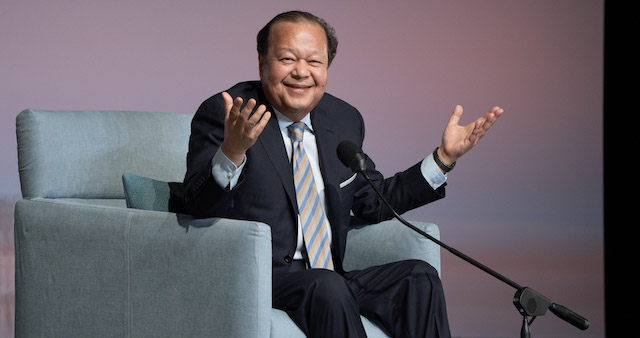
The year was 1982 and I was living in Los Angeles.
Although I had enjoyed some wonderfully casual moments with Prem throughout the years, most of my contact with him had been at big programs, him on stage, me straining to see from the mezzanine, wondering how to get a better seat. Like most of his students I wanted "special" time with him, away from the crowds.
And so when a friend asked me to be a waiter at a party he was throwing for his neighbors I jumped at the chance. I rented the outfit. I shined my shoes. I showed up early. Nobody but my mother could have guessed I wasn't a waiter by profession.
And then, with a signal from the caterer, my adventure began -- silver tray of hors d'oeuvres in my left hand -- spreading out with the rest of the waiters among the guests, each according to our designated areas.
The first thing I saw was Prem.
Technically speaking, he wasn't in my "area," but since none of the other waiters were approaching him, I decided to fill the void. This was my chance, I reasoned, especially since I hadn't talked to him for three years.
"Hors d'oeuvre?" I asked, extending my tray of goodies in his direction.
He pulled his head back, looked away, and extended his hand in a slow, downward motion as if to say, "Keep that thing away from me!"
I smiled and continued on my way, wondering if his refusal had any kind of cosmic significance. Was it me or the pizza puffs? Was he seeing some deep, ancient flaw in me? Was I hopelessly uncool?
Fortunately, the day was too beautiful to obsess on my thoughts for long and so I kept moving until I located my area in the field behind his house. From where I was now positioned, there were absolutely no sight lines to the party, no chance to see, I thought, the one for whom I was happy to be serving. The only thing interesting to look at was the ocean and the sky.

And so it was: Every 10 minutes or so a few guests would make their way back to my area, surprised to see a waiter, umbrella in one hand (it was raining!), tray in the other, standing in a field so far from the party.
It took about ten guests to empty my tray. After that I would head back to the waiters' shed for refills. This must have happened at least 20 times during the day and each time it did, Prem would somehow enter my field of vision -- standing, talking, eating, walking, and doing all the things a person does at a party. And though I could never predict what he was going to be doing when I saw him, I could predict the feeling I would have.
"Jazzed" is how I would describe it. Pumped. Buzzed. Blissed. I was a curious hybrid of boy seeing Santa and a Grateful Dead groupie with a lifetime back stage pass.
"It's him, I would think to myself again and again. "Him!"
This little scene played itself out many times during the day. But then something curious happened. About the 20th time I saw him, I felt nothing. Zero. Nada. Zilch. An unwelcome sense of normalcy began to take me over. Seeing him was suddenly no big deal. I wasn't awed. I wasn't amazed. Neither was I captivated, astounded, excited, glad, grateful, inspired, delighted, or energized.
I wasn't anything.
My concept of Prem Rawat was being deconstructed before my eyes. My "mental model" wasn't working. Something I had counted on for years -- that seeing him would always be uplifting -- was no longer operational.
Was it him? Was it me? Was it both of us? Neither? Something else?
One conclusion I could have easily drawn was that the man before me was nothing special -- a Wizard of Oz made great only by my own neurotic projections.
Yes, if I wanted proof that he was nothing but my own self-invented hype, now I had it. But having received Knowledge from him 12 years earlier and having experienced the many benefits of his guidance in my life, I could not bail out at such a simplistic conclusion.
Something else was clearly going on.
Looking back at that time, my buzzless series of waitering moments at his party felt like the unceremonial end of my extended honeymoon with him -- that formerly delightful time of spiritual romance in which I had been protected from (or blinded to) the moments in which one's "significant other" does not appear very extraordinary.
In marriages, this either marks the beginning or the end of the painful acceptance of the apparent mundane -- the time when the husband no longer seems heroic and the wife is no longer recognized as goddess.
It was confronting to admit it, but the part of my relationship to Prem that I had fabricated was becoming undone. Without knowing it, I had become a fan and a groupie in addition to being a student.
Like my previous strategy in my personal life of creating short-term love affairs to keep myself feeling studly, I had been orchestrating my relationship with Prem to provide well-timed payoffs. Did it work? Yes, it did. But it went only so far.
I was not alone.
In my experience, lots of his students have set him up this way. Ruled by the very human need to define and categorize, we turned him into many things: a superstar, a hero, an Avatar, an anthropomorphized version of our own private God -- projecting all kinds of images on him, not unlike small children do with their parents or teachers.
Inevitably, this leads to disappointment. Which leads to doubt. Which leads to anger. And it is this anger, born from the gap between who he is and who we imagine him to be, that is often the reason why some students of Prem Rawat eventually reject him.
"He is not who I thought he was," they claim. And of course it is true, because, in many ways, it is impossible to know the very hard to categorize Mr. Rawat (or anyone else for that matter) through the medium of thought.
More relationships are ruined, I believe, by expectations than by anything else.
Husbands do it to their wives. Wives do it to their husbands. Parents do it to their kids. The Master/Student relationship is no exception. Somehow we get it into our heads that a Master has to be a certain way.
Casting directors in our own "B" movie, we patch together our favorite stereotypes and create a picture of how the Master should be and then proceed to compare everything he does to that picture.
Of course, we're going to be disappointed. How could it be any other way?
The alternative? Live and let live. Be who you are and let Prem be who he is. Give up the addiction to having everyone and everything fit the Procrustean bed of your own spiritualized imagination.
Allow the simplicity of love to be the fulcrum around which your life revolves. Appreciate each and every breath. Be grateful. Live and let live. Savor the opportunity to be alive and enjoy all the many blessings in your life. Take off the rose-colored glasses and those rose-colored explanations. You don't need them anymore.
PremRawat.com
Prem Photo: Courtesy of TimelessToday
Posted by Mitch Ditkoff at 11:15 PM | Comments (4)
March 22, 2022Draw a Breath, Not a Line
Throughout history and even last Thursday, inner-directed people on the so-called "spiritual path", have had a tendency to perceive the world as "maya" -- the fancy sanskrit name for "illusion."
I used to feel this way a lot.
Back in the early days of my adolescent quest for meaning, I had a curious habit of drawing lines in the sand. On one side of the line was the "inner life" -- the place where God lived (or if not lived, at least vacationed). On the other side of the line was "the world." You know -- the laughable detritus of life on planet Earth: relationships, shopping malls, money, politics, ego, organized religion, high school geometry, taxes, Frosted Flakes, and anything I didn't understand, agree with, or like.
Somehow, it made me feel good to draw these lines -- not unlike the way Democrat and Republican spin doctors strut their stuff on CNN after each political debate.
Well... I would like to take this late night blogospheric moment to humbly apologize to all of those whose lives I somehow judged by my habitual line-drawing behavior.
I see things differently now -- kind of like that old Zen story...
Two young monks, one fine day, found themselves existentially arguing over whether it was the wind or the flag that was moving. Unable to agree, they sought the counsel of their teacher.
"Master, oh Master" they asked, "is it the wind or the flag that is moving?"
"Neither," the Master replied. "It's your mind that is moving."
And so, dear friend, if you find yourself judging anyone these days, including yourself, chill. It's a total waste of time -- especially when you could be enjoying the very thing you were born for.
Draw a breath, not a line.
Posted by Mitch Ditkoff at 12:22 AM | Comments (8)
October 16, 2021The Ten Commandments for Visiting an Ashram or Spiritual Retreat
During the past four decades, a curious phenomenon has swept this nation.
Inspired by the teachings of several Master souls from the East, an unusually large number of ashrams and retreats have made their appearance on the scene -- spiritual centers designed to provide seekers of the truth with a focused environment in which to practice their particular spiritual path.
Seduced by the Western notion of cause and effect, they somehow think that spiritual attainment is related to the way they act -- as if God were some kind of transcultural Santa Claus looking for good little boys and girls to bring his shiny red fire trucks to.
While most people who spend time in these places are extremely dedicated and sincere, there still remains a goodly number who, in their attempt to have "an experience," miss the point completely.
Not surprisingly, the spirit of the law is all too often traded for the letter -- a letter that, no matter how many stamps are put on it, is continually returned for insufficient postage.
Surrender is replaced by submission; patience by hesitation; and humility by timidity.
Alas, in the name of finding themselves, our God-seeking brothers and sisters have tended to lose the very thing that makes them truly human -- their individuality.
And so, with great respect to your personal God, your Guru, your Guru's Guru, and your favorite tax-deductible charity, I humbly offer you the following soul-saving tips should you decide to visit (or move into) the ashram or spiritual center of your choice.
Take what you can, leave the rest, and remember -- it's not whether your shoes are on or off, but if your heart is open.

1. Do Not Change the Way You Walk
Most visitors to a spiritual retreat think they have to change the way they walk if they are truly going to have a meaningful experience. Somehow, they believe there is a direct correlation between the way they move their feet and the amount of "grace" or "blessings" about to enter their lives.
The "spiritual walk," is actually a not-too-distant cousin of the "museum walk," the curious way a person slows down and shuffles knowingly, yet humbly, past a Monet (or is it a Manet?), silently getting the essence of the Masterpiece even as they move noddingly towards that incomprehensible cubist piece in the next room.
If you like, think of the spiritual walk as the complete opposite of the on-the-way-to-work-walk or the exiting-a-disco-in-New York walk.
Simply put, the spiritual walk is a way of moving that practitioners believe will attract small deer from nearby forests -- deer that will literally walk right up to them and eat from their hand -- more proof to anyone in the general vicinity that they are, in fact, enlightened souls, humble devotees, children of God, or the so-far-unacknowledged successors to their guru's lineage.
Ideally, the spiritual walk should be taken in sandals, though Reeboks or Chinese slippers will do in a pinch. Cowboy boots are definitely out, as are galoshes, high heels, and Chuck Taylor Converse All-Stars.
2. Do Not, Under Any Circumstances, Succumb to the Spiritual Nod
Closely related to the spiritual walk, the spiritual nod is routinely practiced in retreats the world over. And while no one completely comprehends it's divine origins, many believe it began when a blissful brother simply forgot the name of his roommate on his way to the bathroom.
Instead of issuing the familiar Sanskrit phrase of the week, our trend-setting friend simply tightened his lips, looked at the ground and... well... nodded.
Now, every time you walk by someone at the ashram, you are half-expected to flash them the nod, the non-verbal equivalent of "Hi! I know you know, and you know I know, and you know that I know that you know, and in my knowing, I know that I know you know, and by so knowing, need not speak, since words are finite and cannot express the knowingness which the two of us (being one) share from such a knowful place. Know what I mean?"
3. Do Not Judge Anyone, Including Yourself
This is the hardest of all commandments to obey. Why? Because spiritual environments not only bring out the best in people, they also bring out the worst. And while the worst is often more difficult to detect than the bliss of people wanting you to notice how blissful they are, the higher you get, the easier it is to notice -- that is, if you are looking for it.
Of course, it would be very easy to spend your entire spiritualized retreat noticing all the subtle ego trips going on around you. Resist this temptation with all your might!
Do not, I repeat, do not, focus on the stuff that would make good material for this article. You have no right. In fact, you have absolutely no idea why anyone is there, what their motivation is, or how they will learn the kinds of lessons you are absolutely sure they need to learn.
In reality, you are most likely seeing your own projections -- those disowned parts of your self that you've refused to acknowledge all these years...
Your spiritual groupie, your brownie point collector, your junkie for more experience, your suburban yogi , your guilty seeker of God, your con man, your eunuch, your resolution maker, your ass watcher, your closet fanatic, your glutton for humble pie, your too poetic definer of ecstasy, your flaming bullshit artist, your know-it-all, your have-it-all, your spring-headed bower towards anyone with more than two devotees.
All of them are you! Every single one of them! Don't judge them. Love them! Bring them tea! Rub their feet every chance you get!
4. Do Not Think That This Is the Only Place Where It Is Happening
Spiritual retreatants have a marked propensity to think that the grounds they inhabit are somehow more blessed than any place else on earth -- that they are privy to a special command performance by God, revealing himself in thousands of exotic ways for those lucky enough to be there, while thousands, nay millions, of George Bush-like souls are stumbling around in uncool places recently vacated by the Power of Life so a very cosmic thing can happen here and only here this weekend.
Life, in fact, is often perceived as so good in the "Center," that the rest of the world becomes eerily cast as the "booby prize."
Indeed, to new age seekers, everything else is simply referred to as "the world," much like Manhattanites speak of New Jersey. In short, the new age retreat comes to represent all that is good -- about God, about the Guru, about life itself.
Somehow ("and I don't know how, but you could ask anyone who was there this weekend") flowers seem sweeter there, the moon seems fuller, the air seems cleaner. Even the bread tastes better. If you glimpse a shooting star at night, it's the "guru's grace." If you see a double rainbow, it's directly over the meditation hall.
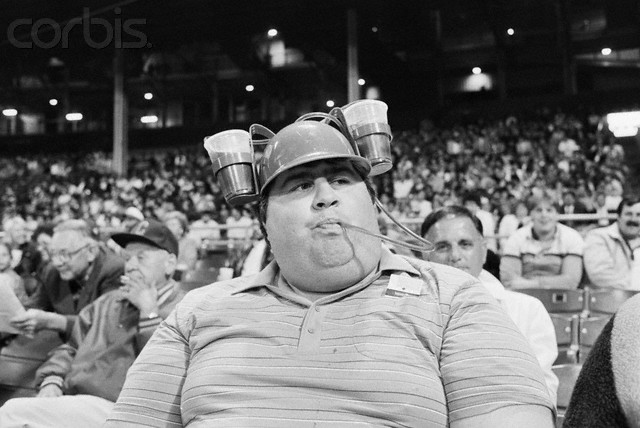
I guess it's all in how you look at it. The same shooting star convincing you that your guru is, in fact, the Supreme Guru, was also seen by a plumber named Leroy who just happened to be drinking a beer in between innings of the Mets game. His conclusion? The Mets were gonna win 20 of the next 25 and bring the pennant home to Flushing!
What do the signs in the sky (or what we perceive as signs) really mean? Isn't the whole world our ashram? Isn't the real issue one of appreciating what is happening all around us? The flowers? The stars? The beggars asking for spare change?
Flowers aren't any sweeter on retreat. It's our willingness to breathe deeply and enjoy them that's different. What's stopping us from being in this place right now? What's stopping us from realizing that the very ground beneath our feet is the promised land -- wherever we happen to be at the time.
5. Don't Put a Red Dot on Your Forehead If You Don't Want To
Unless you've been living in a trailer park your whole life, you probably already know what the red dot thing is all about. That's right. The third eye. The sixth chakra. High holiness. INDIA!! While sometimes mistaken for a beauty mark or a random bit of watermelon, the little red dot is actually a useful reminder to focus one's attention on the space between the eyebrows, which, for some people, is where God lives (or if not lives, at least vacations). Nothing wrong with that, now is there?
Still, you have to concede that the third eye isn't the only spot on the human body that's sacred. What about the earlobes? The belly button? The nipples? They come from God, too -- not too mention chakras #1 - 5 and the highly under-represented center of consciousness at the crown of the head. Sacred, every one of them!
Don't you think that, if the body is the temple of the soul, it follows that our entire physical structure is sacred? Shouldn't we be covered from head to toe with little red dots? And if so, why is it that we routinely quarantine people with measles -- the very people who have selflessly chosen to manifest disease just to remind us to honor our body's ultimate holiness?
6. Play With the Children
The only sentient beings free from the collective mentality of spiritual seekers are the children. Children visiting "holy places," in fact, behave the same way the world over no matter what adjectives their elders use for the unspeakable name of God. When they're hungry, they eat. When they're tired, they sleep. They cry when they want to, laugh for no reason, consume ice cream without guilt, and rarely wonder why your picture of the Master is bigger, newer, or better framed.
7. Fart At Your Own Risk
If you fart, and there's no one around to hear it at the ashram, did it happen? And if it did happen, does that mean you've been disrespectful? Is the resident Guru able to hear you? And if he or she is meditating, out of the country, or dead, is their guru or their guru's guru able to hear you? And if so, so what? Will you be reborn as a gerbil? Does the Guru fart? And if it's OK for him or her to pass wind, why not you?
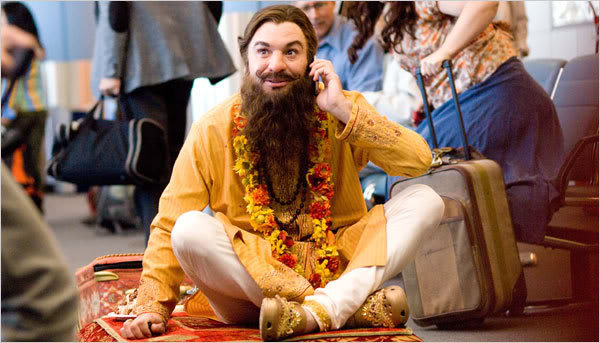
OK, so it's their place and you're a guest. But after all, aren't we all guests here? Even the Guru? Who do they answer to? And if it's not the same one you're answering to, what the hell are you doing getting up at five in the morning and sitting in the lotus position?
Maybe the real question isn't whether or not it's permissible to fart on holy ground, but how you fart. For instance, if you're farting out of a blatant disregard for the Master's teachings or the sincerity of his or her followers, you might want to reconsider where you're coming from. However, if your farting is just a random release of gas, relax! Give yourself the benefit of the doubt. You see, a typical visit to a spiritual center quickens one's ability to "let go" -- so what you call "farting" may, in fact, be a timely sign of your evolving spiritual condition.
8. Do Not Think You Are Higher or Lower Than Anyone Else
One of the favorite pastimes of people visiting a spiritual retreat is comparing themselves to everyone else. "See the guy over there carrying firewood? He's a very old soul -- way older than me. Been on the path for years. And that dude laughing hysterically in the corner? That's Shiva. Oops, he can probably see through me, maybe I better walk around the other way."
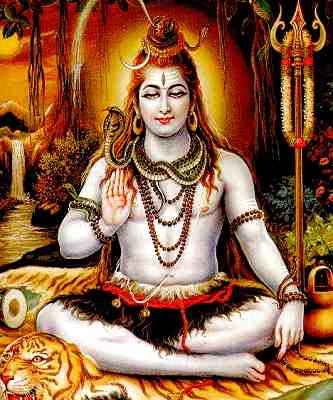
Want to save yourself some time? Don't try to figure out how "on the path" anybody else is. It's impossible. Stare into the eyes all you want, watch for tell-tale signs of liberation, but when it comes right down to it, the only conclusion you'll reach will be your own -- one that may have absolutely nothing to do with the anything but your own projections.
Face it, how accurate is your assessment going to be when 99 percent of humanity couldn't tell that the carpenter from Galilee had something special going for him?
Indeed, it's not at all unlikely that the beer-bellied, first-time visitor you met this morning at the ashram is, at this very moment, being treated like a spiritual mongoloid by everyone who meets him (repeatedly being asked if "this is your first time") when, in fact, the beer-bellied, first-time visitor is actually the reincarnation of Buddha.
9. Do Not Think That You Are Going to Get Something
Many people visit a a spiritual retreat because they want to get something. They want "clarity" or "contentment," "enlightenment" or "grace," "blessings" or "peace of mind." At the very least, they want their business to improve or their marriage to be saved.
Alas, they miss the point completely: If you try to get, you will lose, left only with the sinking feeling of having just bought $300 worth of lottery tickets only to learn that some electrician from Staten Island just won the whole thing.
Look, it's really very simple. You don't go to a spiritual center (or a Big Time Teacher, for that matter) to get. You go to give, to let go -- to relax your grip on the very thing that's been separating you from getting all these years: Your grasping. Your fear. Your well-rehearsed strategy to realize God.
10. Do Not Feel Compelled to Change Your Name
OK, so your name is Joey. Ever since you were knee high to a jar of Cheese Whiz, everyone called you Joey -- as in,  "Hey, Joey, what's goin' down, bro'?" Yeah, you grew up in Brooklyn, cut school once a week, and dated a chick named Angela with very big boobs.
Great. So, here you are at the ashram and ba-bing, you run smack into a bunch of dudes with names like Arjuna, Govinda, Namdev,Shanti, Krishna. "Hey," you think to yourself, "maybe they got something I don't."
Guess what? They do. They have spiritual names given to them by their Guru -- names that make their mothers somewhat close-lipped around the canasta table. And while these names are clearly given with a purpose, the fact of the matter is -- they are irrelevant. Do you think the people in India who have spiritual experiences get their names changed to Eddie, Gino, Stacey, or Shirley ?
Hey, what difference does it make? You are not your name -- even if your namesake was enlightened. It doesn't matter what they call you, when it's time to go, you're gone.
The only name worth knowing at that time is God's name -- and that, my friend, no matter how many mantras you've memorized, can never be pronounced.
Heart of the Matter
Unspoken Word
MitchDitkoff.com
Posted by Mitch Ditkoff at 05:57 PM | Comments (5)
September 28, 2021Cliffhanger in Brighton
On October 9th, Prem Rawat will be speaking at an Author Event in Brighton, England, in honor of his new, best-selling book, Hear Yourself: How to Find Peace in a Noisy World. I won't be there (boo hoo!) but I was able to attend a memorable event with him in Brighton in 1994. Little did I know at that time that Sylvester Stallone was going to be making a surprise appearance. Here's the story:
In 1994, I flew to Brighton, England, to attend a 2-day event with Prem Rawat. Having seen him many times before and knowing how life-changing time with him can be, I was seriously pumped to be going.
Waking up bright and early on Saturday morning, I made my way to the hall, got on line, and took my seat.
Prem, as usual, spoke with great eloquence, humor, and passion, cutting to the heart of the matter -- a great beginning to a series of talks he'd be giving over the next two days.
When he was done, the MC announced the lunch break and informed everyone that the evening program would begin at 5:00 pm.
Perfect! I was really hungry and wanted to find out if the food in England was as bad as people said it was. So I found a few friends and invited them to join me for the fish and chips in a quaint little pub only minutes away.
When I returned to the hall at 4:30, there was already a long line. I found my place on the end of it, chatted up a few locals, and began the slow and steady shuffling forward to the entrance.
Then the line stopped.
"The hall is full," an usher announced to no one in particular. "There are no more seats. Come back tomorrow."
"Tomorrow? Come back tomorrow? Dude, I just paid $650 for a round trip ticket to England! I just took three days off work! No one told me there was even the slightest chance of not getting in. This is insane! Who's in charge? Let me talk to someone with a walkie talkie! There must be a way to get in!"
My pitiful internal dialogue continued, in full stereo neurosis, for the next ten minutes, me alternately blaming the program organizers, the ushers, my pub waitress, "them," the entire country of England and, ultimately, myself for apparently having too leisurely a lunch.
And then... I remembered.
I remembered what Prem had been teaching me in oh so many ways since I first met him many years ago: how to let go... how to enjoy the moment... how to go beyond the chattering monkeys of my mind and enjoy the divine play that is only ever happening NOW.
"Hmmm," I thought to what was left of my self, "I actually have the entire afternoon off in jolly old England. No job. No bills. No responsibilities."
As I exited the scene of my mini-meltdown, I could see, just a few hundred yards away, rising up to the sky like some kind of cinematic mirage -- eight movie theaters.
I scanned the marquee. Four of them I'd seen before. Three didn't start until evening. But one... one was just about to start -- Cliffhanger, starring Sylvester Stallone.
Hey, why not? The joke was on me. And though I hadn't quite begun to laugh, I could definitely feel a smile coming on.
So I bought a ticket, some popcorn, and took my seat (believe me, there were plenty).
For the next hour and 53 minutes while Prem Rawat inspired, uplifted, entertained, cajoled, held forth, waxed poetic, and reminded 5,000 people what life was all about -- I sat in a darkened movie theater watching the former star of Rocky I, II, III, IV, V, and VI battle the bad guys, under impossible conditions, high in the Rocky Mountains, trying to save the day.
It was totally surreal.
There I was, 3,476 miles from home, sitting no more than a few hundred yards from the most amazing person I'd ever met (Prem Rawat, not Sylvester Stallone) and was totally enjoying a movie I wouldn't have chosen to see in a thousand years.
PS: I got to the hall very early on Sunday morning.

Posted by Mitch Ditkoff at 12:53 AM | Comments (10)
November 08, 2020Long Before Words

Being of the Jewish persuasion, I'm not exactly the kind of person given to confession, but allow me the ecumenical luxury of confessing at least one thing in this first paragraph of what may well turn out to be the Mahabharata of blog postings:
Writing about Prem Rawat and the gift that he offers is not easy.
It's not easy for a few reasons.
First off, what I want to say existed long before words -- long before nouns and verbs and the leaky vessels we construct to float our shaky boats of babble. Secondly, words are approximations of the real thing at best. Like menus, they indicate something's cooking in the kitchen, but they are not the food itself. And thirdly, the dog ate my homework.
I don't know how it works, but there are years of my life I can barely remember, but seconds with Prem that remain a vast eternity, indelibly impressed on my heart like some kind of rock 'n roll Rosetta stone.
I never laugh so hard or cry so long as when I'm in his company. I never feel so good.
The first time I heard about him, I was both ecstatic and afraid -- ecstatic at the thought I might finally experience what I'd been born for -- afraid that somehow, grand impostor that I was, I would be the only person on the face of the Earth not to get it. Forget it. I got it.
Yes, that moment happened -- the moment of oooh, the moment of ahhh -- the moment of finally coming into my own after years of imagining my own was someplace very far away -- in a forest, cave, or future lifetime.
What has he taught me? How to wake up -- and stay awake. How to appreciate. How to feel. How to simply be.
What Prem Rawat offers is not so much a teaching as it is transportation to the place we've either been seeking our entire lives or have given up on long ago -- the place of no judgment, the place of no doubt, the place of no worry, no fear, no problem.
Here! The place of remembering. And what we remember here is love -- plain and simple. For love is the name of the game. Always was and always will be.
Photo: TimelessToday
PremRawat.com
VIDEO: The Most Precious Diamond
Posted by Mitch Ditkoff at 09:46 PM | Comments (3)
September 30, 2018Beyond Words

Inspired by the recent five-day event at Amaroo and being on the unexpected receiving end of Prem Rawat's kind words about my writing, I have decided to take it up a notch and offer my services to anyone who reads this blog and wants to get their story out into the world.
The deliverable will be a 1,500 - 2,500 word article that will capture the essence of what it is you want to communicate. The topics? TBD: A life changing experience you've had. A rite of passage. A contribution you are making to society. A message of wisdom you want to leave behind for your children etc. This is not public relations writing, but public elations -- the celebration of something of value that you want to express in a memorable, meaningful way. My role will include coaching, advising, strategizing, feedback, writing, editing, social media, and possible publication.
While I'd love to be able to offer my services for free, I am not in a position to do so. In other words, there is a fee.
Intrigued? Want to know more? Email me and I will respond.
SOME EXAMPLES OF WHAT I HAVE DONE FOR CLIENTS:
The Sprice of Freedom
A Beginner's Guide to Helping Orphans
Monika's Story
Posted by Mitch Ditkoff at 11:24 PM | Comments (0)
October 09, 2016Knocking on Heaven's Door

NOTE: This is a piece I wrote seven years ago. Just stumbled across it today. Maybe it will be useful to you. Or inspiring. Or both.
As I write this, I am sitting in the home of my 94-year old father, in West Palm Beach, Florida. His house is new, but his body is not. "Like a worn out car," he tells me ten minutes ago as he sorts through his evening pills, looking for just the right combination to help him make it through the night.
Riding on the fumes of my own imagined immortality, I'm sitting at his kitchen table, cotton swabs, like yarrow stalks, everywhere.
His oxygen comes from a machine, his caregiver from an agency. He tells me the same stories I've heard a hundred times before, but tonight I do not interrupt. He needs to talk... and I need to listen.
I ask him about the happiest day of his life. "The birth of my two children," he says. I ask him to tell me the name of his father's father, but he cannot remember.
He tells me he wants to cry, but can't.
Sleeping pill swallowed, teeth removed, he invites me to his bedroom to watch the ritual of his night-time aide adjusting the tubes and the pillows beneath his swollen feet. He tells me in a raspy voice, "I want you to see what lies ahead."
He takes another breath. Barely.
I have no idea how I will die. Or when. I have no idea if my loved ones will be there with me or someone from the night shift. All I know is this: No matter how old, decrepit, or alone I may be at the time, I will die a happy man.
How do I know this? Simple. I've already experienced what I came here for. I won't try to name it here, because I can't. But suffice it to say, it's the source of all love, all peace, and all gratitude.
And the one who revealed it to me can reveal it to you.
I want that for my father, at 94. I want him to feel it -- to let go to the power of love.
At this stage of the game, it's a long shot he will, but what do I know? God can enter at any time. Grace can change a life in a heartbeat.
Posted by Mitch Ditkoff at 11:48 PM | Comments (1)
August 28, 2016A Laundry Room at Amaroo

When I was a young man, I had a big desire to have cosmic experiences. The more cosmic they were, the better.
My assumption? That what I was experiencing, in my everyday life, wasn't quite "it" and I needed something more -- kind of like there was an extremely cool party happening somewhere else that I hadn't been invited to.
I am happy to announce that those days are over -- not because amazing experiences aren't still a good thing, but because I am coming to understand that everything is amazing, even the simplest, most mundane situations. That is, if I am in the right place to appreciate it.
Take this past week, for example, in a laundry room just 30 yards from the tent I was living in at Amaroo.

It's a place I found myself inhabiting for hours each day since it was the only place I could find with the outlets I needed to charge my computer so I could post excerpts of Prem Rawat's talks on my blog.
It was a small room, maybe 8 x 14, with two washing machines, two dryers, a wall phone, table top, half a refrigerator, and a bunch of Australian outlets.
At first, I was cranky at having to set up shop there.
After all, I had just traveled 27 hours to experience something profound at this five-day retreat and here I was in a cold and crowded laundry room, hunting daily for an unused outlet, surrounded by people folding underwear, blow drying their hair, and asking if they could plug their iron into my already maxed out adapter.
Not exactly the scene that a younger, God-seeking version of my self would have called "cosmic."
But it was. Very much so. Allow me to explain.
You know the experience when you walk into a dark room from the outside, can't see a thing, and assume it's empty?
But if you pause a little and let your eyes adjust to the light, you soon realize that there are all kinds of things there. What seemed, just a few minutes ago, to be nothing, now reveals itself to be something. You can see.
This was precisely my experience in the laundry room.
For the first hour, it was just your basic laundry room, me impatiently waiting for my laptop to charge and enduring the sounds of somebody else's spin cycle.
But then, a curious thing happened: the laundry room became divine -- not because angels with trumpets were flying around. They weren't. But because the laundry room had morphed into something super animated, inspired, and delightful -- a classic scene out of a Gilbert and Sullivan opera where everyone was perfectly playing their part.
Each day, for five days, when I wasn't listening to Prem Rawat, schmoozing, or eating, I was in the laundry room. Everything that I needed -- to know, to learn, to feel, or to see -- was happening there. Plus a hundred random acts of kindness.
Not because the room, itself, had any magical properties, but because the impact of my teacher's talks were so transforming that my experience of the room was changing before my eyes.
The first thing I noticed was that almost every person who entered the room was uncommonly at ease and relaxed, carrying out their seemingly mundane tasks with playfulness, focus, and grace.
If this had been a scene from New York, New Delhi, or Barcelona, it would have been a very different story, but it was none of those places. It was Amaroo -- the "Beautiful Place".
Spain was in the house. Italy, too. And Slovenia And Croatia. And Australia, Germany, Sweden, New Zealand, Brazil, and America -- all with different detergents, but the same twinkle in their eye.
The sweet feeling in the laundry room had nothing to do with what we knew about each other, but what we knew about ourselves -- the experience of what it is that all people share in common: love, gratitude, and the possibility of peace.
Yes, the washing machines were spinning and so were the dryers, but something else -- at the center of it all -- was very, very still.

Excerpts will look something like these from 2015
Posted by Mitch Ditkoff at 02:29 AM | Comments (8)
February 01, 2016The Three Questions

Some years ago I attended a 5-day conference, in Miami, with Prem Rawat and 50 other people. On the first morning, during his opening remarks, Prem explained that he wanted everyone at the conference to feel absolutely free to ask their questions whenever they had one. Made perfect sense. After all, we were there to learn.
The first morning passed in a questionless mode for me. Everything he said was absolutely clear and I was content simply to sit, listen, and enjoy the feeling of being in the room with him.
The afternoon was a different story. About an hour after lunch, he said something that baffled me. No kapish. I had a question. But I also had something else -- and that was the fear of asking.
One part of me -- the respectful part -- thought I'd be interrupting him if I raised my hand. Another part -- the educated part -- thought I should already know the answer. Yet another part (hey! how many parts did I have?) didn't want to be the focus of attention.
My right hand twitched, but hung at my side like a slacker. Then I remembered what Prem had said the day before: "If you have a question, ask."

I raised my hand and asked.
"That's the stupidest thing I ever heard," he replied.
Ouch! Oy! Now it was official. I was a fool, a moron, a complete idiot -- something I'd always suspected, but now had all the proof I needed.
I could feel myself shrinking, slinking back into my chair.
Prem had answered my question, but I barely heard a word. My mind was out to lunch, but had no idea where the restaurant was. A hundred over-caffeinated PR guys inside me, hell bent on damage control, did their best to save the day, but their efforts were a joke.
I didn't sleep too well that night.
The next morning I took my seat with an extra dose of humility and some last-minute effort to gracefully manage my emotional meltdown from the day before.
Thirty minutes into Prem's morning presentation, he said something that made only partial sense to me. I kind of understood it. I mean, I sort of got what he said, but not really.
I had a question.
No way was I going to ask it. No way was I going to reveal yet another questionable side of my questionable self -- not only to him, but to 50 of my peers, some of whom, I knew, already had their doubts about me.
But then I remembered what he had said on Day One. "If you have a question, ask."
I raised my hand.
"That," he replied, "is a really good question."
Hallelujah! I was back in the game -- now hanging ten in my semi-comfortable hotel chair, waiting for his response to my now, officially-declared, good question.
I barely heard a word he said -- consumed, as I was, by his acknowledgment of my question being "good." I could see he was talking, but I was suddenly deaf. My mind, once more, was out to lunch. OK, maybe not lunch, but out for a meal. Like... maybe breakfast.. or a light snack.
Day Three came quickly.
I woke, took a shower, practiced Knowledge, drank coffee, ate a bagel, and took my seat.
The morning session was smooth as silk. Prem spoke, told some jokes, and showed some slides -- me enjoying my new found status as a question-free human being.
The afternoon? Don't ask.
An hour into it, I felt an old familiar feeling coming over me. I wouldn't exactly call it cluelessness, but I was clearly in need of a clue.
I took a breath. I raised my hand. I asked.
Prem listened. Then he spoke. His response, this time, was neutral. My question wasn't good. My question wasn't bad. It was just a question.
Three days. Three questions. Three different responses.
Looking back at this conference with my favorite person on the planet, the metaphor that comes to mind is one a friend shared with me some years ago.
"Imagine yourself," she said, "as a sword in a stone. It's stuck and won't come out. You pull to the left. You pull to the right. You pull to the left, again. Back and forth, back and forth you go between the extremes: good and bad, up and down, black and white, rich and poor, this and that. With each movement between the extremes, the sword gets looser and looser until it gets loose enough for you to pull from the stone. That's how it works some times -- all this going back and forth, until we're finally free!"
I'm glad I took Prem up on his word and asked my questions. In a curious way, I may have learned more from the act of asking than I did from the answers I received. That's one of the cool things about being in relationship with someone like him. Every interaction is amplified. Every conversation has the potential to reveal something extraordinary.
I'm glad I didn't play it safe. I'm glad I didn't hide behind my simulated mask of understanding. Yes, it's a risk to speak up. But a risk to what? Only that self-serving, legend-in-my-own-mind character more concerned with other's opinions of me than the experience of truth.
Did he know that the three different ways he answered my questions put me through some changes? I doubt it. But it doesn't really matter.
Prem Rawat is not a mind reader. He is not a psychic. He is not a therapist. He merely holds up a mirror. What we see -- and what we do after we see what we see -- is completely up to us.
My Amaroo question
PremRawat.com
Posted by Mitch Ditkoff at 09:57 PM | Comments (13)
June 21, 2015First Breath, Last Breath

There is a time of life when the time of life is about to end -- the time of last breaths, the time of saying goodbye to everything you have ever known or loved, the time of letting go.
This is the time my father now finds himself in.
He is flat on his back in a hospital bed, but the hospital bed is in his bedroom in West Palm Beach which is where he has chosen to die -- and will.
There will be no more calls to 911, no more paramedics, no more blood transfusions, no needles, no pills, no tests. This is his death bed and we are around it, me, his son -- his daughter, my sister -- my wife, his daughter-in-law -- grandchildren, great grandchildren, and the ever present hospice nurse here to keep him as comfortable as possible.
His mouth is dry. He cannot swallow. Someone swabs his lips as he gathers what's left of his strength to move his tongue toward the precious few drops of water.
The sound track for his last night on Earth is an oxygen machine pumping purified air through transparent tubes clipped to the end of his nose.
On the counter -- creams. Creams for this and creams for that and creams for the other thing, too. I've never seen so many creams.
Those of us around his bed are very still, holding his hand, rubbing his back, looking at him and each other in ways we have never looked before.

There is very little for my father to do but breathe. This lion of a man whose life was defined by ferocity and action is barely moving now. A turn of the head. A flutter of the eye. A twitch.
Though his eyes are closed, I know he can hear, so I bend closer and talk into his good, right ear. I tell him he's done a good job and that all of us will be OK. I tell him I love him and to go to the light. I tell him everything is fine and he can let go.
The hospice nurse is monitoring his vital signs. They keep getting lower and lower. I touch my father's cheek and it is cooler than before. His skin looks translucent. Almost like a baby's.
He opens his eyes and shuts them once again. None of us around him know what to do, but that's OK because it's clear there is nothing to do.
Being is the only thing that's happening here.
My father had his last shot of morphine about an hour ago. He had his last bowl of Cheerios yesterday at 10am. Cheerios and half of a sliced banana. That was the last time he could swallow.
It is quiet in the room. Very quiet.
I see my sister, my nieces, my wife, the nurse. All of us are as helpless as my father. The only difference is we are standing.
If only we could pay as much attention to the living as we do to the dying. If only we could stop long enough from whatever occupies our time and truly care for each other, aware of just how precious each breath is, each word, each touch, each glance.
Sitting by my father's side, I am hyper-aware of everyone who enters the room -- the way they approach his bed, what they say, how they say it, the look on their face, their thoughts.
I want to be this conscious all the time, attuned to the impact I have on others in everything I do. It all matters.
Nothing has prepared us for this moment. Not the books on death and dying, not the stories of friends who's fathers have gone before. Not the sage counsel of the Rabbi.
Nothing.
One thing is clear. Each of us will get our turn. Our bodies, like rusty old cars gone beyond their warrantees, will wear out. Friends and family will gather by our side, speak in hushed tones, hold our hands, and ask if we are comfortable.
That's just the way it is. It begins with a breath, the first -- and ends with a breath, the last.
In between? A length of time. A span of years. A hyphen, as my teacher, Prem Rawat, likes to say, between birth and death.
What this hyphenated experience will be is totally up to us.
Will it be filled with kindness? Love? Compassion? Gratitude? Giving? Delight? Will we be there for each other before it's time to fill out the forms and watch the body -- strapped to a stretcher by two men in black suits -- be driven away like something repossessed?
I hope so. I really do. I hope we all choose wisely. I hope beyond a shadow of a doubt before we walk through the shadow in the valley of death that we choose to hold each others' hands NOW, rub each other's backs, bring each other tea, and listen from the heart with the same kind of infinite tenderness we too often reserve only for those about to depart.
My father is very quiet now, breathing only every 20 seconds or so. Or should I say being breathed?
And then...there is nothing. Only silence. No breaths come. No slight changes of expression on his face. No whispered words of love.
We, around his bed, are in his home, but he is somewhere else.
Bye bye Daddy! Travel well! Know that we love you and will keep the flame of who are deeply alive in our hearts. Thank you for everything. We will meet again. Amen!
Posted by Mitch Ditkoff at 07:46 AM | Comments (11)
August 03, 2014Finding the Miracle

A few years ago I was invited to MC an event at the Shrine Auditorium, in LA, where Prem Rawat was going to be speaking. While I was totally thrilled to be asked, I was also totally terrified -- convinced I was the wrong choice and would be a huge disappointment.
Doing my best to ignore the sorry state of my mind, I flew to LA, hailed a cab, and made my way to the hall.
Though I was clearly not at my best, I went through the dress rehearsal, reviewed the announcements, and figured I'll find my groove after I had time to meditate.
I didn't. It got worse.
People were wishing me well, but I was in a well -- a well on the moon -- and the air was extremely thin.
A few hours passed. I took my seat. I took a breath. I studied the announcements one more time and waited for my cue to go back stage.
The cue finally came and I took my new seat, now in the wings, listening to the sound of the hall filling up with thousands of people waiting to see Prem Rawat.
The backstage manager, both focused and relaxed and clearly noticing I was neither, explained the event would start in five minutes. I was still, shall we say, not on top of my game -- hoping the building would catch on fire -- anything to get me out of there.

"Two minutes!" the backstage manager announced.
Now I was in BIG trouble. In two minutes I'd be walking the plank and I WAS NOT READY. My eyes were open, but my heart was not.
And then, with 90 seconds to go, two extraordinary things happened that I will never forget.
First, I remembered something Prem Rawat said years ago -- that human beings had two choices: to go through life gnashing their teeth and waiting for it to be over -- OR saying YES to life and enjoying the moment.
I chose the moment. I said YES. I embraced it all.
The second thing? I heard a few lines of Daya's Find the Miracle being piped into the hall. Such a beautiful song. Such a feeling of peace infused in every word, every note.
Somehow, I found the miracle. The veil lifted and I found the place of peace inside me. Total goodness. Total presence. Total joy. Everything that had been weighing me down, only seconds before, just evaporated in a heartbeat. Poof! Gone! Nowhere to be seen. Now, in this sacred moment, all that remained was a spacious feeling of love and gratitude. I was home.
"Three, two, one" said the backstage manager, holding his fingers high in the air just in case I didn't hear.
I breathed. I stood. I walked out on stage... and began.
Posted by Mitch Ditkoff at 09:02 PM | Comments (2)
July 05, 2014Standing in the Back of the Bus

I am standing in the back of a bus in San Miguel de Allende, just beginning to exit, when I notice a short, heavy-set woman behind me, her long grey hair tied in a bun and a smile that explained a thousand years of Mexican fiestas. How could I not let her pass?
So I take a step to the side and, with a downward sweep of my hand, indicate she should pass me -- that indeed, it would be my pleasure if she did. And so she does, her eyes opening wider, the many laugh lines around her dark eyes, deepening.
I have the impulse to follow, to exit next, especially since I had just given up my place in line, but the boy behind her is obviously on his way somewhere and his need to exit seems to be greater than mine and since I am already standing off to the side, I let the young muchacho do his young muchacho thing.
A man with a guitar passes me, as do two small children.
I look to my left and see a lot of people standing up and starting to make their way to the back of the bus, me now feeling like an usher, perfectly placed to make their exit just a little happier today.
A dark-skinned man with fringes on his jacket passes by, as does a woman behind him whom I imagine to be his wife. She looks tired, 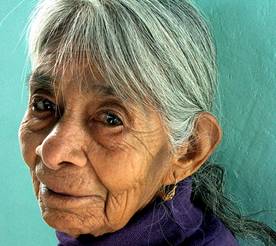 like there are many chores waiting for her at the end of the day -- the same chores her mother and her grandmother still perform daily as an act of worship to a Jesus whose image hangs from the rearview mirror of her husband's 1973 Chevy, along with the rosary beads and dice.
Each of these people pass me and, as they do, I notice that more people are getting on the bus -- the same number, mas o menos, as those who have just gotten off.
So I continue standing there, making way, and bowing to those who seem to be open to more than just a smile or nod.
And then, it dawns on me.
This is my work. This is what I was born for -- what my Buddhist friends like to refer to as "right livelihood" -- though I, in this moment, could not figure out how the universe could possibly compensate me for my service.
I didn't need to think about it for long.
Thirty minutes later, a woman with a turquoise barrette in her hair, brings me a grilled chicken in a plastic bag. Hot. Crispy. And ready to eat. And a 7-Up too, perfectly chilled.
Posted by Mitch Ditkoff at 09:55 AM | Comments (4)
February 22, 2014Calling For As Much Help As Possible

When it became clear to me, at 21, that I was caught in a rip tide and losing strength rapidly, I shot a quick glance at my girlfriend who was swimming just ten feet away. Her eyes were full of fear. She could not speak... so I made my way over to her and did the only thing I could think of which was to cup my hand beneath her chin, tell her to relax, and, with my other hand, try to paddle to shore, which was about as insane an effort as I could have made, her being the same weight as me, me having no clue how to rescue a drowning person, and barely able to keep my own head above water.
It was clear, at that moment, that unless I went for help we were both going to die, and we were too young to die, so I abandoned my heroics, closed my eyes, and started swimming to the shore.
I have no clue where the energy came from. Just seconds before I had zero strength. None. I was gulping water. I couldn't lift my arm. But something had definitely gotten a hold of me. It was fifth gear time.
When I opened my eyes, who knows how long after, I found myself swimming in water only two feet deep. Amazed there was ground beneath my feet, I did my best to stand and stumbled to shore. But no one was there. No one. Not a single soul. The beach was completely deserted.

Here, in this stark naked moment of life and death, when I needed SOMEONE, I was all alone. Totally alone. And then, from the depths of my being something -- a sound, I think, coursed volcanic through my veins and my bones and my cells and made its way to the surface of what remained of my life. One word. That was it. One solitary word. One naked, all alone-in-the-universe word. That's all I could muster. Me, a man of many words, even at that tender young age, had only one word in my vocabulary -- and it was HELP!!!!!
I screamed it from the bottom of my soul to the void. "HELLLLLLPPP!!!"
To my right, about 30 feet away, I saw a young woman walking oh so slowly towards me, not breaking stride, staring at me as if I was completely insane. Getting as close to her as I could, maybe 10 inches from her face, I screamed again at the top of my lungs -- a scream I had never screamed before, a sound I had never heard before.
"HHHHHHELP!" "HHHHHELLPP!!!!"
I turned and pointed to the horizon to show my rescuer where my girlfriend was, but there was no one out there. No one. Nobody. Nothing. All we could see were waves... and sky... and clouds. Nothing else. There was no one out there. No one.
At that moment, a moment I will never forget no matter how many lifetimes I live, I died a thousand deaths. Yes, I was alive, but Connie was gone... gone... she was... gone... and then... unbelieving.... we saw... a head... hers... barely bobbing... above the waves... both eyes open, looking at us.
The woman standing next to me finally understood what I'd been trying to say and shouted to her boyfriend. Together, the two of them ran headlong into the water, swam out to Connie, and dragged her in. It was easy for them, and then, like a dream, they were gone...
The first thing Connie and I did was kiss the ground. Then we started singing children's songs, anything we could think of -- Happy Birthday to You... Jingle Bells... Row, Row, Row Your Boat. It didn't matter what the song was, as long as both of us could sing it together.
That's all we did for the next two hours... lay on the white sand beneath the hot summer sun and sing children's songs. Many children's songs.
Every Minute Counts
Posted by Mitch Ditkoff at 10:07 PM | Comments (1)
February 18, 2014Almost Drowning

When I was 21, I almost drowned in the Atlantic Ocean, I was, literally, going down for the third time when an unexpected will to live and a power well beyond my sapped physical strength took over and swam me to the shore.
So ecstatic I was to be alive, that I vowed, right then and there, to never ever ever complain about anything for the rest of my life.
For three days, I lived in a state of pure elation and gratitude. I would have done anything for anybody -- and I did. Heaven. It was Heaven. Off the grid gladness and delight. Nothing could touch my state of peace.
Then, on the fourth day, upon walking out of my house to get in my car, I noticed that the front right tire was flat. Immediately I started kicking the tire and cursing loudly. The F word ruled supreme.
Then I saw what I was doing. Three days ago I had made a pact with God that I would never complain or get upset about ANYTHING ever again for the rest of my life and here I was kicking a tire on a Pontiac LeMans and screaming like a total idiot gone mad.
To say the least, it was a humbling experience -- but one that was very good to have because it showed me clearly the gap between my empty vows and the state of consciousness I aspired to dwell in.
I've made some progress since then. Some. I'm still getting humbled. I'm still learning. But beyond the recognition of my imperfections and the ups and down of life, remains the "perfume of God" and the knowledge that I am -- as ALL OF US ARE -- extremely lucky to be alive -- with a choice, every day, of what to focus on. I choose gratitude.
Prem Rawat on gratitude
Posted by Mitch Ditkoff at 07:14 AM | Comments (1)
November 07, 2013The Huffington Post Meets the Heart of the Matter

What follows are ten links to articles of mine from the Huffington Post. #1 and #6 are very much related to the work of Prem Rawat. The rest are on a variety of topics -- some humor, some on other topics of interest to me.
1. Jeremy Gilley and Prem Rawat
3. I'm From Woodstock. Yes I Am!
4. The Kindness at Work Manifesto
5. The 27 Best Practices of Volunteer Organizations
6. How to Go Beyond Self Improvement
9. How 13-Year Old Girls Can Wipe Out Terrorism
10. Excerpts from Full Moon at Sunrise
Posted by Mitch Ditkoff at 07:29 AM | Comments (0)
August 30, 2013The Stillness After Prem Rawat Speaks
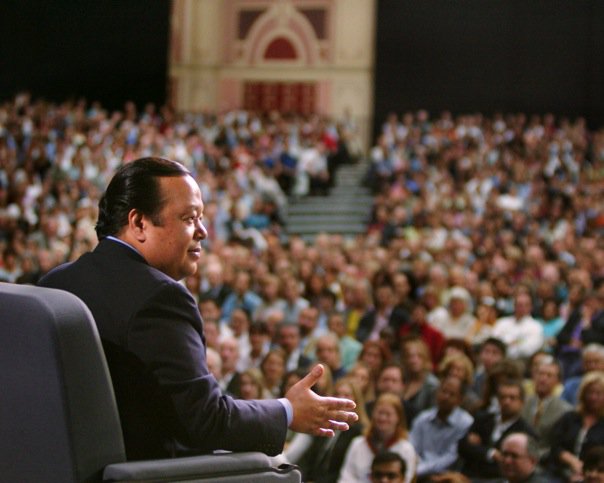
After great performers come to the end of a performance, it is not uncommon for grateful audiences to give them a standing ovation. They clap, they cheer, they focus all their attention on the one who has just opened the door to magnificence. Think Pavarotti. Think Martin Luther King. Think anyone you've ever stood your ground for and loved.
What I find amazing is this is how Prem Rawat's presentations begin.
Before he utters a single word, audiences are on their feet, applauding. And when he's done? Pin drop silence.
Somehow, through his own unique alchemy of wisdom, humor, and insight, he finds a way to bring everyone to a place of perfect stillness, back to the very beginning, where there is nothing left to do, but be.
When Prem Rawat is done speaking, I find myself barely able to move. I am stunned, pinned to the back of my chair by the invisible arrow of love. All dramas in my life disappear and there is no "me" left to applaud the end of the show.
What remains is a feeling.

Sitting in the afterglow of this man's communication of truth is a complete and total joy. Oh yes, I know I must move from my seat eventually. Oh yes, I know I will soon be walking and talking and asking someone to pass me the grated parmesan in that great little Italian restaurant just down the road, but now -- here in this sacred moment after he speaks -- nothing else matters.
I close my eyes and breathe. Then I open my eyes again.
I see people sitting. I see people standing. I see people wanting to linger just a little bit longer in this extraordinary state of arrival.
Some walk in silence toward the exits, eyes down, not wanting anyone or anything to distract them from the deepest of feelings welling up within them far beyond time.
Posted by Mitch Ditkoff at 12:35 AM | Comments (0)
June 17, 2013The Best Archer in All of China

All of us try so hard to DO stuff, to accomplish things, to leave our mark. We sweat, we strain, we hustle -- all in an attempt to get a result we can feel really good about. That's all fine, of course, but sometimes, in the act of accomplishing our goal, we lose touch with who we are. The following story, adapted from an old Zen tale, elaborates on this curious phenomenon.
Once upon a time there was a man named Wu Li, a most gifted archer. Time and again, Wu Li would enter archery tournaments and win. He won so often and so convincingly that word of his accomplishments soon spread throughout the land. By the time he was 22, Wu Li was known as the best archer in all of China.
One day, upon returning home from yet another victory, Wu Li found himself rushing through a marketplace and bumping into an old man carrying a basket of potatoes. Potatoes went flying everywhere and the old man fell to the ground with a thud.
"Old man!" shouted Wu Li, "Get out of my way! Don't you know who I am?"
The old man looked up, squinting.
"Oh yes. I know who you are," he replied. "You are Wu Li. Second best archer in all of China."
"Second best?" bellowed the gifted one. "Second? Ha! I am the absolute best. There is no one in the world who can beat me."
The old man smiled and stood as he slowly gathering his potatoes.
"Yes, you are great, Wu Lei. But there is someone even greater than you!"
Wu Lei was silent, his whole being like an arrow about to be launched.
"Who is this impostor? Where does he live?"
"Oh," the old man said slowly, as if entering a temple. "His name is Master Po. He lives many miles to the North -- high atop Mt. Chi Han."
"Then I will go an challenge him!" the young archer exclaimed. "I will put an end to such nonsense."
Pushin past the old man, Wu Li stormed off into the night.
For 60 days he walked.
When he finally arrived at the foot of the mountain the young archer could not believe his eyes. The mountain was sheer rock face, covered with ice, and pitched at a 90 degree angle straight to the sky, hidden by clouds.
A lesser man would have ended his journey then and there. But not Wu Li.
He climbed. And when he was done climbing, he climbed some more.
On the 8th day of his ascent, the Wu Li saw the crest, grabbed on, pulled himself up, stood, and found himself looking at what appeared to be a little old man sitting on a blanket.
"Welcome wayfarer," the old man said, "I have been expecting you."
Wu Li took a deep breath.
"I... am... Wu Li... best archer in all of China and I... I challenge you!"
The old man, as motionless as the mountain itself smiled, bowed once, then looked to the sky.
"Very well, as you are my guest, please go first."
Without a second's hesitation, Wu Li grabbed an arrow from his quiver, notched it on the string of his immense bow, closed his left eye, tilted his head, looked up, drew the string back and with all of his might, and let the arrow fly.
As it neared the top of its flight, he pulled a second from the quiver and shot it high, halving the first in two and, in a rapid succession of ten, continued, each arrow splitting the one before it, arrow halves landing in a perfect circle around the seated Master and, upon entering the ground, made the ancient sound of Om.
"Hmm," said Master Po. "Impressive. Most impressive. Now, I believe, it is my turn."
Reaching behind him (where there would have been a quiver if he had a quiver), he pulled what would have been an arrow (if he had an arrow), notched what would have been a string on what would have been a bow, closed one eye, pulled slowly back, paused for what seemed like eternity, and then -- in slow motion pantomime -- let go.
Smiling ever so slightly, he turned to the puzzled challenger.
"You, my friend," said Master Po, "have mastered the art of shooting with a bow and arrow. I... have mastered the art of shooting without a bow and arrow."
Excerpted from Awake at the Wheel.
Posted by Mitch Ditkoff at 10:27 PM | Comments (0)
May 23, 2013MY LAST DAYS: Meet Zach Sobiech
Posted by Mitch Ditkoff at 10:37 PM | Comments (1)
February 14, 2013We're All in This Together
The first time I met Joan Apter she was standing in a field in Montrose, Colorado speaking to anyone who would listen about the experience of connecting to the timeless place of love inside every single human being on the planet.
I stood there and listened and she waxed on and on, never tiring, always giving, sharing, and radiating joy. It's 41 years later and Joan is still at it, God bless her.
A few months ago, Joan was diagnosed with breast cancer and, as you might imagine, the medical bills are piling up.
Which is why I'm taking this moment to ask you to consider making a donation, via IndieGoGo, to help pay Joan's medical expenses.
Every little bit helps.
Please give what you can and let's show our love and support to this amazing human being.
Posted by Mitch Ditkoff at 12:08 PM | Comments (2)
October 14, 2012The Whisper

Just like water takes many forms, Maharaji delivers his message in many ways: videos, live presentations, webcasts, DVDs, CDs, websites, blogs, magazines, brochures, casual meetings, one-on-one conversations and... er... whispering.

Whispering? Yes, indeed. Allow me to explain.
The year was 1980-something and Maharaji was giving a 3-day program at the Miami Beach Convention Center. My service, at the event, was to be a lobby usher -- a simple task requiring mostly common sense and knowing where the bathrooms were.
I was just exiting the ladies room (after restocking the paper towels) when Doug Bernard -- one of the event organizers -- approaches me with a sly smile on his face.
"Hey Mitch," he blurts, "Maharaji asked a few of us to come up with a list of possible speakers for tomorrow night's program and... uh... we put your name on the list."
I can see that Doug is talking, but I'm not really sure what he's saying.
Unphased by my lack of comprehension, Doug continues. "So... Maharaji picked your name."
Doug is obviously speaking Swahili. What he's saying makes absolutely no sense to me.
"I suggest," he says, "that you take a break from your service, return to wherever you're staying, and get a good night's sleep. You'll need to be in the Hall tomorrow at 8 am for a meeting with Maharaji."
Huh? What? Me? Speak?
Doug doesn't linger to explore my confusion. I'm left alone, like a weightless astronaut on the ceiling, thinking someone has just made a terrible mistake. Me speak in front of Maharaji and 10,000 people? You gotta be kidding. First of all, I wasn't feeling particularly inspired at the moment. Neither was I feeling particularly clear, devoted, connected, coherent, fluent, confident, or anything else I imagined a person should feel before speaking at one of Maharaji's events.
It was a short ride back to where I was staying, but a long night. My attempts at practicing Knowledge were totally dwarfed by the recurring thought that not only was I the wrong man for the job, but I was less than 24 hours away from ruining Maharaji's event.
In the morning, my friends feed me breakfast and send me on my way.
I flash my pass at the security guy and am escorted backstage. Joan Apter and Charnanand -- the other two speakers -- are already there, looking very relaxed. I am not. We make some small talk, then Maharaji makes his entrance, smiling, buoyant, alive. He looks at us and asks how we're doing. Then he pulls out three vomit bags and hands one to each of us.
"Just in case," he says.
Call me Puke Skywalker. Not only does Maharaji's gesture break the ice, it completely diffuses my anxiety.
The rest of the day? A blur. Though I talk to a lot of people and do a lot of things, I can't relate. Every conversation I have, every thing I do is dwarfed by what I know will happen later that evening -- my walking the plank into a very large ocean.
Aye, matey! This was the high seize -- waves of love followed by waves of fear followed by waves of love followed by waves of my inner Woody Allen looking for a way out.
Now it's an hour before the program begins. There is no turning back. Joan, Charnanand, and I are ushered backstage to a waiting area where we're supposed to cool out. I see a chair. I sit. I breathe.
Two sound technicians walk by, looking purposeful. Two lighting guys adjust something. Then Doug appears, explaining I'll have 20 minutes to speak, but shouldn't worry about the time because someone will flash me a red light when my turn is up. I ask if Maharaji has mentioned anything about what the three of us should talk about.
Doug flashes me an enigmatic Zen smile and continues on his rounds.
"Oh, I get it. I'm the warm-up act. Yes, now I see... I'm supposed to kick things off... then charismatic Joan will take it from there... then Charnanand, the sage, will wrap things up. Makes perfect sense."
Doug signals Joan to stand and take the stage.
What? Joan's first? Wasn't I the warm up act?
With Joan now halfway through her talk on the other side of the curtain, I close my eyes and turn within. The next thing I know, someone is whispering in my ear. It's Maharaji.
"Hey Mitch," he says, "Joan just used all your good lines."
Suddenly, I'm all ears.
Maharaji continues whispering.
"Remember, you don't need to talk about what's supposed to happen. All you need to talk about is what's already happened."
And with that he walks away.
I feel lighter now, as if some kind of psychic surgery had just taken place. In just three sentences, Maharaji had freed me of the concept I had to say something meaningful, ancient, deep, and holy tonight. What a relief! I didn't have to be an oracle. I didn't have to be a sage. All I had to do was be myself and talk about what had already happened to me since receiving Knowledge.
The good stuff. The real stuff. The heart of the matter.
That's what Maharaji loves. That's what the 10,000 people in the hall love. And that's what the other seven billion people on the planet love. Freedom. Real freedom. The genuine feeling of life.
Yes, I had my turn to speak that night. And yes, it was something I will cherish forever. But the real meaning for me, the real experience, was what Maharaji whispered in my ear.
Posted by Mitch Ditkoff at 11:32 PM | Comments (8)
July 03, 2012WAITING DOWN UNDER: A Timeless Moment in Amaroo
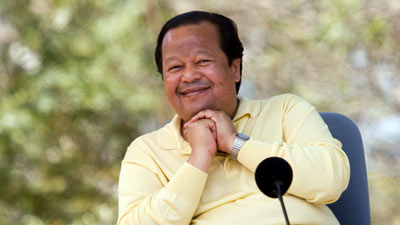
When asked to explain his highly abstract Theory of Relativity, Albert Einstein made it comprehensible in just two sentences. "Put your hand on a hot stove for a minute," he said, "and it seems like an hour. Sit with a pretty girl for an hour, and it seems like a minute."
I can relate.

There are entire years of my life I can barely remember, but singular moments that seem eternal. The birth of my first child was one of them. So was the birth of my second... as was the first time I saw the woman who would later become my wife... and the time I almost drowned.
"Peak experiences," they're called, moments when time seems to stop and we connect with something timeless -- moments when thinking gives way to feeling and we realize, without words, what life is all about.
And though the catalysts for these moments are different for each of us, the experience is universal.
Something takes us over. Something opens up. A Red Sea parts and we feel totally alive, far beyond the usual ways we measure the world, our worth, and life itself.
I've had my share of these moments and am grateful for each of them. But the most memorable ones have been in the company of my teacher, Prem Rawat.
Being around him brings out the best in me.
I laugh the loudest, feel the deepest, and experience the kind of spaciousness within that contains everything. Home sweet home. Free Parking in Monopoly. The peace that passes all understanding.
He is, for me, is an amplifier of all things good, a human tuning fork vibrating at the frequency I most love to frequent -- the frequency of love.
Which brings me back to the reason why I began this article in the first place.
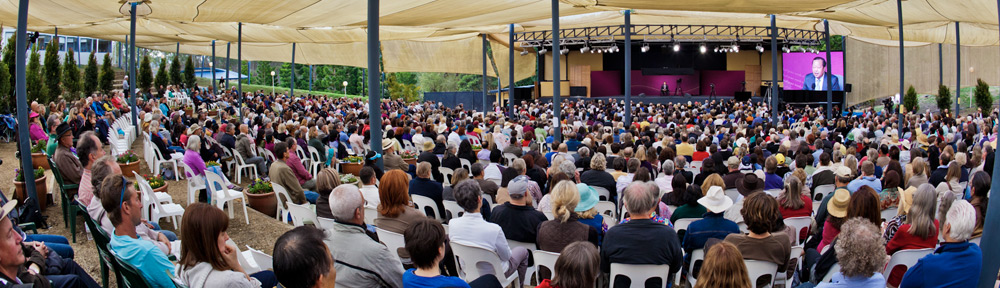
A few years ago, I attended a five-day event with Prem, in Australia, along with 3,500 other people from more than 30 countries.
It took me 27 hours to get there, but it seemed like a minute.
Life was simple in Amaroo. I lived in a tent. I went to bed when the sun went down. I woke with the birds. I had no cell phone, no laptop, no worries, and nothing to do but listen to my teacher -- twice a day -- hold forth beneath the vast Australian sky.
I was a happy camper.
On the fifth day of the event, I began to feel an old melancholy creeping in -- the kind I used to feel as a kid on Sunday afternoons when I knew the weekend was coming to an end.
Ah... the paradox!
On one hand, I was immersed in an experience that left me wanting nothing. On the other hand, the more this awareness grew, the harder it was for me think about leaving.
And so when I bumped into Michelle, an old friend of mine now working at Daya's Fine Dining, the on-site restaurant Maharaji was known to frequent, I asked if there was any way I could get in tonight -- my chance, I thought, to see him one more time before I flew home.

"All the reservations are taken," she replied. "But we still need waiters. If you meet me after the event, I'll introduce you to the woman in charge of personnel."
Fast forward a few hours.
The next thing I know a very focused woman is introducing me to Carl, the Head Waiter -- a well-dressed gent oozing confidence, purpose, and five-star restaurantiness.
Quickly, he explains my role, the difference between salad plates and dessert plates, when to bring the bread, when to pour the water, when to open the wine, when to take an order, how to take an order, where to find the spoons, how to fold the napkins, when to present the check, where to get the checks, what the consecutive numbers of my tables were, and a thousand other things that went over my head like an empty thought bubble in a Homer Simpson comic I had no time to read.
I wanted to take notes, but couldn't find a pen. I wanted to ask questions, but there wasn't any time. I wanted to confess my ignorance, but no one was available to play the priest.
I still didn't know where the kitchen was.
And then, before you could say "What are the specials tonight?" the doors open wide and the guests come flooding in.
I go to my section. I meet. I greet. I pour. I nod. I try to remember how the pork is prepared.
So there I am, walking across the room, carrying a chilled bottle of an Italian mineral water I couldn't pronounce if my life depended on it, when the entire restaurant becomes totally still.

Not the sound of a fork. Not the clink of a glass. Just pin drop silence and everyone looking in the same direction.
This, I knew, could mean only one thing.
There, at the threshold of the room, stood the man I had traveled all this distance to see, radiant, buoyant, completely present. He is looking in what I think of as "my direction," (though I'm convinced he's looking at someone else over my shoulder.)
"Hey Mitch!" he calls out. "So it's come to this? You've been demoted to a waiter!"
Everyone laughs. It's funny. But more than that, it has opened the floodgates. He's broken the ice and opened my heart with only 13 words.
It's clear that he is talking to me, not that mythical dude over my mythical shoulder. It's also clear that, standing halfway across the room, I'm much too far away to be having a meaningful conversation with him.
I should be closer. Much closer.

And then... I have one of those moments Einstein must have been referring to, years ago, when explaining the Theory of Relativity to people like me.
Time twisted. A second became a lifetime. A lifetime became a second.
Next thing I know I'm standing next to him.
I have no clue how I got there. Technically speaking, I walked, but not really. I didn't move an inch as far as I could tell. I was moved -- as if the entire restaurant had just been tilted in his direction... and I simply slid towards him.
Effortlessly.
Now next to him, before any other conversations in the room had a chance to begin, we continue the thread of what started as his humorous ice-breaker. I look at him and smile. He looks at me and says something about ADI, the new magazine he likes so much. I respond with news of my recent meetings with Ole, the editor. He says something else. So do I. Small talk, you could say, but for me it wasn't small at all.
It was huge.
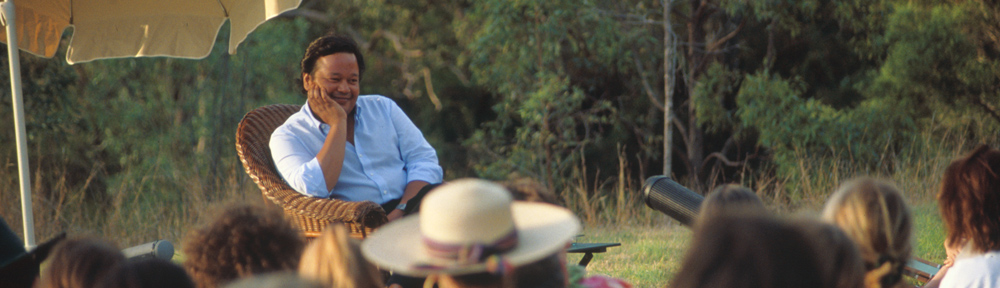
Now everyone in the room is getting into the act. The guy at Table 12 (Trout Almondine and the broccoli soup) asks Maharaji about a new software program. The couple sipping champagne at Table 9 talks about music. Someone asks about this. Someone asks about that. And he is totally gracious and present with everyone -- as if each person speaking was the only one in the room.
Me? I'm just standing there next to him, soaking it all up.
And then, just before he continues on his way, he turns and, out of the blue, says something kind about my writing.
Then he pivots and is gone, schmoozing forward into the next room where more people who love him are waiting patiently. I follow behind, a self-appointed member of his entourage, but I know my moment with him is over. I have people to wait on, wine to pour.
And so I return to my station.
Everyone seems a bit different now than when they first came in. Lighter. More expansive. And no one is asking about food.
Of course, that moment passes, too. Soon someone is asking for more butter. Someone else complains about the bread.
The odd thing?
If you look at this story from the outside, it doesn't seem all that extraordinary. OK, so I fly to Australia, live in a tent, don't use my cell phone, and listen to Prem Rawat for five days. Then I dress up like a waiter, walk across the room, and have a seemingly mundane conversation with him.
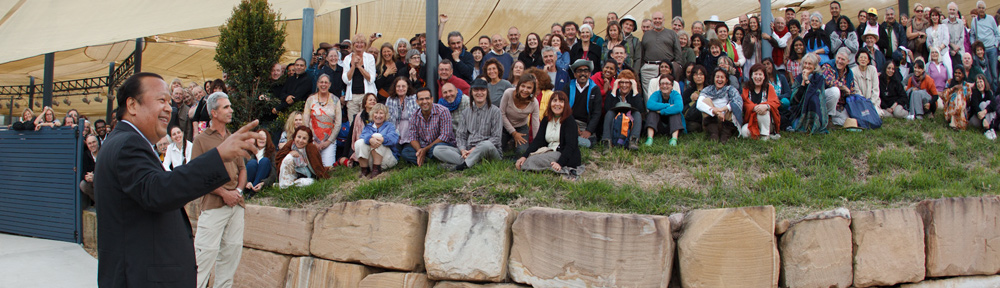
"That's it?" one could easily conclude.
Ahhh... This is precisely where the great mystery kicks in, my friends -- the mystery of the most off-the-grid relationship I know.
It's never about the what. It's all about the who and how.
When you're in love it doesn't matter what's happening. Everything you do, everything you say, everything you don't do or don't say is infused with a feeling.
And that feeling is what it's all about.
My moving across the floor at Daya's Fine Dining took just a few seconds. My conversation with Prem took just a few minutes. But the feeling of it all will last a lifetime.
This is what Knowledge is all about. This is what we were born to experience: the timelessness of love. And it is available to each and every one of us every single second of our blessed lives.
If you have learned the techniques of Knowledge and want to attend this year's Amaroo event, click here.
Most photos from Amaroo.org
Posted by Mitch Ditkoff at 11:14 PM | Comments (12)
November 21, 2011The Joy of Heckling

If you talk to a thousand people who are (or have been) students of Prem Rawat, you will get a thousand different impressions of who he is and what he does. Your guess about the accuracy of their perceptions is as good as mine.
But if you really want to know the answer, you will need to have your experience while being mindful of the words of Anais Nin, "We don't see things as they are, but as we are." Allow me to be more specific.
ACT 1
When Prem Rawat was 16, he married -- not to an Indian woman chosen by his parents, but to a 24-year old American. This troubled some of his students -- especially those who, at that time, had chosen celibacy as part of their path to enlightenment. How could he get married, they reasoned. Marriage was so mundane... such a distraction... so unspiritual.
And so, when Prem Rawat said "I do," a bunch of these people said "I don't" and split the scene.
Other students of his had a different response. They thought his marriage was cool -- more proof that he was free of old-fashioned concepts -- a liberated move that only deepened their love and respect for him. His actions, they concluded, were a kind of divine permission to do the same. And so they did. Got married, that is.

Still others, with no absolutely no desire to stop practicing Knowledge or settle down with a soul mate, had yet a different response. They sent wedding presents. They sent gardenias. They sent roses and cards and effusive telegrams.
Me? I was happy for Prem, wondered what kind of gift I should buy, figured I couldn't afford it, and did nothing -- thinking my long distance thoughts would somehow be enough.
ACT ll (three years later)
As far back as I can recall, Prem Rawat used to conduct "instructor conferences" -- intensive retreats for handpicked groups of his students on how to best represent his message in the world. Like many of his students, I wanted to be invited -- not only for the sheer joy of being with him, but for what I imagined was undeniable proof that I was "getting somewhere" with Knowledge.
Eight years passed. My love for Prem and Knowledge continued to blossom. Not once, however, was I invited to attend one of these events.
And then, completely, out of the blue, one unofficial day -- VOILA! -- I got the word. "Get down to Miami. You've been invited to an instructor conference... but not as a candidate -- as a guest."
A guest? Now I was really confused. I mean, Prem Rawat was inviting me, but he was also not inviting me. Huh?
I went.
For three days I sat in the back of a large conference room and watched this man, like some kind of improv laughing Pied Piper Buddha, in perfectly creased pants, bring everyone to a place of exquisite attention, learning, and relaxation. A magician he was. A conductor of joy. A man on a mission.

And then, before I knew it, the conference was over. Or at least I thought it was over. It wasn't. There was one more thing still to come -- a "Celebration Dinner".
The first thing I noticed when I walked into the room were the champagne bottles -- one on each table.
"This is gonna be interesting," I thought, amused by the fact that 98% of the people in the room hadn't had anything stronger to drink than a smoothie in the past few years.
Someone led me to my table. It was next to Prem's.
Feeling suddenly mid-western, I surveyed the room in a noble attempt to figure out what I was supposed to do -- how I should act. Clearly, no one had a clue. Things were just happening. There were no reference points, no sign posts, no correct courses of action -- only the sound of corks popping and a palpable wave of joy.
Good guest that I was, I raised my glass and drank, occasionally sneaking glances at him like some kind of wide-eyed tourist.
The next thing I know, he's asking if anyone has a good joke.
There's the usual self consciousness... the pregnant pause... then someone stands up, mounts the stage, and begins.
The joke isn't funny, but it breaks the ice. In a flash, someone else mounts the stage, only this time the joke is a lot better and X-rated, to boot. I look at Prem to see his reaction. He is laughing. Of course he's laughing. The joke is funny!
A third person gets up. Then a fourth -- each joke raunchier than the one before -- and everybody crazy with laughter.

At the telling of the fifth joke, I shout out a heckle like some kind of wise guy from Brooklyn. Irreverent. Unrehearsed. And way funnier than the joke itself.
"Who said that?" Prem asks, looking in my direction.
"I did," I say.
He laughs and points at me, "One point for Ditkoff!"
Now here is where all logic breaks down... where what I am about to say may seem as strange as my son's one-time fascination for Pokemon. I got completely ecstatic. In a blink of the eye, a major concept of mine had evaporated and I felt infinitely lighter.
After years of trying oh so hard -- in oh so many futile ways -- to have my special, timeless, sacred, holy, cosmic, blissful, meaningful moment with Prem Rawat, I finally have one -- and it's for heckling an aspiring yogi at a dirty joke contest.
Go figure.
ACT lll (18 years later)
Not long ago, I read an account of this very same event by someone who was also there -- someone once very close to Prem. This particular fellow described the contest accurately. The only thing different was the conclusion he drew.
For him, the contest was inappropriate, off-putting, poorly timed, and in bad taste.
Hmmm... For me, it was perfect, divine, liberating, and transcendental -- exactly what was needed for that particular group of people on that particular night, so focused on the "path" that they had forgotten to smell the roses... or accept themselves for simply being human.
Looking back, it's fair to say that I learned more in those few joke-telling moments about life -- my life -- than I did from years of meditating and reading holy books.
A Red Sea parted.
For me, it parted. Not for that other guy. He had a different experience. He tells a different story now. Which, of course, is his right, but does not make him right. That's just one of the amazing things about this life. We all see it differently -- based on where we're coming from at any particular moment in time.
Prem Rawat's Official YouTube Channel
PremRawat.com
TimelessToday
The Prem Rawat Foundation
Posted by Mitch Ditkoff at 07:09 PM | Comments (3)
November 11, 2011The Reception

The year was 1986. Or maybe it was 1989. Or 1990. I really don't remember what year it was, but it doesn't matter in the least because my story has nothing to do with time.
Maharaji (aka Prem Rawat) had just spoken to a few thousand people at a venue in Queens, NY. I was on my way out of the building when an old friend comes up to me and mentions there is going to be a small reception for Maharaji, immediately after the program, at the Carlyle Hotel in New York City.
In a heartbeat I'm out the door, zipping through traffic, and pulling up to the hotel entrance.
A smiling usher greets me in the lobby and points to the reception room on the second floor.
I bound the stairs three at a time and enter, fully expecting last minute preparations to be in full-frazzled swing. They're not. Maharaji is already there -- standing quietly in the middle of the room and talking to someone...
My first instinct is to rush across the room, go right up to him and say hello... or shake his hand... or thank him profusely... or offer an hors d'oeuvre... or ask if he needs help ... or volunteer for something... or remain inscrutably silent... or attempt to blend in like I'd been attending these kinds of gatherings with him for years.
So I do what any good guest at an elegant reception in a fancy New York City hotel would do. I sidle up to the buffet.
By now, it's clear I don't know how to approach Maharaji, but I do know how to eat. And though I'm not all that hungry, eating, I reason, will give me something to do as I wait for my opening to get closer to him.
The crudite looks good, but too much like a picture from a magazine I wouldn't read in a dentist's office. And besides, carrots and celery are nowhere near my "celebration foods" -- the stuff I eat whenever I'm feeling really good.
Ah...look! Over there by the olives! Cashews! I love cashews! The perfect finger food! Nothing to drip on my shirt!
And so I grab a few and eat -- doing my best, at all times, to sense where Maharaji is in the room -- a curious kind of modern day yoga not yet featured in Time or Newsweek.
The cashews are good. Very good.
They are also, I discover, very salty. This is not good because my right hand -- the one I'd be using to shake Maharaji's should I ever get close enough -- was now completely greasy.
I pick up a napkin to wipe off the salt, but succeed only in further spreading the salt over both my hands. I think of going to the men's room to wash them off, but then I'd be leaving the room Maharaji is in and who knows how much longer he'd be there?
Trusting the moment, I quickly take my leave, wash both hands, and re-enter the room. Maharaji, I'm relieved to see, is still there, now talking to someone else.
And then... in a classic, pre-verbal, pure instinct, swallow-back-to-Capistrano mode, I find myself spontaneously migrating towards him, stopping only when I'm about an arm's length away.
He is talking about radio conversations he's had with Russian fighter pilots when piloting his plane.
I do my best to stand there without standing out.
He continues, making some kind of reference to the apocalypse, which triggers, for me, the following response:
"Maharaji, I've heard it said that the only thing that will remain after World War lll will be a McDonald's milkshake."
"No," he replies. "Cockroaches."
COMMENTARY:
There are many ways a person could interpret the preceding story.
One could easily conclude that what I experienced at the Hotel Carlyle reception with Maharaji was simply a function of my own mindset and mood that night -- the quirky way I see the world and the choices I make based on those perceptions.
Show three people a sharp knife and you'll get three different reactions. Someone's going to think of a stabbing... another, the number of carrots they can chop in three minutes... still a third, how much they could get for it on eBay.
"We don't see things as they are," said Anais Nin, "we see things as we are."
I'm guessing the other 75 guests at the reception told very different stories the next day -- none of which had anything to do with cashews, salt, or Russian fighter pilots.
"Motivation affects perception," explain the psychologists.
Still, I'd venture to say that everyone in the room that night, at the root of their own story, shared one thing in common.
And that was a feeling.
Not a thought, not a concept, not an opinion, projection, abstraction, comparison, analysis, or conclusion.
A feeling.
A feeling of love and freedom far beyond the specifics of what they experienced at the reception that night and how they told their stories the next day.
This feeling is why I was happy to be at the reception with Maharaji. And it's why I'd be happy to be in a desert with him. Or a bus station. Or a hallway. Or a field far away from here.
What Maharaji connects a person to is a place beyond the story of their life -- a place that cannot be found on a map.
A place that can only be found in the heart.
Intrigued? Click here or here or...hey...over here.
Not intrigued? Got other fish to fry? No problema. May you enjoy all the rest of your days no matter what you do. May you count your blessings. Then lose count. May you have the grace and the courage to let go of whatever is in your way -- and if you can't let it go, then at least kick it aside. If there's not enough love in your life, take a breath and look within. That's where you'll find it.
Posted by Mitch Ditkoff at 10:54 AM | Comments (0)
October 23, 2011Selma Speaks
My mother, Sylvia, was a Jewish mother. She played canasta. She ate bagels. She got her hair done once a week. And, knock on wood and spit three times, she thought I could do no wrong.
That is, until 1971, when I received Knowledge from that "boy Guru," Maharaji.
Bottom line, my mother had no way to relate to the whole thing. First of all, Maharaji wasn't Jewish. Second of all, he was from India. And third of all, see reasons #1 and #2.
Of course, my over-the-top proclamations about Knowledge and Maharaji's perfection didn't help matters in the least. Nor did my sudden habit of lighting incense in my parent's home.
It wasn't enough that my girlfriend wasn't Jewish (a shiksa!) -- now I had an Indian Guru. As they say in the old country, "Oy Vey."
All of which led my mother, one fine Spring day, to forbid me -- for all time -- from ever speaking about Maharaji in her home.
"No problem, ma," I replied, affecting my best suburban yogi's attempt at being non-attached. "Mum's the word."
Five years passed.
Life was good. I was practicing Knowledge. I was happy. And my adolescent need to convince my parents of anything had vanished.

Then I got word that Maharaji was coming to Miami for a weekend event, one I absolutely wanted to attend. This, I figured, my parents didn't really need to know, so I simply told them I was flying in to visit them that Sunday. I didn't want to push their buttons.
As usual, when the golden boy, Jewish prodigal son returns home, his parents invite their friends to celebrate the return. All the regulars were there: Blanche, Shirley, Ellie, Irv, Bert, Seymour, Solly, and some new friends of my parents I hadn't yet met.
Just having seen Maharaji, I was feeling especially alive and in the moment.
Taking a deep breath, I knocked on the door and let myself in, surveying the room and enjoying that sweet moment of arrival before the slightly deflating reality of visiting one's parents truly sinks in.
An elderly Jewish woman in the back of the room stood up and smiled at me -- someone I'd never met before.
"Oy gevalt, Mitchell," she said. "Wasn't Maharaji beautiful? I could have plotzed!" (I later found out this woman, Selma, had received Knowledge three years earlier).
I looked at my mother. My mother looked at me.
"Hey, Mom," I said, shrugging. "She's your friend. I didn't say a thing."
Posted by Mitch Ditkoff at 06:16 PM | Comments (4)
August 13, 2011Here's What I Know

The sky is blue,
the grass is green,
my eyes are brown,
the God we are looking for
is looking for us,
the pilgrimage is the pilgrim,
there is nowhere to go,
nothing to say,
no seed to sow.
So why am I writing this?
Because
it can be no other way.
Posted by Mitch Ditkoff at 03:48 PM | Comments (0)
March 20, 2011The Treasure Inside
The following remarkable story is by Joel Metzger, the creator of TreasureInside. It's the story of a major rite of passage in Joel's life -- the time when he was in a terrible car accident and no one thought he would ever recover. But he did. Big time.
Imagine yourself in an unknown, unlit place. You are restless, but unable to move with control; alone, but unaware of what surrounds you.
You have no desire to know where you are. Your concern is of immediate senses. More than the pain you feel, is the intense discomfort you suffer. You try to move to relieve the distress and then move again.
Anyone else would see you are in a hospital bed, bandaged and barely conscious. Tossing. Groaning. A nurse walks in the room. The nurse leaves.
Yet part of you is safe.
This is where I have been. I know only what others have told me -- a late summer night, driving alone down my street, going home, my car passing over a bridge.
I was going 35, the other car 90. The other car jumped the median, flew across the bridge, and collided with me head-on. The other driver was killed instantly, along with his passenger. I was pulled from my car -- broken jaw, lacerations, and severe head trauma.
"An existence without conscious thought" was the best my family was told to hope for.
"The rest of his life in a nursing home ... irreversible brain damage ... never speak again ... no functional activity," doctors said. "Pray for a miracle."
The brain injury would most likely be fatal, coupled with the high fever and brain fluid infection. There was little hope.
Again, imagine.
You are alone, far alone and solitary. There is sadness here with no thought; pure emotion with no concerns.
Here is heartbreak without the story, a single frame from a movie. Far from you is the mass which is your body. The cry from a sad song is heard with no music or lyrics. You are left with only your life's skeleton. The flesh that had filled your moments is gone and you are in a vacuum, unable to think even one comforting thought. Each thing that has given you joy, and all you cared for, has gone, but the caring has not.
Imagine: you are sightless, falling from an airplane. You do not recognize the contents of the large pack on your back. It is heavy and massive. You are far too frightened to wonder.
You are a lone diver, deep in the sea. You are in the black, with no glimmer of light. The ocean's floor stretches without end, and water fills all space. Your depth underwater is not known. Life hangs on a tether stretching to the surface, the thin line carrying air.
You are lowered further into the unknown darkness, leaving the cares and the people who have accompanied you every minute of your life. You cannot cry. Your heart sinks as if weight pressed your chest. Slowly you are dropped to the ocean floor, and there you are deserted.
This is the bedrock, where each person will come, as the movement of life winds down.
Once you were happy that people befriended you. Now you have no company. The people are over there -- far away. You stand alone as if abandoned. But it is not they who leave. It is you. You go where no one can follow. You are alone.
Yet a baseline remains that can never be taken, the common ground of all moments and events. A part of you is safe.
I slowly recovered. The miracle came. After two months, my coma lightened and I drifted in and out of restless dreams. I was flown to another city for rehabilitation and there my earliest memories begin.
Mine is the opportunity that everyone wishes for: "If only I could do it over again knowing what I know now!"
The doctors were wrong. Never speak? No functional activity?
More than ever I talk and function. They said I'd live in a nursing home the rest of my life. Ha! One friend said, about the prognosis, that I would be like a vegetable.
"You're doing better than any broccoli I've seen."
A favorite joke of mine: "You only live once."
Truthful is the sentiment. Ironic is the statement. I have lived twice -- closer than almost anyone to experiencing reincarnation in the same lifetime.
In my life, suddenly, the rug was pulled from beneath me and life was stripped of thought and action. There remained only the necessary: myself alive.
I was without a body I could command, a personality I could call my own, and a memory I could retain.
And all the while, a cord held me. I watched life rebuild someone, myself almost dead, into a real living person, my new self fully whole.
I fell to the bottom where I lay flat, and said, "No one can go lower. From here one can only climb uphill."
As I ascended, I knew this lifeline. Now I have returned.
Once again, imagine yourself: a newcomer to this life, isolated and vulnerable to surroundings. You are exposed, open to harm, yet part of you is safe.
Along with your fragile condition, imagine the vital thread that will continue. You feel its unbroken cord sustaining you. You stand on a foundation of stone, the life in your body, but now without the physical and mental capabilities that were yours.
Still you feel the power that will persist. As you fell, you recognized the massive pack on your back to be a parachute. It broke your fall, letting you down gently.
In place of your identity, you now lie on ground common to all. A bed of rock supports you, warm and smooth. You are able to stand and walk.
Here you go, right to the edge of existence. That thread will follow you to the end, as always. The thread defines safety: that which survives intact.
Now, for all your days, for all you do, for however long you exist, you will know. You are held by life and you are safe. You are safe.
This episode took place many years ago, in 1983. I have recovered fully. Now I am living fully functional (I hope) and making movies for TreasureInside.net.
What a statement of the power of life!
This injury is way behind me, but it speaks a profound message that I clearly hear. I've lived the miracle that doctors talked about. I recovered. A much greater miracle is happening now: I'm alive.
We often overlook the importance of life. Well... at least I overlook it. But I get reminders. This episode was certainly a big reminder, and there is a story behind this one.
Life holds a treasure. Hiding quietly in life's simplicity and beauty, there is a beautiful feeling.
My teacher helps me know this. He guides me and reminds me to stay close to the peace inside of me. Listening to him is another big reminder.
Treasure Inside
Posted by Mitch Ditkoff at 09:45 PM | Comments (0)
February 24, 2011Pass the Bus!

A couple of days ago, driving from New York City to my home in Woodstock and stuck behind a bus, I started hearing weird metallic sounds coming from my engine.
Ouch! I was already paying thousands of dollars to my son's orthodontist and had zero interest in shelling out more for an unexpected car repair.
The more I drove, the louder the sound got.
I looked at my dashboard, expecting to see red lights, but everything seemed to be fine -- more proof, I thought, that the strange sound coming from my engine was so expensively undiagnosable there wasn't even an indicator for it on the dashboard.
The closer I got to the bus, the louder the sound grew.
Then it dawned on me.
The sound was coming from the bus, not my car. The sound wasn't mine. Somehow, I had adopted it, took it in, gave it shelter. But it wasn't mine. It didn't belong to me at all.
Doh!
That grinding sound I hear in my head? The worries about money? The distractions that steal my focus and make me think there's something wrong?
All made up. Not mine. Time to let them go! Time to pass the bus! Time to enjoy how smooth the ride home really is.
Posted by Mitch Ditkoff at 02:23 AM | Comments (2)
January 08, 2011Snow Day Revisited
It's a great feeling
when space opens up,
and time,
when you have nothing to do
except BE,
when all the demands
of your life
relax their grip
and you are free to enjoy --
free to let things
settle way down.
This often happens
on a snow day --
a good reminder
that it is possible.
More
Illustration: Sara Shaffer
Posted by Mitch Ditkoff at 08:58 AM | Comments (0)
January 06, 2011What Did I Really Have?

George Bernard Shaw once said "that the test of a man or woman's breeding is how they behave in a quarrel."
In other words, what we're made of often doesn't become visible until we're confronted with a tough situation. Then all bets are off.
Here's an inspiring story about one such moment -- not the story of a quarrel, but the story of a peace loving Israeli man who found himself dealing with the stark reality of being on the front lines of war and, at the same time, experiencing something within him that was beyond all conflict.
Posted by Mitch Ditkoff at 11:56 PM | Comments (0)
December 30, 2010Looking for the Real
See that guy to your left?
Looks a little intense, eh? Must be on some kind of spiritual trip. Or maybe he's just protein deficient. I'm guessing he's into Eastern things. Probably reads the Bhagavad-Gita and doesn't make enough to pay taxes. Maybe he lives in a tent. Fruitarian? Macrobiotic? I really don't know for sure.
Wait a minute! That's me! 40 years ago. (Now you know why my parents were so freaked out when I was in my 20's.)
After all, I was their golden boy, the carrier of the family name, the hope for the future. According to everyone, I was supposed to be a doctor, a lawyer, a dentist. Maybe even a rabbi.
I coulda been a contender.
What happened? Why the long hair, the sallow cheeks, the penetrating I-can-outstare-anyone look.
Growing up in the suburbs of New York, you'd never think I would have gone off what some people referred to as the "deep end."
After all, I had it good. I had my own room, my own TV, a good looking girlfriend, a dog, excellent grades, played varsity basketball, and went to summer camp. And though my father, unlike Buddha's, was not the King, he had enough money to send me to a fine college -- where I majored in English and existential despair.
No matter. Still, I graduated with honors and went on to graduate school. Not in medicine, law, teeth, or the Talmud -- but poetry.
So there I was, in some fancy-schmancy Ivy League grad school -- hair and shadow growing longer by the day, when I get this invitation to an ultra hip, faculty-student party -- the kind where everyone is either drunk or stoned. Or both.

Feeling especially bold that night, I approached each of my professors and asked a simple question: "If you could be anywhere on Earth, at this precise moment, where would it be?"
Each of them, glad for the audience, began waxing poetic on their favorite place -- the nearest of which was 2,000 miles away.
Doh! No one wanted to be where they were! Everyone wanted to be somewhere else!
And me, the wise-ass, longhair, full of poetic-potential, Vietnam-phobic, draft-deferred 22-year old enduring Beowulf, Wallace Stevens, and iambic pentameter homework assignments was aspiring to be one of them?
I saw the future and it wasn't pretty.
I'd be 45, bearded, smoking a pipe, sitting in this same room being asked by my much younger alter ego where I wanted to be at that moment in time and it was going to be some place very far away.
Ouch!
Enough said. I decided to quit.
Thus began a series of adventures and accompanying odd jobs "beneath my station" that left my mother somewhat speechless around the canasta table --  dish washer, waiter, cook, hotel desk clerk, house painter, day care teacher, and food stamp collector.
Thirsty for less, I moved to an island in the ocean -- a pristine place where I could really get away from it all.
And so I did.
I grew vegetables. I grew a beard. I grew further disillusioned with "the world." I fasted. I chanted. I prayed. I read the Gita, the Tao Te Ching, the Upanishads, the Dhammapada, the Aquarian Gospel, the Zen Teachings of Huang Po, the Old Testament, the collected writings of Chuang Tzu, Meher Baba's discourses, the Life of Milarepa, the Tibetan Book of the Dead, and anything else that addressed what life was all about.
I was living in paradise, but I wasn't happy. Not even close. To the casual observer, I had it all -- the house in the country, the girlfriend, the dog, the friends, the fresh baked bread, the mellow job on a 200 acre farm, but it wasn't enough.
I plastered my house with pictures of all the enlightened beings I could find -- Buddha, Jesus, Krishna, Shiva, and Meher Baba. I prayed to them all.
And then I got the letter -- the letter from my best friend, Ed.
Ed was the real deal -- a practicing Zen Buddhist, a calligrapher -- a kind of spiritual big brother to me. Five years older (and maybe several lifetimes, too), Ed was deep, soulful, authentic, and cool.
He was also a minimalist. Preferred one flower in a vase, to many. Was a man of few words. Had a huge BS detector and always had a twinkle in his eye. A full tilt individual, he was not the easily influenced kind. Nor was he a joiner of anything that smacked of group think.
I trusted him.
Which is why I was so intrigued to get a letter from him one fine Summer day. Ed, the man of few words, had a lot to say in this missive. Apparently, since the last time I'd seen him, he'd "received Knowledge" from a 13 year old "boy Guru" from India -- someone named Maharaji.
Hmmm...
The first thing I did, after reading the letter, was stuff it in a drawer. Something in me knew the jig was up -- that all my seeking was about to come to an end. But I didn't want to give it up. I liked seeking. Seeking was cool. Seeking was exciting. Seeking was spiritual... familiar.. and a proven way to pick up chicks. Seeking gave me an identity -- the seeker.
Finding, on the other hand, was... well... confronting.
Flash back to high school: Seeking is to dating as finding is to... um... er... uh... marriage!
MARRIAGE! Help! Who, in their right mind, wanted to get married? Certainly, not me. Marriage was so... so... final... so entrapping... so end of the line.
And so I procrastinated as best I could.
I knew, in my gut, that Ed's letter was a direct response to a deep prayer within me, but the immediacy of it all made me anxious -- like when a really good teacher called me to the front of the room and asked questions I didn't know the answers to.
But Ed was relentless. He was not about to concede to my procrastination. Two weeks later he called me, inviting me to visit for the weekend.
I went.
The first thing I noticed in Ed's apartment was a framed picture of Maharaji. I found it odd -- especially since my image of "The Guru" was very different than the one in Ed's frame. Where were the sallow cheeks? Where was the long white hair? The robes? The ancient look in the deep-set eyes as if to say:  "Come my son, I know you have waited lifetimes for me to incarnate, and here I am -- crossing the universe to come for one of my favorite (and most humble) disciples of all time."
In reality, the picture of Maharaji in Ed's apartment looked more like a second string fullback for a little known high school in New Jersey. "That's the Guru?" I thought to myself. "That's the guy who's created such a stir?"
It made no sense.
Ed, God bless him, didn't care in the least. He just kept on talking and laughing and smiling. When we went for a walk, I couldn't keep up with him. He was a ball of fire -- radiant, glowing, buoyant, alive. Gone was the Zen minimalist shtick. Gone was the dude who mindfully chewed his rice 100 times before swallowing. In its place? Radiant, child-like wonder. Fun. Mojo. Elan. And something neither of us had talked about in any of our esoteric conversations -- happiness.
When I returned to my home on the island, I had a lot to think about.
Could it be? Could this young boy from India be the ONE (at least for me, that is)? Could all of my chanting and praying and fasting and yoga and reading and attempts to meditate have invoked this moment in time? Was Maharaji's appearance on the scene in direct response to my inner calling?
I didn't have to wait long for the answer.
Two weeks later Ed called to tell me that one of Maharaji's emissaries was going to be in Boston and that, if I wanted to receive Knowledge, I should come. The cost? Nothing. Zero. Nada. Zilch. Ed explained there was no charge because what I was about to receive I already had.
Sounded good to me.
I went. I asked. I received.
It was, looking back, the most extraordinary experience of my life. Like coming home. Like waking up. Like discovering I was made of pure love. Everything became so simple, so perfect, so full of essence, energy, and peace.
I could have pulled Redwood trees from the ground.
These, of course, are only words. If you ask a hundred different people who have received Knowledge (and practiced it), you'll probably hear a hundred different descriptions. But all of them will be spoken with the kind of feeling that will catch your attention.
What I'm trying to stay is this:
What you are looking for is within you.
Your thirst to experience this will guide you on your way.
What you will get guided to will be a direct response to your thirst.
You will need to trust your thirst and that which it guides you to (even if I'm not supposed to end this sentence with a preposition.)
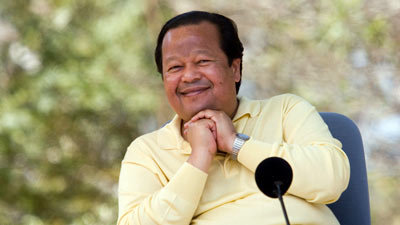
For me, this thirst led me to Maharaji and his gift of Knowledge. His invitation is the same now as it was 40 years ago. He's still here. And so are you.
Now that you know, what do you want to do? It's your move.
Posted by Mitch Ditkoff at 01:01 AM | Comments (13)
December 28, 2010Happy New Year from Jesse, My Son
Posted by Mitch Ditkoff at 02:10 PM | Comments (0)
December 16, 2010Service in the Air
I just flew 19 hours from Newark to Singapore on Singapore Airlines. In a nutshell, here's the difference between Singapore Airlines and all the other airlines.
When it's time to turn off your computer, just before landing, the flight attendant actually comes from a place of kindness and love rather than the gestapo-like monitoring of "bad passenger behavior" that most other airlines seem to be dominated by.
My flight attendant (who was as attentive in the 18th hour of the flight as she was in the first), ASKED me to turn my computer off instead of TELLING me. Huge difference.

After she continued down the aisle, moving like a cool breeze at 36,000 feet, I WANTED to turn my computer off instead of feeling as if my junior high school penmanship teacher had just berated me for something I didn't do.
Singapore Airlines gets it, big time. And it all starts with their flight attendants.
For starters, they like their job. That is totally clear. They treat you like a human being, not a possible disturbance in row 26. And their "customer interactions" don't smell of "training," but of genuine human decency, consciousness, and care.
Here's the bottom line, strange as it may seem. When my flight finally landed, I didn't want to get off the plane. I just wanted to keep flying around -- watching movies, washing with hot towels, and wondering how the Singapore Airlines flight attendants stay so gracefully benevolent for 19 hours in a row.
Posted by Mitch Ditkoff at 11:27 AM | Comments (1)
December 10, 2010The Tourist Syndrome

Sometimes, when a person hears about a Living Master, an odd phenomenon takes place. I call it the "Tourist Syndrome." No matter how sincere the seeker is or how approachable the teacher, a funny dance ensues -- not unlike the way some tourists relate to shop owners in foreign cities.
Anyway... if this intrigues you, click here. Words of Peace Global has just published it on their nifty blog. (How often do you use the word "nifty?" Not often, I bet).
But I digress. On to The Tourist Syndrome... and the rest of your day.
Illustration by Barbara Bash
Words of Peace Global
More about Istanbul
Posted by Mitch Ditkoff at 02:45 PM | Comments (1)
November 18, 2010Yin, Yang, and Jung

She
wanted
more
space,
I
gave
her
the
universe.
Posted by Mitch Ditkoff at 11:33 PM | Comments (1)
November 12, 2010What's in a Name?
Words of Peace Global
has just published a
third in a series
of weekly blogs --
this one a light-hearted
look at the phenomenon
of attempting to name
one's relationship
to Maharaji.
Take a look.
See if you can relate.
If you want to comment,
go right ahead.
Speak your truth,
share your feeling,
let it rip.
Videos of Maharaji
More
A big thank you to Julian West, Sara Shaffer, and Jossi Fresco for all the work they're doing to bring the WOPG blog alive!
Posted by Mitch Ditkoff at 04:33 PM | Comments (0)
September 14, 2010Surprise!
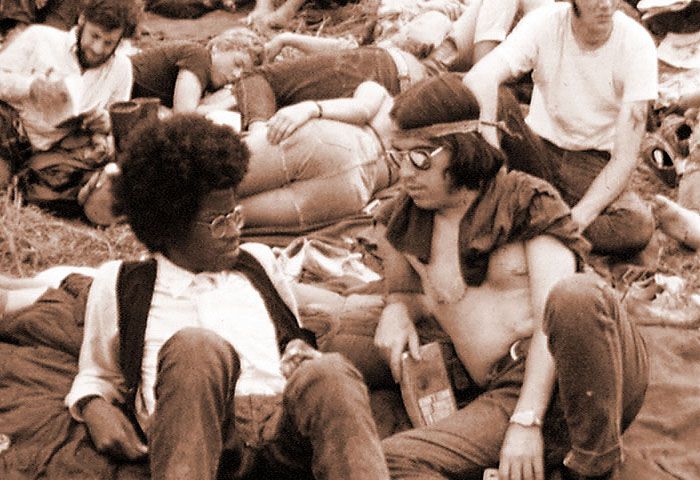
Here's a
nice little surprise
for you --
a recent
article of mine,
about
Maharaji's visit
to Woodstock,
now posted on
Words of Peace Global.
Posted by Mitch Ditkoff at 07:51 PM | Comments (1)
August 03, 2010And Now For Something Completely Different

OK. I'm taking a bit of a risk here -- including a posting that will make some Heart of the Matter readers scratch their heads and unsubscribe. So be it. If this happens to be the last story you'll be reading on my blog, I hope you get a chuckle or two out of it.)
But first, some back story...
A few months ago, my awesomely cool, smart, and creative daughter, Mimi, turned 13 and invited 12 of her girlfriends to our house for a celebrational sleepover.
The first 30 minutes were great as each girl, gift in hand, was dropped off by a parent, who, upon surveying the room, offered my wife and I a glance of great compassion as if to say "Better you than me."
The girls? Don't ask...
They talked. They texted. They talked. They texted. Ate chocolate. Brushed hair. Played music. Painted fingernails. Laughed. Texted. Called friends. Finished not a single sentence, rolling their eyes every time a parent entered the room.
Mindful of my daughter's need for space and my own weird tendency to be a little too present when her friends were around, I retreated to my bedroom like some kind of mid-western chicken farmer looking for a storm shelter.
I tried reading. I tried napping. I tried meditating.
Nothing worked.
My attention was completely subsumed -- taken over by an invisible vortex of swirling social networking energy being channeled by a roomful of partying 13-year old girls -- the next generation of, like, whatever.
And then, with absolutely no warning, everything became suddenly clear. In a flash, I understood exactly how to end terrorism once and for all.
THE PLAN:
For starters, the government flies a squadron of 13 year-old girls to Guantanamo -- or wherever high profile terrorists are being interrogated these days.
The girls, impeccably guarded by the highest qualified soldiers available, are walked into a prison waiting room where the shackled terrorists are already sitting.
Immediately, the girls begin texting, eating chocolate, talking, painting fingernails, and exponentially interrupting each other with a steady stream of "OMG's" and other, esoteric internet acronyms none of their parents have a clue about.
The prisoners, at first, find the whole thing amusing -- a delightful break from their dreadful prison routine. They smile. They wink. They remember their youth.
But the girls, wired to the max (sugar and wi-fi), radically pick up the pace of their texting and talking like some kind of futuristic teenage particle accelerator.
After five minutes, the prisoners stop smiling. After ten, they become silent. After twenty, they start twitching. A lot.
They try covering their ears with their shackled hands, but the chains are too short. They start looking madly around the room, hoping to catch the eyes of their jailers -- but their jailers sit motionless, miming the movements of the twelve texting teenagers.
A few of the terrorists start crying. A few go catatonic. And then, the roughest looking of the bunch -- a tall man with a long, jagged scar on his left cheek -- calls out in his native language.
"STOP! I CAN'T TAKE IT ANYMORE! I'll TELL YOU EVERYTHING YOU WANT TO KNOW."

The guards nod and switch on the nearest tape recorder. But it's totally unnecessary.
The girls, totally tuned into the terrorists' confessions as if watching the finals of American Idol, are texting everything they hear to a roomful of Pentagon heavyweights in an undisclosed location.
The information proves vital to our national defense.
Within three days, a record number of terrorist cells are taken down. Word gets out to the global terrorist community and, in only a matter of weeks, it becomes impossible for the Jihadist movement to recruit.
Yes, of course, the ACLU raises a stink about this "new strain of American torture," but a thorough investigation by a bi-partisan task force of international peacekeepers proves to be inconclusive. No long-term damage to the prisoners can be detected.
On a roll, my daughter and her rock-the-world friends create a Facebook Group that teaches other 13-year old girls how to help the cause. A movement is born.
Soon, hundreds of teenage girl "patriots" are dispatched to war zones around the world -- radically decreasing the incidence of terrorism on all seven continents.
Subsequent interviews with former Jihadists reveal that merely the threat of being in a room with 12 texting 13-year old girls was enough to get them to lay down their homemade bombs and return to farming.
Peace comes to the Middle East. Pakistan and India make up. (Make up, girls!) The Golden Age begins.
As you might guess, HBO and Hollywood come calling.
Big time producers want to do a reality show and a major motion picture, but the girls -- newly inspired by the impact they've had on the world -- refuse to become a commodity as they prepare (OMG!) for summer camp and 8th grade and the September launch of that next, cool cell phone with the incredible keyboard.
Posted by Mitch Ditkoff at 03:54 AM | Comments (3)
July 29, 2010Mehmet the Rug Merchant

Today, Evelyne and I bought a Turkish rug from Mehmet, Istanbul's Hafiz of rug merchants.
If I could write as well as he could sell, people would still be reading my poetry 800 years from now.
Technically, speaking, Mehmet didn't really sell us anything. He simply created the conditions that allowed us to buy (which some people, I know, will think is really just a clever form of selling, but it wasn't.)
How did Mehmet work his magic, when all we did was sit down at his cafe to drink some coffee with no conscious desire to buy a rug?
MEHMET'S MAGIC
1. He effortlessly established rapport
2. He gave us all the space we needed
3. He shared his knowledge with great feeling
4. He had beautiful rugs and knew them better than most people know themselves
5. He loved what he did
6. He had a wonderful sense of humor
7. He had kind eyes and a big heart
8. He conducted the transaction in the spirit of service
9. He asked us how much we thought the rug was worth and then sold it to us for less.
10. He knew what he was doing and he did it with the perfect blend of flair and humility.
Here's to Mehmet and the new rug we are thrilled to own -- a beautiful remembrance of Istanbul and the Hafiz of the rug realm.
Posted by Mitch Ditkoff at 06:03 PM | Comments (4)
April 21, 2010Buying a Book for My Mother

For many years I wanted to buy a book for my mother -- a book that would explain everything... what I hadn't or couldn't explain since I had been old enough to notice my mother wasn't all that happy and, Lord knows, I wanted my mother to be happy and if not "happy" per se, then at least aware of what it was that made me, her son, happy -- the "thing" that, for so many years, she thought was just a phase I was going through and, even worse, some kind of heartless rejection of her and her way of life.
Oy vey...
Yes, I wanted to buy my mother a book that would explain it all -- the whole "New Age thing," the whole "Guru thing," the whole "it's OK that I don't eat your veal parmagiana any more because I'm a vegetarian thing."
Somebody must have written it. Somebody must have noticed the market niche of "mothers over 60 who worry why their high performing sons have gone spiritual."
And so, I went looking for the book. Like some people look for God.
And though I never found it, I did find some reasonable facsimiles -- cleverly titled books displayed by the check out counter, conceived by marketing geniuses who somehow knew my need -- the need a son has to make his mother smile... the book that would keep his mother company during those long, cold nights when her husband was working late and her children were asleep and there was nothing good on TV... the ultimate self-help book that would remove her worries, her doubts, and her exponentially growing fears of thinking her son had gone off the deep end for "receiving Knowledge" from that young boy from India.
I wanted my mother to know how beautiful life was and how simple it could be to experience that beauty. I wanted her to know there was something timeless within her, something beyond the stress of aging and the clipping of coupons.
Maybe it was selfish of me, but I wanted to buy my mother a book that would deliver some proof that love was the name of the game... and that (bite your tongue and spit three times) the act of "receiving Knowledge" from Maharaji was as healthy as chicken soup.
Twelve years ago my mother died from a four-year bout with emphysema.
During my stay with my father after the funeral, I discovered the books I had given my mother for the past 35 years.
Most of them had never been opened. Like some strange mix of Stonehenge rubble, they lay in piles all around... on her night table, on her desk, stuffed behind cookbooks, in the garage. Some, when you opened them, still had that new book crackling sound.
I felt sad she didn't read them. Disappointed. And the kind of resignation teenagers feel when they realize their parents just don't get it.
Looking back, I realize now that no book would have been sufficient to have given my mother.
No. I wanted her to have the experience the books were describing, not the description of the experience. As my teacher, Maharaji, has mentioned many times, if you are thirsty, you need water to drink, not the description of water.
Ultimately, that's what Maharaji's offer is all about: helping people find the water -- the naturally occurring well of well-being inside us all.
It's something my dear, sweet, canasta playing mother would have definitely appreciated.
Photo by Weeping Willow
Posted by Mitch Ditkoff at 01:15 AM | Comments (3)
February 12, 2010SOS from Mexico!
If you are reading this, please help me. I need your help!
For the past eight days, I've been in Mexico, being deprogrammed. My captors are quite clever -- latino ninjas, I believe. They never show their faces. But they are definitely having an effect on me.
Two days ago, I completely lost my desire to log on to Facebook. I can't remember any of my passwords. Or the name of my insurance agent.
What in the world is happening to me?
And it's getting worse. Last night, after being fed some "fresh" guacomole, I found myself looking at the moon instead of my email.
Have you ever heard of such a thing? Is it reversible?
For a couple of days, I thought my shaky state of mind might be due to "something in the water," but then I remembered I've been drinking mostly margaritas and cervesa.
These deprogrammers are extremely accomplished. They stop at nothing. I don't know how they do it.
My ability to comprehend the basics of my life? Rapidly deteriorating. I have no idea how many hits my website got last week. I have no clue how the Knicks are doing. The sun is up. That I know. But the Dow? Beats me.
Please, help me!
Do you know anyone at the U.S. Consulate who can intercede? A website I might check out when no one is looking? Something! Anything! Please!
Wait... shhhh... can you hear it? There... off in the distance... church bells... many church bells ringing... Listen.
Posted by Mitch Ditkoff at 11:50 PM | Comments (2)
September 06, 2009Be Healthy! Keep It Simple!
"Life is really simple, but we insist on making it complicated." - Confucius
When I was in my 20s, I worked at the University of Virginia Medical Center. Initially, I was impressed when I heard the interns and residents spicing their diagnostic conversations with impressive sounding Latin words.
It made me feel like I was in the presence of experts -- people in the know -- professionals to whom I could entrust my life should I ever get really sick.
In time, it became clear to me that the Latin name dropping routine was just a game -- a way that insecure medical students could instantly feel better about themselves, somehow justifying all those long nights of studying while, at the same time, raising their perceived value in the eyes of their overwhelmed patients.
It's not just medical students who are enamored of complexity. We all are. Somehow, in our over-caffeinated, multi-tracking, digitally-assisted life, we have come to equate complexity with wisdom.
Complexity is not wisdom. Complexity is complexity. Simplicity is where it's at.
All the savvy people I know have a knack for keeping things simple. They demystify. They speak in the language of the people. They cut to the chase in a way that cuts no one in the process.
My invitation to you today? Keep it simple -- no matter what path you're on. You will feel way better at the end of the day -- and so will all the people around you.
Want to know what Einstein, DaVinci, Tolstoy, and others had to say about the topic? Keep reading...
"Everything should be as simple as possible -- but no simpler." Albert Einstein
"Simplicity is the ultimate sophistication." Leonardo DaVinci
"Our life is frittered away by detail... Simplify, simplify, simplify!" Henry David Thoreau
"Simplicity is the final achievement. After one has played a vast quantity of notes and more notes, it is simplicity that emerges as the crowning reward of art." Fredrich Chopin
"There is no greatness where there is no simplicity." Leo Tolstoy
"Nothing is true, but that which is simple." Goethe
Posted by Mitch Ditkoff at 08:59 PM | Comments (0)
July 31, 2009A Eulogy for My Father

A BIG THANK YOU to all of you who shared your love, wisdom, and condolences with me after the passing of my father on July 14th. It meant a lot to me. I am touched and humbled by the outpouring of good vibes from so many heart-centered people. What follows is the eulogy I wrote for my father on the night before his funeral.
Last night, I sat in my father's office attempting to write this eulogy. I started five times and stopped five times. I started again, trying to find the words to describe how it feels to be here without him. I still don't know.
You see, I had a father for 94 years and have only not had a father for three days, so anything I say today must be understood as the words of someone only three days old. But still I will try.
Indeed, this trying -- this effort to accomplish the seemingly impossible -- is a gift I've received from my father...
He was the most tenacious person I knew. Ferocious, focused, and fueled by a need to be his own man which he accomplished in countless ways until the very end. To him, it wasn't "my way or the highway," it was "my way or the my way."
I do believe if God had appeared to him as a Burning Bush in his bedroom during the difficult last weeks of his life, he would have advised the Unnamable One to switch from mutual funds to stocks as a way to save on the commission.
![IMG_0511[1].jpg](http://www.ideachampions.com/heart/IMG_0511%5B1%5D.jpg)
The simplest thing I can say about my father is this: He was a force of nature, a storm of a man.
In his path, things moved. Nothing stayed still. He was primal, persevering, and on fire with the possibility that something good was just about to happen if only you worked hard enough to make it so.
It wasn't always easy being with him, but so what? Easy doesn't always equal good. Being a father isn't always easy. Or being a husband, or a friend, or a rabbi, for that matter.
I became strong because of him and the way I burned in the crucible of his intensity -- able to press through challenges... able to be alone... able to find God, Prem Rawat, my self, my soul mate, and raise two extraordinary children -- who, one day, will have their own chance to reflect on what their daddy meant to them.
![IMG_0516[1]-1.jpg](http://www.ideachampions.com/heart/IMG_0516%5B1%5D-1.jpg)
As a young boy, I did not understand my father at all -- why he worked so hard, so late, and so much. It was only later, after I had my own kids, that I understood. He worked so I might play. He worked so I wouldn't have to work in a tannery like he did at 15, joyful only for the times the machines broke down so there might be a few minutes reprieve.
His work, in a curious way, was a kind of prayer -- a way he connected with something beyond himself, a way he tuned into the meaning of service, of giving to others in an unreasonable way -- an experience I would only learn much later in life.
I remember, late at night when I was in bed, hearing the sound of his Volkswagen turning the corner as he approached home. He'd enter my room, open the window, kneel by the bed, and put his head on my chest. Half asleep, I could feel his day's stubble pierce my pajama tops.
It was, at once, both harsh and comforting.
There, in the darkness, we would talk. He'd ask me how my day went and kiss me on the cheek. Then he'd say goodnight, eat dinner, talk with my mother, go to bed, and do it all over again the next day.
I see him now, 50 years later, as a Suburban Samurai -- a man who long ago took a sacred oath he couldn't quite remember, an oath to live a life of principle, purpose, and perseverance.
He was smart, but I cannot recall him ever reading a book. He just didn't have the time. And even if he did, he'd rather read people which he became very good at.
His BS meter was quite evolved. He could pinpoint a fool at 30 paces and if you were a salesmen trying to hustle him in the middle of his workday you were out the door before he could say "Schmuck, don't even think of coming back."
I didn't always like him. Then again, I didn't always like my high school coaches, either -- all of whom believed in my potential so much that they were willing to be unpopular with me to make a point they knew would move me toward success.
As a college graduation gift, my father gave me a turquoise 1965 Pontiac LeMans convertible. I gave it back a few months later, suspicious of his intentions to control me with his supposed generosity. I actually left the car in his driveway with a heartless note on the steering wheel and then hitched back to where I was living some 500 miles away.
Looking back now, I realize my ability to return that car was the real gift he gave -- the gift of speaking my truth, the gift of being a man of my word to myself, the gift of going beyond the expected and doing what I felt was right -- even if it was unpopular or uncomfortable.
I've never met anyone as generous as the man we have come to celebrate today. He gave more to people than people gave to him. If someone in our family needed something -- a house, a car, a loan -- chances were good he would give it.
My wedding? Paid for by him. The down payment on my house? A gift from him. A business loan when I was going under? That, too. And the terms? No interest. Pay me back when you can.
Don't get me wrong. I'm not talking about Mother Teresa here. No. My father was sometimes more like Attila the Hun -- but Attila with a twist... and a story... and a joke... and a pearl of wisdom only visible to me when I stopped judging him for being so imperfect.
His generosity wasn't just with our family. In his later years, when he got into Real Estate -- a career, by the way, he mastered -- he'd find a way to help his clients buy houses they could never afford on their own. "The First Bank of Barney," we used to call it. Some of those people are here with us today.
My father's last days were not easy. Always used to being in control, he found it hard to concede to the body's imperfection and the growing need to depend on others for support. Always a giver, now he had to receive. Always the one in charge, now he was the charge of others.
Oy vey.
That was hard for him. But in time, slowly... grunting and groaning... he began to find his way -- a new way, a softer way -- learning the kinds of lessons as he approached death that weren't always accessible to him in the prime of life. Thank God.
No, my father was not perfect, but who in this world is? Who? He was, however, I am happy to say, perfectly himself... a warrior... a teacher... a man of integrity... and for that I am forever grateful.
Posted by Mitch Ditkoff at 01:56 PM | Comments (4)
July 29, 2009At the Threshold

A few years ago I found myself standing in my closet, madly searching for clean clothes in a last minute attempt to pack before yet another business trip, when I noticed my 4-year old son standing at the entrance.
In one hand, he held a small blue wand, in the other -- a plastic bottle of soapy water.
"Dada," he said, looking up at me, his eyes wide open, "do you have time to catch my bubbles?"
Time? It stopped. And so did I. At that moment, it suddenly made no difference whether or not I caught my plane -- I could barely catch my breath. The only thing that existed was him and that soulful look of longing in his eyes.
For the next ten minutes, all we did was play -- him blowing bubbles and laughing. Me catching and laughing, too. His need was completely satisfied. His need for connection. His need for love. His need for knowing, beyond a shadow of a doubt, that absolutely everything was perfect just the way it was.
He is almost 15 now. His bubbles are digital. But his need is still the same. And so is mine -- and yours, I would venture to say.
Scratch the surface of our differences, remove the cultural masks, and all of us -- regardless of age, religion, politics, gender, or astrological sign -- are seeking the same thing.
![IMG_1123[1].jpg](http://www.ideachampions.com/heart/IMG_1123%5B1%5D.jpg)
And this "thing" is a feeling -- a feeling of contentment, a feeling of peace, a feeling of deep freedom, fearlessness, and joy.
Spiritual practitioners have been attempting to name this feeling for centuries, but ultimately it doesn't matter what it's called.
This sweetness is the place all journeys end. My son's took him across the living room to the threshold of a closet. Yours will take you other places.
But no matter where it takes you, one thing is for sure -- what's moving you has moved millions of others since the beginning of time. Yours is an ancient quest. Primal. Tidal. Pure. As basic as breath itself.
For the moment, let's call this driving force "thirst" -- the innate quest each of us has for meaning, love, and fulfillment. Why poets wait beneath a moon for words. What dancers feel before they leap. Why birds fly halfway around the world to the place where they were born.
This thirst is not the same thing as "desire." Desire is wanting what you don't have. Thirst is wanting want you do.
Desire assumes the emptiness you feel can be filled by getting -- as if the world was a giant puzzle and all you needed were the pieces. Thirst assumes nothing. It's all about being -- not getting or having.
The good news? You don't have to go to the Himalayas to find what you're looking for. You can start today, wherever you are. The pilgrimage you need to take is actually quite short -- merely the distance between your head and your heart. That's the so-called path.
Your guide on this journey? Thirst. All you need to do is feel it. And if you don't, then at least want to feel it. And if you still don't, then at least want to want to feel it.
Pretty simple, huh?
Posted by Mitch Ditkoff at 12:29 AM | Comments (0)
July 19, 2009The Slide Show and the Sleeping Bag

When I received Knowledge in 1971, my life turned around for the better.
One of the benefits that soon followed was the recognition of just how beautiful it was to serve -- to give from the heart without any thought of return.
The urge to serve was huge for me.
And so, one fine Spring day, I decided to leave my happy home on Martha's Vineyard and drive to an ashram of Maharaji's followers in Concord, Massachusetts where I figured I could "help out" for the day.
Which is exactly what I did.
And then, just before I began my long drive home, my hosts -- seeing how exhausted I was -- invited me to stay the night. In their living room. In my sleeping bag. Just a few feet from the largest framed picture of Maharaji I had ever seen.
I slept like a baby.
That is, until 2am when the lights went on and 20 highly animated people in pajamas came bounding into the room.
Apparently, one of them had just returned from India and wanted to show everyone, on his classic Kodak projector, some never-been-seen-before photos of Maharaji.
I yawned. They oohed and ahhed and oohed again.
This totally baffled me. Though I, too, had received Knowledge, I wasn't feeling anything remotely close to oohing and ahhing.
The more everyone expressed themselves so effusively, the more I felt there must be something terribly wrong with me.
I wasn't oohing. I wasn't ahhing. I wasn't even smiling.
"Maybe this isn't the path for me," I thought. "Maybe I'm not loving enough. Maybe I'm too mental... too Western... too self-absorbed."
At the height of my doubt, a particularly radiant, bald-headed man from India shot me a very powerful glance from across the room. And then, with a simple, downward sweep of his hand, he signaled me to lie down and go back to bed.
I did, waking four hours later when the sun came up -- fully rested, happy, and very much alive.
I realize now, some 38 years later, that I learned a lot that night.
And though my experience may have only been meaningful to me, I think it's possible it may have meaning for you, too.
Here goes:
1. Comparing yourself to others is a total waste of time.
2. There is no one right way to express love.
3. Everyone grows in appreciation of their Beloved in their own sweet time.
4. There is no rush required to feel anything "special" at all.
5. I am who I am and that is good enough.
6. "Devotion" isn't always visible.
7. The practice of Knowledge is a very individual thing.
8. There's nothing wrong with going to sleep when you're tired.
9. Devotion is not emotion.
10. It's always a good idea to keep a sleeping bag in the trunk of your car.
Posted by Mitch Ditkoff at 07:14 AM | Comments (3)
May 13, 2009Mimi and Mahatma-Ji

For the past two days, my wife Evelyne and I have had the good fortune of hosting Charananand at our home, in Woodstock, New York. (He's been here to speak at an introductory program featuring the message of Prem Rawat.)
Last night, about an hour before he left for the event, Mahatma-ji saw our 12-year old daughter, Mimi, reading a book on the couch in the living room. With great respect, he approached.
"Mimi," he said," what is more important, money or life?"
Mimi looked up from her book and smiled. "Life," she said.
"That's right," Mahatma-ji replied. "And what is the most important thing in life?"
She thought for a moment. "Friendship."
Mahatma-ji paused, then asked why friendship was important to her.
"Because friends are nice and loving," Mimi replied.
"And friends make you feel... what?" responded Mahatma-ji.
"Happy!" said Mimi.
"Ah," Mahatma-ji said. "Then happiness is the most important thing in life. Yes?"
Mimi smiled and agreed. Then the two of them just looked at each other for a few seconds.
I found this exchange completely fascinating.
That Charananand would take the time -- getting ready as he was for the intro program -- to engage my 12-year old daughter in a very nuanced conversation about life was completely delightful.
His exchange with her was spontaneous, diamond-like, and timeless. He wasn't preaching. He wasn't moralizing. He wasn't trying to teach her a thing. He was just being with her and letting the moment evolve.
As I watched, I saw how two minutes of conversation, inspired by genuine curiosity and a heartfelt desire to share the truth, can make a huge difference in a person's life. (Mimi's and mine.)
Later that night, as I was putting Mimi to bed and attempting to summarize her moment with Charananand, she corrected me three times. My recollection of their conversation was a bit fuzzy, but she remembered every single word.
What I'm learning these days is this: it's the small moments that count -- the stuff I all too often miss on my way to "something important."
Life is happening now. The moment of truth is happening now. The chance to give and receive is happening now. The miracle of life is happening now.
PS: 82 people attended the Woodstock intro event. And that included 40 guests. Prem, if you're reading this, please know that Woodstock is ripe for a visit from you and we all love you very much.
Posted by Mitch Ditkoff at 03:53 AM | Comments (0)
May 08, 2009Bleeding Hearts at 8:07
My daughter's school bus comes at 8:07 every morning -- at an intersection just 500 feet from our house. Today, at 8:00 AM, she asked me if I would drive her to the bus stop.
"But Mimi," I said, "it's a perfectly beautiful Spring day and your bus stop is only 500 feet away."
She paused, gathering the many forces at her disposal almost all the time.
"But Daddy," she replied, "I want to be with you."
Helpless to be logical in the presence of a present 12-year old, I told her I'd be "right there," fetched my sweater, grabbed my car keys and drove to the bus stop.
She was already there, smiling, and hopped in the car.
Then she opened her hand and showed me a pink bleeding heart she had just plucked from a bush.
"Look, Daddy, it's two perfect hearts... And if you look closely, you can see a tiny, tiny drop of water between them."
More inspiration
Posted by Mitch Ditkoff at 09:32 AM | Comments (1)
April 15, 2009By the Time We Got to Woodstock
I speak today as a resident of Woodstock -- a town known far and wide for peace -- a place now metaphor for the highest aspirations of the human race.
What I have to say existed long before speech, long before teachers and those who thought they needed to be taught.
I speak of the time before time, before "us" and "them," before otherness, separation, and the need to make amends.
Pure presence there was back then. Isness. First light. What the wise ones among us call by many names according to their faith. But it has no name, this impulse to be, this pulsation of life -- what poets feel before they pick up their pens, why dancers -- quivering in their own skin -- look around the room for space in which to leap.
Back then, before the yes and no, the good and bad, the black and white, the East and West.... back then before our addiction to naming and knowing and the curious claim people make that God is on their side and their side only -- there was only one thing, one infinite expanse of grandeur, one breath.
The human voice was silenced with awe before it.
I speak of presence and wonder and the state of divine receptivity. I speak of being at home in ourselves and with each other -- what children feel before they sleep, alone in their bed, knowing their parents are awake in the next room. I speak of the place where no fear of death abides, and even more importantly, no fear of life.
In this beginning is life -- this fresh start that comes with every breath, the only path there is, the one we make by walking on it.
The path Buddha walked. And Jesus. The path of Krishna, Moses, Rumi, Kabir, Lao Tzu, The Ba'al Shem Tov, Hafiz, Mother Theresa, Masters known and unknown, YOU, your neighbors and your friends -- each on fire with the possibility of living life as it was meant to be, each ignited by the very same power some call God -- the God whose name lovers, no matter what their path, scream at the height of their passion.
The God of Abraham, Isaac, Jacob and Gypsy Rose Lee. The God of Wizards. The God of Fools. Why the earth turns and the Sufis and the seasons.
It is this unreasonable force, this power of love, this mirror of our selves to whom we pray even when we sleep, that joins us all together here today -- why men with beards dig deeper underground half a world a way and others penetrate the sky, each fueled by what they think is noble enough to die for.
The question, my friends, is not what to die for, but what to live for. What is your calling? Your dream? Your gift? What is your personal responsibility?
The choice, as always, is yours. The messenger abides within you... comes to your threshold... sneaks past the guards you've posted at love's door and speaks:
"The cave you seek is the cave of the heart. The air you patrol is your breath. Walk whatever path you choose, but know that each step is also an arrival. Slow down. Breathe deep. Trust. Give roses to people you barely know. Make someone tea. Embrace humanity all you want, but don't forget to embrace each other -- NOW, the only time there is.
Let your weapon of choice be cupid's bow. See God in everyone. Have fun. Be real! Let go! Live as if this was the first day of your life... or the last.
Men, be men. Women, be women. Win the war inside you -- the battle between darkness and light. Rejoice in the undeniable fact that you are alive. Find your voice. And when you do, use it wisely. Sing! Praise! Dance!
Do whatever you can, with all your might, to wake up from the dream.
Posted by Mitch Ditkoff at 01:50 AM | Comments (7)
March 24, 2009The Right Bank for Changing Times
This just in from David Gittlin, guest blogger and all around cool guy.
The moment arrived unannounced during a set of solitary yoga postures on my plush, living room rug. A long stretch to relieve the tension of the day popped something open inside me. It was not a ligament or a tendon. It was my hardened heart.
In the Hollywood version of the story, the hero manages to crawl to the phone, call 911, and then wakes up in a hospital bed after a miraculous, life-saving operation by a brilliant, open-heart surgeon. The experience impresses upon our hero a number of crucial life lessons. After the crisis, the hero's character and actions towards others change profoundly for the better.
Fortunately, life does not resemble a Hollywood B movie, notwithstanding my intense desires for this to be the case at the time. My physical heart had not split open. A more subtle heart had opened, and with it, a door to a new world and another destiny.
It all started with Jorge, the new employee I would never have gone to lunch with if my usual lunch-buddies had not run off somewhere without me.
Jorge was Mexican, the only Latin guy on the second floor executive suite of Wallco, a wallpaper distribution company that hired mostly white Anglos in 1981, when Miami's transformation into a multi-cultural city began in earnest.
Jorge, like me, was in his early thirties, average looking, average height, dark hair, brown eyes, thin mustache -- an easy-to-get-lost-in the-crowd kind of guy. I had no idea his unheralded arrival would trigger a seminal occurrence in my life.
Wallco hired Jorge for its fledgling export division. Jorge's mission was to open up markets in South America and the Caribbean -- approximately one quarter of the world -- all by himself. He had the ability to speak Spanish and, I presumed, Super-human sales skills coupled with a pioneering spirit. I didn't envy Jorge one bit.
I considered myself above Jorge. I was the high and mighty Marketing Director -- Jorge the lowly new sales recruit. I had served my time in sales. I was grateful, beyond words, not to have to spend my days selling wallpaper sample books to dealers who had no more room in their stores for them. I figured, if nothing else, I could learn something about the export market by going to lunch with the new recruit. Besides, Jorge was the only soul left on the second floor other than myself.
Jorge suggested we eat at a nearby natural food restaurant. This sounded much better than tamales or burritos, or whatever weird, bready, spicy stuff Mexicans ate. I happily agreed.
Over salads and grain burgers, I discovered Jorge was a vegetarian and engaged in practicing meditation on a daily basis. Here was a subject I had some interest in, having experimented with various forms and teachers of meditation over the years. You might say I was a semi-serious spiritual seeker. I had reached a curious crossroads, a sort of impasse in my life.
I had everything a thirty-something American male could wish for: the perfect job in a field I enjoyed; a great boss; a townhouse bachelor pad; girlfriends, a few pals to hang out with; a sports car and club memberships. I had scrupulously followed all of the prescribed formulas for success. I had turned up every stone in my search for happiness.
I had cobbled together all of the accoutrements of an ideal life. Yet I felt restless and unfulfilled.I was terrified there was something terribly wrong with me. I felt the cold winds of middle age blowing in my direction. I saw myself dating one girl after another well into my eighties, until I finally abandoned the search for true love when my body and spirit caved in from old age.
There I was, sitting across from the lowly new recruit, munching on his iceberg lettuce, rattling on about a profound experience of peace. He invited me to a presentation scheduled at a hotel on Miami Beach that evening. I told myself there was no way I was going to drive all the way from South Miami to the Beach to attend some dubious spiritual seminar.
That night, I found myself sitting in a lime green, orange accented meeting room at the Carlyle Hotel. Curiosity and something between Jorge's words at lunch had picked me up from the chocolate brown pit sofa in my living room and deposited me in an uncomfortable chair with a room full of strangers.
Indian music played from six-foot speakers flanking a makeshift stage. The only thing that kept me in my seat was the absence of Hare Krishna-like chanting.
I glanced to my left and caught a glimpse of Jorge, who smiled kindly at me. Someone took the stage and began speaking into a microphone mounted on a pole with a long wire snaking outwards to an amplifier.
The Indian Music and the microphone are the only details I recall after the program began. My perspective slowly shifted from an outward focus to a pleasant inward experience. A succession of three speakers addressed the gathering that evening. I do not recall a single word any one of them said. I just remember feeling relaxed. For the first time in a very long while, I had actually enjoyed myself without a great deal of effort or alcohol to help me along. I felt like an invisible hand had knocked off a layer of caked mud from my body.
It is difficult for me to describe what happened after that evening. I can only say that it marked the beginning of a long journey that lasts to this day, to this very moment. It is a journey filled with peace and joy, based on a living, inner experience.
The experience has transformed me from the inside out. The Indian music has since changed to New Age and Modern. Six years after the event, I walked into the receptionist's office at work and promptly told her my life story. She became my wife and soul mate. A year later, our daughter, Danielle, came into the world. She is now a beautiful, sane, nineteen-year old who everyone adores.
My life remains full of challenges, but I face them with real joy and optimism. I have discovered that life can be every bit as beautiful as you want it to be. It takes some courage and effort, but the possibility is real for anyone willing to step up to the plate.
The saying goes: "No depositâ€â€ÂNo return." The trick is to find the place where you can get the best return on your deposit.
If this story strikes a responsive chord, you can discover more at www.wordsofpeace.org
Photo by BeHereNow
Posted by Mitch Ditkoff at 08:45 PM | Comments (0)
February 12, 2009Sneakers
Here's one of the simplest ways I can think of to describe the value that Maharaji (aka Prem Rawat) provides a human being.
This morning I was just about to leave my house and drive to my local health club when I realized I couldn't find my sneakers. I looked in my backpack where I usually stash them. They weren't there. I looked on the shoe rack. They weren't there, either. I looked in the hallway, the mudroom, the kitchen, and closet. Not there, not there, not there, and not there.
Then I looked down. Doh! I was wearing them!
What Maharaji does is show people what they already have, but aren't necessarily conscious of. Me? In my life? I was looking everywhere else for what seemed to be lost -- in places, in things, in people, in books ... but I couldn't find it anywhere.
Then Maharaji showed me where to look -- and what was waiting for me there. Voila!
Ah... I can hear my dear, sweet mother now. "Mitchell, for this, you're making such a big deal? A man who showed you what you already had? Oy vey!"
My mom's reaction, God bless her, is similar to the way many people describe a consultant: "Someone who tells you the time with your own watch."
But here's where the comparison breaks down. Maharaji doesn't just tell me the time... he tells me the timeless. And far beyond telling, he shows me.
(Oh, by the way, I made it to my health club and read People Magazine on the Stairmaster)
Posted by Mitch Ditkoff at 01:35 AM | Comments (0)
December 20, 2008The Story Behind the Story

Ahhh...the Holidays are coming -- that delightful time of year when we finally unplug from work, eat large amounts of pie, and open lots of presents. Yahoo!
And so, in that spirit, I thought it would be timely -- not to mention fun, bold, and highly subjective -- to bundle together some of my "moments with Maharaji" stories and present them to you, here.
Why in the world would you take the time to read about my experiences when you're busy having your own?
Because at the root of all our experiences, there is an invisible thread of humanity, devotion, longing, craziness, and love that links us all together. And though the details of my life are different from the details of your life, the fact remains that STORIES are a great way to access the heart and soul of who we are.
Merry Christmas and Happy Hannukah to all of you out there! (And thanks for all your support...)
So Far Beyond the Blues
50 Reasons Why People Like Being with Maharaji
If you have a story to tell, click here.
Posted by Mitch Ditkoff at 01:50 AM | Comments (3)
December 10, 2008So Far Beyond the Blues (revisited)

In honor of Maharaji's birthday, what follows is a previously posted story about his 50th birthday event in San Diego last year -- or at least an aspect of it, seen through the eyes of yours truly. Happy 51st birthday, Maharaji! You have taught my heart to sing a song so far beyond the blues.
OK. Here's the scene...
It's December 3rd, five days before Maharaji's 50th birthday event in San Diego, when the phone rings in my kitchen. Its Kate, one of the program coordinators, wondering if I'm available to be the "back up MC."
"Back up, MC?" I ask. Kate laughs and deftly explains that Maharaji has already selected the MC for the event, but they always like to have a back up, "just in case."
"In case of what?" I'm thinking. "A heart attack?"
Two thoughts race through my mind...
One is the wow-amazed-humbled-what-a-beautiful-opportunity thought that spontaneously arises from deep within the heart of someone who loves Maharaji and wants to be of service in any way possible.
The other?
"Oops! I'm in big trouble now. I'm not exactly who you think I am. I'm in way over my head and will surely screw up Maharaji's event for thousands of people, proving, once and for all, that I am a complete idiot impostor.
I think you get the picture.
So there I am on the phone, metaphorically breaking out in hives and maintaining the last remnants of my rapidly disappearing persona, when Kate -- picking up on my obvious mini-meltdown -- goes on to tell me that there is very little chance that I will actually be needed as the back up.
"Hey, this could be the best of both worlds," I'm suddenly thinking to myself. "I'll get a great seat, feel extra good about myself for being chosen, and maybe even get to see Maharaji at the dress rehearsal.
"Sure," I say to Kate. "Count me in."
Kate thanks me and proceeds to tell me what Maharaj said he wanted from the MC at the event. It all makes sense.
I hang up and start floating around my house like some kind of astral bodied Marx Brother. I'm pumped. I'm psyched. I'm pooping in my pants.
The next day I get to thinking about what Kate said Maharaji wanted from the MC and suddenly, I get an inspiration.
"Hey!" I think to what's left of myself, "I could write a funny blues song, poking fun at premies! I can send it to Kate and she can give it to the real MC -- and he can decide if there are any good lines in it to include his opening remarks.
Service!
Cool! Whew! The pressure's off! I like creating new things -- especially blues songs I won't have to perform. The best of all worlds!
It's a work day for me and I only have 30 minutes to spare, so I write some lyrics on the fly. Done! I email them to Kate -- and just as quickly forget about them, getting back to the business of working.
A day goes by. Then the phone rings again. It's Kate.
"So...," she says, without much need for a segue to the second part of her sentence. "You're going to be performing your blues song at the San Diego event."
I heard what she said, but didn't quite understand it. Performing? Blues song? San Diego? Me? She says it again just for good measure and goes on to explain that, after reading the lyrics and laughing loudly, she showed them to someone on his way to Maharaji's residence who also found them funny, so she gave him a copy and he showed them to Maharaji who read them immediately, laughed, and said something like "Good! Let's have Mitch perform this song at the event."
I am stunned. Dazzled. Baffled. Befuddled. The weird thing? In times gone by, I've spent years working on a piece of writing for Maharaji and never heard boo in response. Now, after 30 minutes of parody blues writing, I'm getting an invitation to perform for him and 5,000 people at his birthday event. Huh?
"But Kate... I'm NOT a musician. I'm NOT a singer. I don't have a blues band."
Kate talks me down from the ledge -- explaining that I didn't really need to sing the song, I could talk it -- like the talking blues -- and I didn't need a band -- a blues guitarist was being located to accompany me.
In over my head, I am praying my heart will show up soon.
Kate assures me that everything is going to be fine and that, hey, my blues performance won't happen until the party which is going to be on the afternoon of the second day when everyone is going to be so blissed out that I could read the San Diego phone book and people would probably applaud.
The next two days go by very quickly. I seem to be working. I seem to be a husband. I seem to be a father. I seem to be packing. But I'm actually imagining myself performing a blues song in front of Maharaji and 5,000 people from all around the world. "Be here now?" Not exactly. It's more like "Be there then."
So there I am in my San Diego hotel room, the day before the day before the event, munching on chocolate covered almonds from the overpriced mini-bar, when the phone rings. It's Kate again, mumbling a few pleasantries before cutting to the chase.
"So... it looks like you're going to be the MC," she explains. "The MC couldn't make it. Something came up. Oh," she adds, "Maharaji wants you to start the event with the blues song!"
"Medic! Mommy! Man overboard!"
I didn't sleep too well that night -- sort of like a baby tuna flopping around the deck of a very expensive yacht.
The next day was rehearsal time in Kate's room. Picture it. Me, the non-black, non-musician, pinch hitting, balding Jewish guy getting in the groove with the recently drafted classical guitarist -- Manuel Iman.
Now, I don't know about you, but there's a moment in everyone's life when you are not only uptight, but everyone knows you are uptight and they don't want you to be uptight (because they love you or are depending on you to be cool for a particular purpose) and they approach you and start massaging your shoulders so you will be less uptight, but the very act of them approaching and massaging you is such a dead giveaway that you are hopelessly uptight that even if their massage was perfect, the fact that they've identified you as someone who needs a massage makes you even more uptight in a way that no massage could ever be enough to relax you.
That's the condition I was in, sad to say, during the first part of our rehearsal.
And so it goes...
"I woke up this morning,
I got off the plane,
I went to the airport,
My suitcase went to Spain."
OK. Fast forward. It's half an hour before the program is supposed to start. I'm looking snappier than usual in my dark blue Hugo Boss suit, suitably sitting in the front row, patiently waiting for my cue, when the Hanuman-like Scott Cronin brings the newly blues-riffing Manuel and I a rather large tuna on rye.
"Are you hungry?" he asks.
Yes, we are, not having eaten since 8:00 am, but since it's obviously not elegant to be eating a tuna sandwich in the front row just minutes before the program, Manuel suggests we slip behind the curtain and have our pre-program repast backstage. Voila! We open the curtain to find a place to munch and there, just 15 feet away, is Maharaji, casually talking to a few smiling premies.
Manuel and I become very still. Time stops. Space stops. My attempts to think of cool metaphors to describe the moment stops. We're in the eye of the storm. But there is no storm -- only the impossible-to-translate experience of standing in the effortless radiance of Maharaji.
And then he turns and looks at me.
"So, Mitch, how are you feeling? Are you ready to MC?"
"Maharaji, I'm feeling really good," I say. "Yes, I am ready to MC."
Whatever residual nervousness or self-consciousness may have been clinging to me evaporated in that moment.
The next thing I know, the program has started and I'm onstage singing the blues...
"I woke up this morning,
I got off the plane,
Went to the airport,
My suitcase went to Spain,
They told me not to worry,
They'd bring it to me soon
'Soon coming' is a phrase I've heard
that could mean the end of June.
I woke up this morning,
Maharaji on my mind,
With oh, so many premies,
Would I have to wait in line?
Would I find myself a good seat
Or be stuck in the mezzanine?
I've heard of getting high,
but that's not really what I mean.
Maharaji, you're almost 50
Not to mention timeless, too
Can you tell me where's the usher
Who can seat me next to you?
I woke up this morning,
I practiced for an hour,
Did all techniques in order,
Then took a nice, hot shower,
Watched the news and checked my email,
Then brushed my last three hairs,
But I couldn't find my Smart Card,
Couldn't find it anywhere.
Maharaji, you're almost 50,
And five decades are complete,
Can you tell me where's the usher
Who can help me find my seat?
I woke up this morning,
Went down to the lobby,
Saw all of my friends,
Billy, Joe, Pam and Bobby,
Billy weighed 500 pounds,
Bobby had "special needs,"
Pamela had a triple chin
And Joe... could barely breathe.
But hey, they ain't my problem,
Don't matter what they do,
I came to San Diego, boss,
Only to see you,
So I ran straight to the program,
Dashed across the street,
Focused only on your birthday
And a front row seat.
Maharaji, you da man,
You da Hanuman of Love,
You da best friend that I got,
You da mezzanine above,
You da reason we have come here,
You da universal glue,
Maharaji, happy birthday,
Maharaji, we love you!!!!
Posted by Mitch Ditkoff at 06:18 PM | Comments (7)
December 08, 2008Twinkle Twinkle
So there I am, 11 years ago, putting my 3-year old son to bed, when I notice it's an especially clear night, a perfect time, I think, to introduce him to the ancient art of "wishing on a star." Scooping him up in my arms, I tenderly carry him across the room, part the gauzy curtain, and position him just right so he can see the fullness of the brilliant night sky.
"Jesse," I whisper, pointing up at the sky, "do you see that star? If you make a wish right now while looking at it, your wish will come true."
He turns and looks at me as if I had just revealed the secret of the universe. "Really, Dada?" he says.
"Oh yes," I reply, waiting for my first born to make his first wish on this perfect summer night.
He continues staring out the window, searching, it seems, for some deep sense of what he really wants from life. "I wish...."
(I couldn't believe my good fortune, the honor of being allowed to witness this, his first real act of longing.)
"I wish... I wish," he says, looking up at the sky and pausing ever so slightly, "for... a... lot of pretzels."
PS: What do YOU wish for? And more than that, what do you KNOW is possible?
Posted by Mitch Ditkoff at 12:37 AM | Comments (0)
November 29, 2008Diving In Deeper
If you are new to Heart of the Matter, chances are good you've only seen a small percentage of what's available to you here -- more than 200 postings of all kinds: videos, slide shows, excerpts and reports from Maharaji's events, stories, personal reflections, poetry, humor, a talking puppet, links to cool resources, and much more.
You can always access the most recent 30 postings by logging onto the site and scrolling down. For the rest of the content, you'll need to click on the archives (in the sidebar beneath "Recent Entries"). But since you're already here right now, all you need to do is click the link below for a hot-linked list of all past postings. (If you find something you like, please feel free to forward it to friends, acquaintances, family, or neighbors. That's how word about this blog is getting out.)
Heart of the Matter Monthly Archives
October
September
August
July
June
May
April
March
February
January
Photo by Durango99
Posted by Mitch Ditkoff at 05:12 PM | Comments (0)
November 15, 2008Golfing in Jaipur
Thanks, again, to Loring Baker for sharing his reflections from India...
Today I participated in the first Delhi TPRF Golf tournament. About 54 people played, including many young Indian Golf pros. I believe almost $100,000 was raised for TPRF. Major hats off to the people who organized the event, a simple example of focus + fun = more fun + fruit.
In a way it seemed surreal playing golf in India. But then I thought about it. Why does it seem surreal? It is just my idea about India. For the people who live there, playing golf is quite natural.
Hmmm... I wonder how much of my view of "reality" is defined by the limits I place on it.
For sure, my definitions have done quite a number on today -- creating a tired little box -- compared to what today was really all about. I guess that's why I came to India, in the first place, for this three-day visit with a demolition expert.
Does that sound terrifying? It's not. Actually, it's a great feeling to see where I'm really at and what I really have.
The walls of my house haven't been demolished. The big bay window has just been cleaned. Now the sun is shining in and once again I remember the door is wide open, there's no homework to do, and the playground awaits!
Whatever concepts we have about Maharaji, be they lofty or not, are probably surreal, but one thing is certain -- he has the power to help us see how full and free we really are.
Being with him, we only grow in gratitude and awe at what we really have.
Posted by Mitch Ditkoff at 12:19 AM | Comments (0)
August 27, 2008The Reward
Well... I just came back from visiting my 93-year old father in Florida. He's one tough man, but he's on his way out -- suffering these days from congestive heart failure, lymphoma cancer, loss of hearing, and increasing kidney problems. We were sitting in his living room, Beijing Olympics turned off, when he turns to me, his arms black, blue, and purple from all the blood tests and says...
"These days it's all about doctors and needles. Where is the reward?"
Father of two, grandfather of five, great grandfather of four, he could not -- at that moment -- find any redeeming grace in his life, any proof that his life was well-lived. He could not identify the "reward" for all his many heroic efforts.
Several times, over the years, I've done my best to bring this topic to the table, in words he might understand, with not a whole lot of success. Now, at the end of his days, we were both sitting there in the stillness, his question echoing in the room:
"Where is the reward?"
One thing I've learned is that answering this question is not easy. Words do not cut it. Nor do books, pep talks, poetry, or procrastination. The answer to my father's question needs to come from within. When I stop and reflect on my dad's question, the answer I get is that the reward people are seeking is the experience of LOVE and GRATITUDE in the present moment.
For some of us, "reward" has come to mean retirement or recognition or financial security or comfort or the promise of heaven. Um... I don't think so... and only have to look into the eyes of my dying father to know that for sure.
And so, dear friends known and unknown, I humbly invite you to reflect on my father's question today: "Where is the reward?"
If you are waiting for it to come, you may want to reconsider your approach. As far as I can tell, the reward is already here and always has been. Indeed, the ultimate reward is being able to recognize and appreciate that the reward we've been seeking is already here.
Each one of us already has it. The inheritance has already been given. No lawyers are needed to help us fill out papers. No notary public is needed to stamp them.
All we need to do is feel it and give thanks.
In terms of eternity, my dad is leaving just a second sooner than the rest of us. Each of us will get our chance. As the Buddha said, "All things made of component parts eventually return to the ONE" -- be it your business, your marriage, your house, or your body.
So, while we're here, let's do everything we can to enjoy that reward. This very moment.
Posted by Mitch Ditkoff at 09:36 AM | Comments (0)
August 15, 2008At the Threshold
A few years ago I found myself standing in my closet, madly searching for clean clothes in a last minute attempt to pack before yet another business trip, when I noticed my 4-year old son standing at the entrance.
In one hand, he held a small blue wand, in the other -- a plastic bottle of soapy water. "Dada," he said, looking up at me, his eyes wide open, "do you have time to catch my bubbles?"
Time? It stopped. And so did I. At that moment, it suddenly made no difference whether or not I caught my plane -- I could barely catch my breath. The only thing that existed was him and that soulful look of longing in his eyes.
For the next ten minutes, all we did was play -- him blowing bubbles and laughing. Me catching and laughing, too. His need was completely satisfied. His need for connection. His need for love. His need for knowing, beyond a shadow of a doubt, that absolutely everything was perfect just the way it was.
He is almost 15 now. His bubbles are digital. But his need is still the same. And so is mine -- and yours, I would venture to say. Scratch the surface of our differences, remove the cultural masks, and all of us -- regardless of age, religion, politics, gender, or astrological sign -- are seeking the same thing.
And this "thing" is a feeling -- a feeling of contentment, a feeling of peace, a feeling of deep freedom, fearlessness, and joy. Spiritual practitioners have been attempting to name this feeling for centuries, but ultimately it doesn't matter what it's called.
This sweetness is the place all journeys end. My son's took him across the living room to the threshold of a closet. Yours will take you other places. But no matter where it takes you, one thing is for sure -- what's moving you has moved millions of others since the beginning of time. Yours is an ancient quest. Primal. Tidal. Pure. As basic as breath itself.
For the moment, let's call this driving force "thirst" -- the innate quest each of us has for meaning, love, and fulfillment. Why poets wait beneath a moon for words. What dancers feel before they leap. Why birds fly halfway around the world to the place where they were born.
This thirst is not the same thing as "desire." Desire is wanting what you don't have. Thirst is wanting want you do. Desire assumes the emptiness you feel can be filled by getting -- as if the world was a giant puzzle and all you needed were the pieces. Thirst assumes nothing. It's all about being -- not getting or having.
The good news? You don't have to go to the Himalayas to find what you're looking for. You can start today, wherever you are. The pilgrimage you need to take is actually quite short -- merely the distance between your head and your heart. That's the so-called path.
Your guide on this journey? Thirst. All you need to do is feel it. And if you don't, then at least want to feel it. And if you still don't, then at least want to want to feel it.
Pretty simple, huh?
Posted by Mitch Ditkoff at 06:56 PM | Comments (1)
August 07, 2008THE BEST INVITATION YOU'LL GET TODAY: Moments with Maharaji
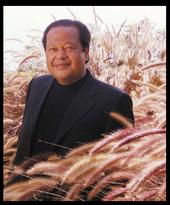
If you've been reading this blog for a while, you've probably noticed that some of the postings describe memorable moments I've had with Maharaji over the years -- interactions that taught me something useful, fascinated me, or further connected me to the joy of life.
If you have received Knowledge, I'm guessing that you've had your own moments with him -- however subtle or dramatic they may have been.
Maybe you've shared these moments and maybe not. If not, I wouldn't be surprised. It's definitely a challenge telling these stories in a way that conveys the power of their meaning to others.
True. But there are moments that can be described -- remembrances that can provide others with a catalyst for exploring the sweetness of the relationship between Maharaji and those who love him.
And so... you are hereby unofficially invited to share one of your own moments with Maharaji for possible publication on this blog. Sound good?
If so, take a few minutes now to review the following guidelines.
SUBMISSION GUIDELINES
1. Write in your own voice -- how you say things.
2. Write for a general audience -- not just people who have received Knowledge.
3. Stay away from words, phrases, or references that would make no sense to the general public.
4. Focus mainly on your story -- less so on your commentary about your story -- though it's fine to include reflections on what your moment with Maharaji meant to you.
5. 1500 word maximum.
6. Be careful not to preach, moralize, or proselytize. Let your story deliver the message.
7. Be conscious of your use of superlatives. Saying that your experience was "incredible" or "amazing" may mean something to you, but it won't necessarily mean anything to the reader. How was it incredible? How was it amazing?
8. Include enough details about the setting of your story to give it dimension. Remember, you're writing a story -- not a treatise, discourse, or sermon.
9. By submitting your story, you are granting me permission to publish it on this blog. If your story is selected for publication, I may end up editing it. If I do, I will send you the edited version for your approval.
Please forward this invitation to anyone you know who may want to submit a "Moments with Maharaji" story for publication on this blog.
Here are some examples of these kinds of stories already on the blog: here and here and there and over there... and this one, too.
Posted by Mitch Ditkoff at 11:59 PM | Comments (0)
July 23, 2008The Ten Commandments for Visiting a New Age Ashram
During the past two decades, a curious phenomenon has swept this nation. Inspired by the teachings of several Master souls from the East, an unusually large number of ashrams and retreats have made their appearance on the scene -- spiritual centers designed to provide seekers of the truth with a focused environment in which to practice their particular spiritual path.
While most people who spend time in these places are extremely dedicated and sincere, there still remains a goodly number who, in their attempt to have "an experience," miss the point completely.
Seduced by the Western notion of cause and effect, they somehow think that spiritual attainment is related to the way they act -- as if God were some kind of transcultural Santa Claus looking for good little boys and girls to bring his shiny red fire trucks to.
Not surprisingly, the spirit of the law is all too often traded for the letter -- a letter that, no matter how many stamps are put on it, is continually returned for insufficient postage. Surrender is replaced by submission; patience by hesitation; and humility by timidity.
Alas, in the name of finding themselves, our God-seeking brothers and sisters have tended to lose the very thing that makes them truly human -- their individuality.
And so, with great respect to your personal God, your Guru, your Guru's Guru, and your favorite tax-deductible charity, I humbly offer you the following soul-saving tips should you decide to visit (or move into) the ashram or spiritual center of your choice. Take what you can, leave the rest, and remember -- it's not whether your shoes are on or off, but if your heart is open.
1. Do Not Change the Way You Walk
Most visitors to a spiritual retreat think they have to change the way they walk if they are truly going to have a meaningful experience. Somehow, they believe there is a direct correlation between the way they move their feet and the amount of "grace" or "blessings" about to enter their lives. The "spiritual walk," is actually a not-too-distant cousin of the "museum walk," the curious way a person slows down and shuffles knowingly, yet humbly, past a Monet (or is it a Manet?), silently getting the essence of the Masterpiece even as they move noddingly towards that incomprehensible cubist piece in the next room.
If you like, think of the spiritual walk as the complete opposite of the on-the-way-to-work-walk or the exiting-a-disco-in-New York walk. Simply put, the spiritual walk is a way of moving that practitioners believe will attract small deer from nearby forests -- deer that will literally walk right up to them and eat from their hand -- more proof to anyone in the general vicinity that they are, in fact, enlightened souls, humble devotees, children of God, or the so-far-unacknowledged successors to their guru's lineage.
Ideally, the spiritual walk should be taken in sandals, though Reeboks or Chinese slippers will do in a pinch. Cowboy boots are definitely out, as are galoshes, high heels, and Chuck Taylor Converse All-Stars.
2. Do Not, Under Any Circumstances, Succumb to the Spiritual Nod
Closely related to the spiritual walk, the spiritual nod is routinely practiced in retreats the world over. And while no one completely comprehends it's divine origins, many believe it began when a blissful brother simply forgot the name of his roommate on his way to the bathroom. Instead of issuing the familiar Sanskrit phrase of the week, our trend-setting friend simply tightened his lips, looked at the ground and... well... nodded. Now, every time you walk by someone at the ashram, you are half-expected to flash them the nod, the non-verbal equivalent of "Hi! I know you know, and you know I know, and you know that I know that you know, and in my knowing, I know that I know you know, and by so knowing, need not speak, since words are finite and cannot express the knowingness which the two of us (being one) share from such a knowful place. Know what I mean?"
3. Do Not Judge Anyone, Including Yourself
This is the hardest of all commandments to obey. Why? Because spiritual environments not only bring out the best in people, they also bring out the worst. And while the worst is often more difficult to detect than the bliss of people wanting you to notice how blissful they are, the higher you get, the easier it is to notice -- that is, if you are looking for it.
Of course, it would be very easy to spend your entire spiritualized retreat noticing all the subtle ego trips going on around you. Resist this temptation with all your might! Do not, I repeat, do not, focus on the stuff that would make good material for this article. You have no right. In fact, you have absolutely no idea why anyone is there, what their motivation is, or how they will learn the kinds of lessons you are absolutely sure they need to learn.
In reality, you are most likely seeing your own projections -- those disowned parts of your self that you've refused to acknowledge all these years: your spiritual groupie, your brownie point collector, your junkie for more experience, your suburban yogi , your guilty seeker of God, your con man, your eunuch, your resolution maker, your ass watcher, your closet fanatic, your glutton for humble pie, your too poetic definer of ecstasy, your flaming bullshit artist, your know-it-all, your have-it-all, your spring-headed bower towards anyone with more than two devotees.
All of them are you! Every single one of them! Don't judge them. Love them! Bring them tea! Rub their feet every chance you get!
4. Do Not Think That This Is the Only Place Where It Is Happening
Spiritual retreatants have a marked propensity to think that the grounds they inhabit are somehow more blessed than any place else on earth -- that they are privy to a special command performance by God, revealing himself in thousands of exotic ways for those lucky enough to be there, while thousands, nay millions, of George Bush-like souls are stumbling around in uncool places recently vacated by the Power of Life so a very cosmic thing can happen here and only here this weekend.
Life, in fact, is often perceived as so good in the "Center," that the rest of the world becomes eerily cast as the "booby prize." Indeed, to new age seekers, everything else is simply referred to as "the world," much like Manhattanites speak of New Jersey. In short, the new age retreat comes to represent all that is good -- about God, about the Guru, about life itself.
Somehow ("and I don't know how, but you could ask anyone who was there this weekend") flowers seem sweeter there, the moon seems fuller, the air seems cleaner. Even the bread tastes better. If you glimpse a shooting star at night, it's the "guru's grace." If you see a double rainbow, it's directly over the meditation hall.
I guess it's all in how you look at it. The same shooting star convincing you that your guru is, in fact, the Supreme Guru, was also seen by a plumber named Leroy who just happened to be drinking a beer in between innings of the Mets game. His conclusion? The Mets were gonna win 20 of the next 25 and bring the pennant home to Flushing!
What do the signs in the sky (or what we perceive as signs) really mean? Isn't the whole world our ashram? Isn't the real issue one of appreciating what is happening all around us? The flowers? The stars? The beggars asking for spare change? Flowers aren't any sweeter on retreat. It's our willingness to breathe deeply and enjoy them that's different. What's stopping us from being in this place right now? What's stopping us from realizing that the very ground beneath our feet is the promised land -- wherever we happen to be at the time.
5. Don't Put a Red Dot on Your Forehead If You Don't Want To
Unless you've been living in a trailer park your whole life, you probably already know what the red dot thing is all about. That's right. The third eye. The sixth chakra. High holiness. INDIA!! While sometimes mistaken for a beauty mark or a random bit of watermelon, the little red dot is actually a useful reminder to focus one's attention on the space between the eyebrows, which, for some people, is where God lives (or if not lives, at least vacations). Nothing wrong with that, now is there?
Still, you have to concede that the third eye isn't the only spot on the human body that's sacred. What about the earlobes? The belly button? The nipples? They come from God, too -- not too mention chakras #1 - 5 and the highly under-represented center of consciousness at the crown of the head. Sacred, every one of them!
Don't you think that, if the body is the temple of the soul, it follows that our entire physical structure is sacred? Shouldn't we be covered from head to toe with little red dots? And if so, why is it that we routinely quarantine people with measles -- the very people who have selflessly chosen to manifest disease just to remind us to honor our body's ultimate holiness?
6. Play With the Children
The only sentient beings free from the collective mentality of spiritual seekers are the children. Children visiting "holy places," in fact, behave the same way the world over no matter what adjectives their elders use for the unspeakable name of God. When they're hungry, they eat. When they're tired, they sleep. They cry when they want to, laugh for no reason, consume ice cream without guilt, and rarely wonder why your picture of the Master is bigger, newer, or better framed.
7. Fart At Your Own Risk
If you fart, and there's no one around to hear it at the ashram, did it happen? And if it did happen, does that mean you've been disrespectful? Is the resident Guru able to hear you? And if he or she is meditating, out of the country, or dead, is their guru or their guru's guru able to hear you? And if so, so what? Will you be reborn as a gerbil? Does the Guru fart? And if it's OK for him or her to pass wind, why not you?
OK, so it's their place and you're a guest. But after all, aren't we all guests here? Even the Guru? Who do they answer to? And if it's not the same one you're answering to, what the hell are you doing getting up at five in the morning and sitting in the lotus position?
Maybe the real question isn't whether or not it's permissible to fart on holy ground, but how you fart. For instance, if you're farting out of a blatant disregard for the Master's teachings or the sincerity of his or her followers, you might want to reconsider where you're coming from. However, if your farting is just a random release of gas, relax! Give yourself the benefit of the doubt. You see, a typical visit to a spiritual center quickens one's ability to "let go" -- so what you call "farting" may, in fact, be a timely sign of your evolving spiritual condition.
8. Do Not Think You Are Higher or Lower Than Anyone Else
One of the favorite pastimes of people visiting a spiritual retreat is comparing themselves to everyone else. "See the guy over there carrying firewood? He's a very old soul -- way older than me. Been on the path for years. And that dude laughing hysterically in the corner? That's Shiva. Oops, he can probably see through me, maybe I better walk around the other way."
Want to save yourself some time? Don't try to figure out how "on the path" anybody else is. It's impossible. Stare into the eyes all you want, watch for tell-tale signs of liberation, but when it comes right down to it, the only conclusion you'll reach will be your own -- one that may have absolutely nothing to do with the anything but your own projections.
Face it, how accurate is your assessment going to be when 99 percent of humanity couldn't tell that the carpenter from Galilee had something special going for him? Indeed, it's not at all unlikely that the beer-bellied, first-time visitor you met this morning at the ashram is, at this very moment, being treated like a spiritual mongoloid by everyone who meets him (repeatedly being asked if "this is your first time") when, in fact, the beer-bellied, first-time visitor is actually the reincarnation of Buddha.
9. Do Not Think That You Are Going to Get Something
Many people visit a a spiritual retreat because they want to get something. They want "clarity" or "contentment," "enlightenment" or "grace," "blessings" or "peace of mind." At the very least, they want their business to improve or their marriage to be saved. Alas, they miss the point completely: If you try to get, you will lose, left only with the sinking feeling of having just bought $300 worth of lottery tickets only to learn that some electrician from Staten Island just won the whole thing.
Look, it's really very simple. You don't go to a spiritual center (or a Big Time Teacher, for that matter) to get. You go to give, to let go -- to relax your grip on the very thing that's been separating you from getting all these years: Your grasping. Your fear. Your well-rehearsed strategy to realize God.
10. Do Not Feel Compelled to Change Your Name
OK, so your name is Joey. Ever since you were knee high to a can of Cheese Whiz, everyone called you Joey -- as in, "Hey, Joey, what's goin' down, bro'?" Yeah, you grew up in Brooklyn, cut school once a week, and dated a chick named Angela with very big boobs. Great. So, here you are at the ashram and ba-bing, you run smack into a bunch of dudes with names like Arjuna, Govinda, Namdev,Shanti, Krishna. "Hey," you think to yourself, "maybe they got something I don't."
Guess what? They do. They have spiritual names given to them by their Guru -- names that make their mothers somewhat close-lipped around the canasta table. And while these names are clearly given with a purpose, the fact of the matter is -- they are irrelevant. Do you think the people in India who have spiritual experiences get their names changed to Eddie, Gino, Stacey, or Shirley ?
Hey, what difference does it make? You are not your name -- even if your namesake was enlightened. It doesn't matter what they call you, when it's time to go, you're gone. The only name worth knowing at that time is God's name -- and that, my friend, no matter how many mantras you've memorized, can never be pronounced.
Posted by Mitch Ditkoff at 12:32 AM | Comments (5)
June 28, 2008A Stroke of Insight
This 20 minute video is extraordinary. It's the story of a brain scientist, Jill Bolte Taylor, who had a severe stroke and, in the process, experienced the true essence of who she was. She makes a compelling case for the choice we all have -- separateness or unity, struggle or peace. Well worth watching. In the words of an old song whose name escapes me at the moment, "You are not your body, you are not your mind..."
Posted by Mitch Ditkoff at 02:46 AM | Comments (1)
June 18, 2008PASSAGES: A Video Retrospective of Maharaji's Message
Billy Fairchild just sent me this link to a fabulous series of eight online videos (repackaged for the internet from the original PASSAGES video produced by Kate McGowan and John McNelly in 2001 to celebrate Maharaji's 30th anniversary in the West). These 9-10 minute videos capture the essence of Maharaji's message, his spiritual roots, and the evolution of the way in which he's communicated his message since arriving in the West in 1971.
Includes engaging interviews with some of the people who were on the scene in the very beginning: Ron Geaves, Joan Apter, Charananand, Glen Whittaker, Peter Lee, Tim Gallwey, John Hampton, and others.
Enjoy!
(And if you haven't had a chance to respond to the recent Heart of the Matter poll click here. Will take you three minutes.
Posted by Mitch Ditkoff at 10:40 AM | Comments (0)
June 03, 2008Broom

Have you ever felt that nothing you do actually matters -- that all your efforts, no matter how selfless, inspired, or persevering are merely finger paintings in the void?
Ultimately, it's not so much what we do, but how we do it. Even if you win an Oscar, how long does that moment of acknowledgment really last? Simply put, we've got to enjoy the ride just as much as the destination.
BROOM
The kitchen is dirty,
There is dust between the floor boards,
The harder I sweep,
the more bristles break off.
Dust flies and settles again.
Coughing,
I have swept up the broom.
Posted by Mitch Ditkoff at 09:51 PM | Comments (0)
The Book I Wanted to Buy My MotherFor many years I wanted to buy a book for my mother -- a book that would explain everything... what I hadn't or couldn't explain since I had been old enough to notice my mother wasn't all that happy and, Lord knows, I wanted my mother to be happy and if not "happy" per se, then at least aware of what it was that made me, her son, happy -- the "thing" that for so many years she thought was a phase I was going through and, even worse, some kind of heartless rejection of her and her way of life.
Yes, I wanted to buy my mother a book that would explain it all -- the whole "New Age thing," the whole "Guru thing," the whole "it's OK that I don't eat your veal parmagiana any more because I'm a vegetarian thing." Somebody must have written it. Somebody must have noticed the market niche of "mothers over 60 who worry why their high performing sons have gone spiritual."
And so, I went looking for this book. Like some people look for God. And though I never found it, I did find some reasonable facsimiles -- cleverly titled books displayed by the check out counter, conceived by marketing geniuses who somehow knew my need -- the need a son has to make his mother smile and nod her head approvingly... the book that would keep my mother company during those long nights when her husband was working late and her children were asleep and there was nothing good on TV. The ultimate self-help book that would remove her worries, her doubts, and her exponentially growing fears of thinking her son had gone off the deep end for "receiving Knowledge" from that young boy from India.
I wanted my mother to know how beautiful life was and how simple it could be to experience that beauty. I wanted her to know there was something timeless within her, something beyond the stress of aging and the clipping of coupons.
Maybe it was selfish of me, but I wanted to buy my mother a book that, like the tooth fairy, would deliver some proof that love was the name of the game... and that (bite your tongue and spit three times) the act of "receiving Knowledge" from Maharaji was as natural and healthy as chicken soup.
Eight years ago my mother died from a four-year bout with emphysema. During my six-day stay with my father after the funeral, I discovered the books I had given her all these past years. Most of them had never been opened. Like some strange mix of Stonehenge rubble, they lay in piles all around... on her night table, on her desk, stuffed behind cookbooks, in the garage. Some, when you opened them, still had that new book crackling sound. All of them had this fortune cookie like quality -- like no matter what page you turned to, some kind of bite sized wisdom was waiting.
I don't think I was sad she didn't read them. Just disappointed. Or maybe it was more like resignation -- the kind teenagers feel when they realize their parents just don't get it.
Looking back, I realize now that no book would have been sufficient to have given my mother. No. I wanted her to have the experience the books were describing, not the description of the experience. As my teacher, Maharaji, has said many times, if you are thirsty, you need water to drink, not the description of water.
Ultimately, that's what Maharaji's offer is all about: helping people find the water -- the naturally occurring well of well-being inside us all. It's something my dear, sweet, canasta playing, veal parmagiana making mother would have definitely appreciated.
Photo by Weeping Willow
Posted by Mitch Ditkoff at 07:53 AM | Comments (1)
June 01, 2008Shameless Self-Promotion

Dear Heart of the Matter reader:
If you are enjoying this blog, chances are good you will also enjoy my new book, Awake at the Wheel.
Part fable, part creative thinking toolbox, the book is a simple way to radically increase your chances of manifesting your most inspired ideas.
Although there are people who will say that "ideas are a dime a dozen," the fact of the matter is: your most inspired ideas are priceless. Indeed, they are often clues that there is something you are here to do.
Maybe it's an idea for a book you want to write. Maybe it's an idea for a business you want to start... or a change you want to make... or a way to serve in a new and exciting way.
Whether your idea is big small or big, it's yours and you cannot get it out of your head.
Why? Because it's trying to get your attention.
You may want to consider honoring this idea, instead of characterizing it as "mind" or "ego" or a bothersome thought distracting you from your "inner life." You may even want to follow the yellow brick road to it's ultimate manifestation.
If you do, Awake at the Wheel can help -- in a fun, entertaining, and useful way.
Intrigued? Then click here to find out more. Want to read what others have said about the book? Then click here. And if you want to read two recent reviews on the web, click here and here.
Oh... if you've already decided you want to buy the book, click here.
"If you do not express your own original ideas, if you do not listen to your own being, you will have betrayed yourself." -- Rollo May
Posted by Mitch Ditkoff at 07:52 AM | Comments (0)
May 15, 2008Jazzman
A couple of nights ago I went to a local concert that featured my friend, the jazz saxophonist, Peter Buettner and his quartet. I had heard Peter play many times before, but never like this. He was soaring, free, transcendental, and plugged into the saxophone Gods that night. After the gig, I saw him in the lobby and told him how awesome he was. Peter smiled and mentioned that he finally figured out a way to go beyond himself and stop analyzing his own playing. In other words, he let go to his natural gifts and just let it rip.
This is the same challenge we all have, no matter what medium we use to express ourselves. When we give up being self-conscious, when we give up worrying about what other people think, the true power and beauty of our art form materializes immediately.
And so, in honor of Peter's breakthrough and the one that's imminent for you, here's a song of praise for all the jazz boppers out there -- the ones who go beyond the boundaries of form and somehow find their way home.
(Please read it aloud for maximum impact...)
JAZZMAN
There's a billion jazz men in my blood, blowing their horns for love. They've been out on the street too long to wonder what the hell is going on -- for in their freedom -- in their utmost respect for recklessness, they know that life is but a high note held above the head of anyone who listens.
Happy to be playing on a night when others less fortunate than them are recovering from day jobs, these jazz boppers restore all integrity to the underground club that is my body here in this nether world of friends and future lovers. I sing with them! I dance! I tap my soul to the beat of their incessant drumming! And though they do not need to look at me, they smile.
What I see I cannot say, nor can this midnight review redeem the essence of what it is these billion molecules of madness in human form demand.
This is the form of God before your eyes! This is the moment of majesty!
Jazz men, jazz men, play your horns and drums, pound those keys so the vague interrupters of eternity can finally get up and dance and forget themselves once and for all.
Jazz men, play yourselves.
Hey you finger drumming soldiers of man's need to stop finding himself, and so stopping, actually find himself to be found. Hey, you street licking bluesmen of the space between day and night, I love your song, your scream for no one in particular.
Posted by Mitch Ditkoff at 11:53 AM | Comments (0)
April 29, 2008Time Out for Love

Ta da! Introducing Jesse (13) and Mimi (11), my two kids.
When Jesse was four, I asked him what he wanted to be when he grew up. "Everything!" he replied, without missing a beat. And then there was the time when Mimi mounted the living room table, raised both hands high overhead and declared, as if kicking off some kind of invisible Olympic ceremony: "Babies... and gentlemen!"
When it snows, they think snow angels. I think shovel.
Thomas Edison had it right: "The greatest invention in the world is the mind of a child."
Posted by Mitch Ditkoff at 07:44 AM | Comments (0)
February 08, 2008Forget About the Box, Get Out of the Cave!
See the caveman to your left? That's Og. He's the protagonist of my new book, Awake at the Wheel: Getting Your Great Ideas Rolling (in an Uphill World). The word "protagonist" is not in Og's vocabulary. Never was, never will be. Even I don't use the word "protagonist" all that much -- though I have used it three times in this paragraph.
Hmmm... That's pretty odd.
Then again, the experience of inventing the wheel was pretty odd, too. Which is what Og did. 24,000 years ago. Long before Game Boy, i-Pod, or Starbucks. And yes, long before the Mesopotamians -- the people who usually get all the credit for the wheel -- some 20,300 years after my main man, Og.
Hey, when was the last time you used the word "Mesopotamian?" That's another word not in Og's vocabulary.
Actually, Og didn't need a big vocabulary. He had something else going for him: Neanderthalic genius. Stone age brilliance. Originality.
Og, you see, was the first innovator. Intrinsically motivated, he was. Fascinated. Inspired. Mojo-driven. And while he was not without imperfections, he needed no attaboys, cash awards, or stock options to follow his muse.
Back in Og's time, when men were men, and stones were stones, even the idea of an idea was unthinkable. And yet... somehow, he had one -- an IDEA, that is -- and not just your dime a dozen variety. Nope. A GREAT idea, a BIG idea, or what I like to call an "out of the cave" idea: The wheel.
Ah... but I go on too long. If Og were here, he'd be frowning by now, shrugging his stooped shoulders, wondering in his delightfully pre-verbal way what other new ideas and discoveries awaited his wonderfully hairy touch.
Want to order the book now? (Og gets 10% of every sale). Go ahead. Help him put bear meat on the table.
Posted by Mitch Ditkoff at 12:29 PM | Comments (0)
February 05, 2008The Big Game
A few weeks ago, I watched the NY Giants beat the Green Bay Packers 23-20 in an NFL championship football game. I watched it with eight friends. As always, we had a fantastic time -- an experience that our wives (no matter how wonderful they may be) have never been able to fathom. Our viewing behavior, to them, is a merely a parody of the American male: two-dimensional, woefully predictable, and absurd.
That assessment, however, was not my experience as I watched the BIG GAME. No way. On the contrary, my experience was noble, ecstatic, tribal, and divine. Beyond the pretzels, popcorn, chips, and beer something else was happening.
At the risk of making a mountain out of a football game, allow me to share a few observations about the experience and, by extension, the experience of millions of men huddled together before the Big Game. In that sacred act of viewing, NOTHING ELSE WAS HAPPENING! Zero. Nada. Zilch. No work. No bills. No back taxes. No car repairs. No war in Iraq. No recession. No primaries. No relationship issues. No cholesterol. No this and no that. Only THE GAME. Pure immersion it was. Spontaneous expression. Presence. Unbridled emotion. Liberated laughter. And the kind of concentration most yogis would gladly trade their third eye for.
What, you may ask, has any of this to do with love, longing, and letting go -- the supposed topic of this supposed blog? Plenty. The state of mind (no, make that state of being), of the BIG GAME-watching, pretzel-munching men noted in the paragraphs above is exactly the state of being required of anyone wanting to have even the slightest chance of experiencing something glorious.
OK. Let's go to the slow motion, video replay of that last sentence: I'm talking focus, friends. I'm talking compelling goal. I'm talking feeling, humor, fun. The experience of uncensored delight. And the realization that anything is possible.
Please don't get me wrong. I'm not talking about the common garden variety trance experience induced by watching TV or a movie. No. I'm talking about the BIG GAME. The "All In" moment. The Full Monte. The No Turning Back. The This Is It. The There's No Tomorrow. And all of it sprinkled with a healthy dose of pepperoni and celebration even before anyone knows the final score.
Yes, I admit, the eight of us didn't deliver anything as a result of watching the BIG GAME -- no output, no product, no proof that we had used our time well. But so what? When you're eating chips and experiencing the Unified Field of Consciousness on the day the Lord rested and time stops as your team huddles in the freezing cold, against all odds, to gather together one more time, focused on the goal and absolutely free of constraint, doubt, and delusion, what is there left to say except:
Giants 23, Packers 20. (And in overtime, yet!)
Posted by Mitch Ditkoff at 10:09 PM | Comments (0)