101 CreativiTeas for Innovators

No matter how many times I tell people there's no such thing as a "magic innovation pill," every one keeps asking.
This just in: I don't have the magic pill. But I DO have something even better -- a virtual potion that has the potential to liberate you from the bothersome obstacles that keep sabotaging your ability to innovate. Simply read the list below, pick the CreativiTea you most need to imbibe, and think about what it would take you to manifest more of this quality in your life these days. Bottoms up!
1. Opening Up to PossibiliTea
2. Easy Going FlexibiliTea
3. Gandhi-like HumiliTea
4. Well-timed AdaptabiliTea
5. Taking Care of Details Amidst InfiniTea
6. Loosey Goosey ManeuverabiliTea
7. Acceptance of MortaliTea
8. Flashes of NonsensicaliTea
9. Beyond MoraliTea
10. An Occasional Dose of RealiTea
11. Following Your Passion With ImpuniTea
12. Balancing PolariTea
13. InterdimensionaliTea
14. Total QualiTea
15. Unfettered CreativiTea
16. Appreciation of DiversiTea
17. Tuning in to SynchroniciTea
18. OriginaliTea
19. UnconventionaliTea
20. Old Fashioned PracticaliTea
21. CuriosiTea
22. Celebration of IndividualiTea
23. A Deeper Sense of InevitabiliTea
24. Letting Go of FutiliTea
25. A Transformed MentaliTea
26. Go With the Flow FluidiTea
27. Baby Oh Baby SensualiTea
28. WhimsicaliTea
29. Child-like SimpliciTea
30. Tiger-like FerociTea
31. Nose to the Grindstone DurabiliTea
32. Let it Rip TheatricaliTea
33. Grrr!! TenaciTea
34. Authentic AuthenticiTea
35. Mucho GenerosiTea
36. Acceptance of AsymmetricaliTea
37. Quick Moving MobiliTea
38. Enlightened SpiritualiTea
39. Day By Day ClariTea
40. Sylvester Stallone MusculariTea
41. In the Moment SpontaneiTea
42. Twelve Step SobrieTea
43. Beethovian VirtuosiTea
44. Wild Maniacal HilariTea
45. Increased CapaciTea
46. ABCDEFGHIJKLMNOPQRSTea
47. Lucid PerspicaciTea
48. Ha Ha Ha LeviTea
49. Focused SingulariTea
50. A Daily Shot of InsaniTea
51. Expressing Your PersonaliTea
52. Frontal NudiTea
53. International CommuniTea
54. Much More VarieTea
55. Information Highway ActiviTea
56. Higher ProductiviTea
57. Que Sera SororiTea
58. Off the Wall BanaliTea
59. Alimentary CanaliTea
60. Relaxed InformaliTea
61. Sprint? Verizon? AT&Tea?
62. Understanding Primal CausaliTea
63. SpecificiTea
64. Huge Amounts of PubliciTea
65. Give Up Feeling ShitTea
66. IntentionaliTea
67. Beyond Beyond MetaphysicaliTea
68. A Bowl of Soup and a BLTea
69. Hip Hop, Reggae MusicaliTea
70. Calling on Your Own DiviniTea
71. A Touch of SubtleTea
72. Profound ProfundiTea
73. Bottom Line ProfitabiliTea
74. Surprise and SerendipiTea
75. Do It Now InstantaneiTea
76. Proven CertifiabiliTea
77. Solid MarketabiliTea
78. Truth, Love and BeauTea
79. ExponentialiTea
80. Let Go and Be EmpTea
81. We Are the World SolidariTea
82. A Twist, A Change, Some NovelTea
83. Getting Down to the Nitty GritTea
84. San Andreas FaulTea
85. Midwestern SinceriTea
86. Transcending Financial ScarciTea
87. Death of CertainTea
88. Buddha and KrishnamurTea
89. You Don't Have to Feel So GuilTea
90. Total ResponsibiliTea
91. Challenge AuthoriTea
92. Anyone here From Joisey CiTea?
93. More and More CredibiliTea
94. Get it Done MasculiniTea
95. Be More Receptive to FemininiTea
96. A Three Month Vacation in TahiTea
97. Get Rich and Become a CelebriTea
98. Much Deserved SereniTea
99. Hot Diggity DoggiTea
100. Tons of PositiviTea
101. If All There Is Is Now, What Is EterniTea?
MitchDitkoff.com
Idea Champions
Posted by Mitch Ditkoff at 12:52 AM | Comments (2)
July 09, 2023Ethan Hawke on Creativity
Posted by Mitch Ditkoff at 09:14 PM | Comments (0)
September 20, 202225 Simple Ways to Free Up Your Innate Creativity

Most people agree that creativity is a good thing. Accordingly, they want to know how they can become more creative. Makes sense, right? The question, however, is a tricky one, not unlike asking "How can I have a good marriage?" or "How can I become a better human being?" There are hundreds of answers and often different strokes for different folks.
Bottom line, there is no blueprint, no follow-the-dots instructions in this realm. But there are some simple principles and guidelines to consider. Below are 25 of them (and all it takes is ONE to get unstuck).

1. Ask yourself WHY you want to become more creative: If you don't know the answer to this question, the rest of the guidelines that follow will be nothing more than fairy dust. What's in it for you? Why make the effort to become more creative?
2. Realize you already ARE creative: Most of us are subject to the myth that only some people are creative. Writers, artists, musicians, and filmmakers get lots of points for being creative, as opposed to accountants, tax auditors, and engineers. Hey folks, everyone is creative. The only thing is that sometimes our creativity gets obscured by years of funky habits, programming, and conditioning. Psychologists tell us that a human being is most creative at the age of five. After that, it's a slow and steady decline into conventionality. What are the characteristics of a five-year old and how can you bring more of those to bear during this time of the Coronavirus?
3. Identify what blocks your creativity: When Michelangelo was asked how he made his iconic statue, The David, he explained, "I simply took away everything that wasn't." To him, the statue was already in the stone. All he needed to do was remove everything in the way. What is blocking your creativity, these days? And what can you do to remove it?
4. Remember a time when you were creative: All of us have had times in our life when our creativity was flowing. The conditions were ripe for us to do our best thinking/creating. What was that time in your life? And what can you do to bring more of these conditions to bear during these odd times?
5. Define what you mean by "creative": If you Google the phrase "Definitions of Creativity", you'll find 53,900,000 entries. "Creativity" means different things to different people. What does it mean to you?
6. Identify a project you want to be creative about: If you don't have a project that inspires you enough to apply your creativity to, your effort to become more creative will be vague, at best. You need to have some skin in the game. What is the project you would most like to infuse with a renewed dose of creativity? (HINT: The best way to do this is to frame your project in the form of a question that begins with the words "How can I?")

7. Immerse: Creative people, no matter what their field, have the ability to dive in and stay with a project for long periods of time. They don't just hit and run. Instead, they become completely absorbed in their effort and it is often their state of absorption that is their secret sauce. That's why Einstein said, "It's not that I'm so smart. It's just that I stay with problems longer." How can, you create the time to immerse in your most inspired project?
8. Reframe failure: Creative people are less afraid of making mistakes than most people. They realize that creativity is a volume business -- that many experiments are needed and that trial and error comes with the territory. When Thomas Edison was asked how it felt to fail 800 times before coming up with tungsten as the filament for the light bulb, his reply said it all: "Fail? I didn't fail once. I learned 800 times, what didn't work." How can you launch more experiments? How can you embrace failure more than you currently do?
9. Go beyond your limiting assumptions: Often, the suppositions that we make at the beginning of a project are completely fictitious, a function of our past experiences and false beliefs. Creative people have a knack for being less bound by limiting assumptions than most people. This state of open-mindedness allows them to proceed in ways that open up new territories to explore. What is your biggest limiting assumption about your most exciting project? What can you do to go over, around, or through this assumptions?
10. Stay inspired and fascinated: I know of very few depressed people who are consistently creative. And while it's true, that creative people can sometimes get depressed, they don't dwell in that state for very long. What are three ways you can stay inspired and fascinated about your hottest, new venture?
11. Ask WHAT IF: Creative people have a unique ability to go beyond the status quo. One way they do that is by asking powerful questions -- questions that challenge the status quo and open up totally new horizons. The simplest question to ask in this regard is "What if?" What aspects of your work, these days, might benefit from asking "what if?"
12. Make connections between seemingly disparate elements: One of the qualities of a creative thinker is the ability to synthesize -- to see new connections between this, that and the other thing. What is MTV? Simply the connection between music and television. Drive-in banking? The connection between cars and banking. The Bloody Mary? Vodka and tomato juice. Most of us are so much "in our boxes" that we too infrequently connect A + B to get C. Tunnel vision has a hold of us. How can you combine two seemingly unrelated variables to create a new product, service or better way of doing business?
13. See through others' eyes: One of the biggest obstacles to creativity is our odd little habit of viewing everything through our own eyes/lenses/filters. Addicted to our own point of view, we tend to be constrained by our habitual ways of perceiving. The simplest way to free yourself from this constraint is to look at your problem, project, or opportunity through the eyes of someone else. What if Willie Nelson was responsible for solving your problem? Stevie Wonder? Rosa Parks? Oprah Winfrey? How would any one of these people go about it? And what clues do you get from their approach?
14. Pay attention to your subconscious: Many brilliant ideas come to people off line, in dreams, or in surprise moments when they're not trying to figure things out. What happen is this: the conscious, problem-solving part of our mind hits a wall and gets stuck. That's when the problem gets turned over to our subconscious mind. That's how Elias Howe's invention of the lock stitch sewing machine happened. That's how Rene Descartes came up with the Scientific Method. And that's what Seymour Cray, the inventor of the Cray Supercomputer, attributed his success to -- the ability to walk away from a problem and let his subconscious mind do the work. Where and when do you get your best ideas away from work?
15. Suspend logic and linearity: Most of us think deeply. We like to problem solve and, more often than not, we are rational beings -- so called "left-brainers." Buut there are times, in the creative process, especially in the beginning, when too much logic gets in the way. We also have a right-brain that needs to be exercised -- the associative, playful, non-rational side of ourselves How can you suspend logic and linearity for a while? In what ways can you allow more time to consider that which is beyond the rational?
16. Trust your instincts, intuition, and hunches: Albert Einstein once said, "Not everything that counts can be counted; and not everything that can be counted, counts." Indeed, he used to conduct what he called thought experiments, a fancy name for daydreaming, whenever he needed a breakthrough. Simply put, he trusted the intuitive part of himself. What is your intuition telling your most creative project? How can you trust this intuitions more than you usually do?

17. Entertain the fantastic: Gary Kasparov, the former Soviet Union Grand Chess Master, had the ability to strategize 26 moves ahead. But when, in 1989, he was asked what enabled him to beat Big Blue, IBM's mainframe computer, in a two game chess match, he attributed his success to "the ability to fantasize" -- to be able to make a quantum leap of thought. Einstein, too, was a big proponent of fantasizing and is famous for having said "the ability to fantasize has meant more to me than my ability to absorb positive knowledge." How can you make more time to dream big these days of the Coronavirus?
18. Collaborate: Some people assume that creativity is the result of a lone wolf genius inhabiting some kind of ivory tower. And while this sometimes happens, it is mostly a myth. Often, creativity is informed by the so-called lone wolf genius being in relationship to people -- i.e. jamming, brainstorming, and getting feedback. This kind of variable input has the potential to spark all kinds of insights and ahas. How can you increase the amount of creative collaboration in your life? Who might you ask to join forces with you this week to develop a new idea or possibility?
19. Have fun: This just in! The words "aha" and "haha" are very much related. In the aha moment, the person with the epiphany gets surprised about a given outcome. He/she becomes dislocated from their normal assumptions, i.e. Archimedes in the bathtub and Newton under the apple tree. The "haha" moment is similar. Indeed, the reason why most of us laugh is because our expectations have been disrupted by the storyteller or comedian. This surprise moment sparks an involuntary reaction called "laughter." Creativity and humor are joined at the hip. Get too serious and too sober and you diminish the odds of creativity flourishing. In what ways can you infuse your life with more humor and playfulness these days?
20. Look for happy accidents: Do you know what penicillin, vulcanized rubber, Post-It Notes have in common? They were all the results of accidents in the lab. They were not planned. They were not the result of a brainstorming session. They showed up unannounced. But instead of being dismissed as a mistake, the innovators associated with these discoveries, got curious. They paid attention. And they played around with this so-called mistake until they discovered its commercial value. Research indicates, in fact, that 75% of all product and service breakthroughs are the results of serendipity, surprise, and happy accidents. What have you been noticing in your life that others may have dismissed as a mistake or failure, when, in fact, it might be the clue you have been looking for?
21. Change environments: Sometimes, the simplest way to spark creativity when you are feeling stuck is to change environments. Socrates knew this. That's why he invented his "Peripatetic School of Education" -- a way to "walk the talk." Indeed, that's why many people get their best ideas during or after exercising. Where can you go, to refresh and renew yourself, whenever you are feeling stuck?
22. Be comfortable with ambiguity: Creating something new is not a function of an algorithm or sequential process. It often requires a lot of time spent not knowing or being confused or not having all the answers. This is why Tom Peters, innovation provocateur, likes to say that "innovation is a messy business." Yup. It is messy. And frustrating. And non-linear. And it often requires some time in the chaos zone. If you are not mindful of this phenomenon, you will likely grab onto the "first right idea" just to diminish your discomfort. In what ways can you stay with ambiguity longer than you usually do when working on a challenging project?
23. Acknowledge your progress: Creating something new is often a frustrating phenomenon. Results don't always come quickly. As a result, we sometimes get discouraged, enter into a cranky mindset, and lose our inspiration. The simplest way to neutralize this phenomenon is to take a few minutes at the end of each day to pause and acknowledge whatever progress you have made that day, no matter how small. Think of a project of yours that has been especially frustrating. What progress have you made on this project recently?
24. Give and receive feedback: Sometimes, creative people are on the right track, but their addiction to "being right" gets in the way. What they need to do, at times like this, is get some simple feedback from their peers -- another point of view. All too often, however, we interpret feedback as "criticism", so we're not open to it. Ouch! In what ways can you get more feedback from someone you trust?
25. Honor the polarities: People aspiring to become more creative, especially those who are time-crunched, would love there to be some kind of blueprint to follow. Guess what? There isn't. It doesn't exist. And even if it did exist, it would include contradictory directions. That's because the act of "being creative" is often a contradictory process. That's why Niels Bohr, the Nobel-prize winning physicist, once said: "Now that we have met with paradox, we have some hope of making progress." To the creative person, their process is not either/or. It's both. Below is a short list of some classic contradictions/paradoxes that creative people experience. Any of them familiar to you?
- Patience/impatience
- Solitude/collaboration
- Urgency/relaxation
- Seriousness/playfulness
- Divergence/convergence
What other contradictions/paradoxes do you experience in your own creative process? What can you do to honor them more than you currently do?
Jump Start Creativity
Idea Champions
MitchDitkoff.com
Posted by Mitch Ditkoff at 01:13 AM | Comments (0)
July 16, 2022Creativity Requires Time
If you want to foster more creativity in your school, business, organization, community, or family, look for ways to give everyone more time. The difference between 10 seconds and 10 minutes can often be the difference between "same old, same old" and WOW.
In what ways can you give your students, teachers, staff, or employees more time to stretch their wings?
Posted by Mitch Ditkoff at 04:38 PM | Comments (0)
September 25, 2021Here Comes the Awakening Creativity Conference
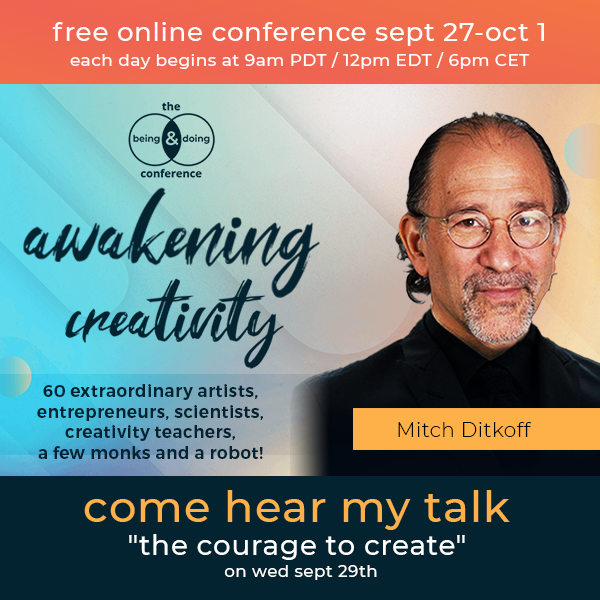
If you reading this, there's a very good chance you are interested in exploring ways to spark innovation and creativity. If so, I invite you to click the link below and register for a FREE 5-day, online conference on AWAKENING CREATIVITY, beginning on Monday, September 27th. I will be one of the featured speakers. My presentation can be viewed all day on Wednesday, September 29th, starting at 12:00 pm EDT. There will be a total of 60 speakers and performers for what promises to be a very dynamic conference.
Posted by Mitch Ditkoff at 10:41 AM | Comments (0)
July 13, 202110 Ways to Help Left Brainers Tap Into Their Creativity

If your job requires you to lead meetings, brainstorming sessions, or problem solving gatherings of any kind, chances are good that most of the people you come in contact with are left-brain dominant: analytical, logical, linear folks with a passion for results and a huge fear that the meeting you are about to lead will end with a rousing chorus of kumbaya.
Not exactly the kind of mindset conducive to breakthrough thinking.
Do not lose heart, oh facilitators of the creative process. Even if you find yourself in a room full of 10,000 left brainers, there are tons of ways to work with this mindset in service to bringing out the very best of the group's collective genius:
1. Diffuse the fear of ambiguity by continually clarifying the process
Most left-brain-dominant people hate open-ended processes and anything that smacks of ambiguity.
Next time you find yourself leading a creative thinking session, make it a point to give participants, early is the session, a mental map of the process you'll be using. Explain that the session will consist of two key elements: divergent thinking and convergent thinking.
In the divergent segment, you'll be helping people consider non-traditional approaches. In the convergent segment, you'll be helping people analyze, evaluate, and select from the multiplicity of ideas they have generated.
If participants are going to get uneasy, it will happen during the divergent segment. Your task? Periodically remind them of where they are in the process. "Here's our objective," you might say. "Here's where we've been. Here's where we are. And here's we're going. Any questions?"
2. Get people talking about AHAS! they've had
No matter how risk averse or analytical people in your sessions may be, it's likely that all of them -- at some time or another -- have had a really great idea.  "Creativity" really isn't all that foreign to them (although they may think it is). All you need to do to get them in touch with that part of themselves is help them recall a moment when they were operating at a high level of creativity.
Get them talking about how it felt, what were the conditions, and what preceded the breakthrough. You'll be amazed at the stories you'll hear and how willing everyone will be, after that, to really stretch out.
3. Transform limiting assumptions
One of the biggest obstacles to creativity is the assumption-making part of our brain -- the part that is forever drawing lines in the sand -- the part that is ruled by the past. Most people are not aware of the assumptions they have -- in the same way that most drivers are not aware of the blind spot in their mirror.
If you want people to be optimally creative, it is imperative that you find a way to help them identify their limiting assumptions about the challenge they are brainstorming. "Awareness cures," explains psychologist Fritz Perls. But DON'T get caught in a lengthy discussion about the collective limiting assumptions of the group. This is often just another way that left-brain dominant participants will default to analyzing and debating.
Instead, lead a process that will help participants identify and explore their limiting assumptions. Then, time allowing, help them transform each of these limiting assumptions into open-ended "How can we?" questions for brainstorming.
4. Encourage idea fluency
Dr. Linus Pauling, one of the most influential chemists of the 20th century, was once asked, "How do you get a good idea?" His response? "The best way to get a good idea is to get lots of ideas and throw the bad ones away."
That's why "Go for a quantity of ideas" is the first rule of brainstorming. You want to encourage people, early and often, to go for quantity. This will short circuit participants' perfectionistic, self-censoring tendencies -- two behaviors that are certain death to creativity.
5. Invite humor
The right use of is a great way to help people tap into their right brains. Indeed, "haha" and "aha" are closely related. Both are the result of surprise or discontinuity. You laugh when your expectations are confronted in a delightful way.
Please note, however, that your use of humor must not be demeaning to anyone in the room. Freud explained that every "joke" has a victim and is used by the teller to gain advantage over the victim -- a way to affirm power. And when a group finds itself in the realm of power (and the yielding of power), it will undoubtedly end up in left brain territory.
You don't want to feed that beast.
Instead, set the tone by telling a victimless joke or two, or by your own self-deprecating humor. But even more important than "joke telling" is to allow and encourage a free flowing sense of playfulness.

6. Do the right brain/ left brain two-step
Brainstorming for 3, 4 or 5 hours in a row is unusually exhausting, resulting in the "diminishing returns" syndrome. Creative thinking, like life itself, follows natural laws. Day is followed by night, winter by spring, inbreath by outbreath.
That's why the design of your creative thinking session needs to alternate between the cerebral and the kinesthetic -- between brainstorming and some kind of hands-on, experiential activity. By doing this two-step, participants will stay refreshed and engaged.
7. Periodically mention that chaos precedes creative breakthroughs
Left-brained, logical people are rarely comfortable with ambiguity, chaos and the unknown. It seems messy. Disorganized. Downright unprofessional. Indeed, much of the Six Sigma work being done in corporations these days is to reduce variability and increase predictability.
Paradox alert!
If you want to get really creative, you will need to increase variability and help participants get more "out of control." Picasso said it best, "The act of creation is first of all an act of destruction." Tom Peters said it second best, "Innovation is a messy business."
So, when you sense that your session is filled with ambiguity-phobic people, remember to mention how it's normal for ambiguity to precede a creative breakthrough. You may even want to mention how you will be purposefully infusing the session with moments of ambiguity, just to prime the creative pump.
8. Establish criteria for evaluation
The reason why ideas are usually considered a dime a dozen is because most people are unclear about their process for identifying the priceless ones. That's why a lot of brainstorming sessions are frustrating. Tons of possibilities are generated, but there is no clear path for winnowing and choosing.
Let's assume, for example, that the session you facilitate generates 100 powerful, new ideas. Do you have a process for helping participants pare the 100 down to a manageable few? If not, you need one. Ideally, the criteria for selecting ideas will be clarified before the session and introduced to participants early in the session.
Please note that there is some debate amongst brainstorm mavens as to when to offer the criteria. Some say this should happen at the beginning of the session (to help assuage the left brain need for logic and boundaries). Others suggest delaying the identification of criteria until just before the idea evaluation process. Either way will work. Your call.
9. Be a referee when you have to
No matter how many ground rules you mention about "suspending judgment" or "delaying evaluation," you are going to have some heavy hitters in the room just waiting for a moment to doubt your approach or "the process."
Indeed, one of the favorite (often unconscious) strategies of some left-brainers is to debate and question the facilitator every step of the way. While you want to honor their concerns and right to speak their truth, you also want to hold the bar high for the intention behind the brainstorming session -- and that is to challenge the status quo, entertain the new, and create space for imaginations to roam.
Don't be afraid to be firm with participants who want to control the session. At the very least, ask them to suspend their need for "convergence" (i.e. evaluation, judgment, decision making) to the end of the session when there will be plenty of time to exercise that very important muscle.
10. Consult with the tough people on the breaks
Every once in a while, a really opinionated person shows up in a session -- someone who is probably very smart, competent, experienced, with a big BS detector, and just enough arrogance to make you feel uncomfortable. These people can really affect the group, especially if they hold positions of power in the organization.
In the best of all worlds, these people would always be on your side. They won't be. Be careful about playing to these people in a neurotic attempt to get their approval. You won't get it. But DO seek them out on breaks and engage them. Get them talking. Pay attention. See if you can pick up any useful feedback or clues about revising your agenda or approach.
Even though you wouldn't choose to be trapped on a desert island with them, these folks may turn out to be a huge blessing -- because they are carriers of a particular sensibility that needs to be honored. More than likely, some of the other people in the room are feeling the same thing, but have been too polite to show their true colors. So, don't be afraid of these people. They can be a very valuable resource.
Idea Champions
Brainstorming for left-brainers
Right-brain teaching stories
Posted by Mitch Ditkoff at 10:43 PM | Comments (3)
January 11, 2021Eight Ways to Create Flow
Here's a very useful article by Mihaly Csikszentmihalyi -- the author of Flow on what it takes to cultivate flow -- sometimes referred to as "the zone"
Posted by Mitch Ditkoff at 06:46 PM | Comments (0)
July 09, 2020The DNA of Idea Champions Workshops and Trainings

Most people think that the ability to be innovative is a mystical state available only to the chosen few.
The effort, they imagine, takes a lot of time and hard work. And since they don't have time and don't like hard work, they reason that innovation just isn't in the cards for them.
But innovation is not a mystical state. It's a natural state -- a human birthright. The people in your organization, in fact, already are innovative. The only thing is: their natural ability to be innovative is being obscured by their own habits of mind and a variety of bothersome organizational constraints.

Their challenge is the same one as seeing the "hidden" arrow in the FedEx logo (look between the "E" and the "X").The arrow has always been there, but most people never notice it.
This is the work of Idea Champions. We help people see what they already have, but don't know how to access.
We help people make meaningful adjustments of vision, insight, and perception so they can acknowledge, embrace, and apply their innate ability to be more creative on the job -- and, for those clients who want to reinvent their "innovation process", we help them figure it out.
What follows is a brief summary of how we do this...
1. Know Thy Customer:
Long before we ever get into a room with participants, we do our due diligence -- learning about WHO we are serving, WHAT they expect, and HOW our time with them will be the most significant.
Sometimes this takes the form of phone interviews. Or online polls. Or studying key documents our clients send us in order to understand their current reality, industry, business challenges, organizational constraints, and hoped for outcomes.
2. Customization:
Based on our assessment of our client's needs, we put together a game plan to get the job done. Towards this end, we draw on more than 100 "innovation-sparking" modules we've been developing since 1986.
3. Co-Creation:
Early in the design process, we invite our clients to give us feedback about our approach. Their feedback stirs the creative soup and provides us with the input needed to transform a good session design into a great one.
4. Spacing In:
We make a great deal of effort to ensure that the space in which our sessions take place are as ideal as possible. Form may follow function, but function also follows form.
When participants walk into an Idea Champions session, they begin "mind shifting" even before the session begins. It is both our belief and experience that culture/environment is a huge X factor for creativity and innovation.
5. Drive Fear Out of the Workplace:
W. Edwards Deming, one of America's most revered management consultants, was a big proponent of removing fear from the workplace. So are we. Towards that end, each of our sessions begins with a norm-setting process that makes it easy for participants to establish a dynamic culture of innovation for the day.

6. Mindset:
Organizations don't innovate, people do. But not just any "people." No. People who are energized, curious, confident, fascinated, creative, focused, adaptive, collaborative, and committed.
People who emerge from our sessions are significantly more in touch with these "innovation qualities" than when they began. Their minds have changed. They see opportunities when, previously, all they saw were problems.
They let go of perfectionism, old paradigms, and habitual ways of thinking. In their place? Open-mindedness, listening, idea generation, original thinking, full engagement, and the kind of commitment that drives meaningful change.
7. Balancing Polarities:
Human beings, by nature, are dualistic, (i.e. "us" vs. "them," "short-term" vs. "long-term," "incremental" vs. "breakthrough," "left brain" vs. "right brain".)
The contradictions that show up in a corporate environment (or workshop) can either be innovation depleters or innovation catalysts. It all depends how these seeming conflicting territories are navigated. Idea Champions is committed to whole-brain thinking -- not just right brain or left brain thinking.
Our work with organizations has shown us that one of the pre-conditions for innovation is a company's ability to strike the balance between these polarities.
Each workshop we lead and each consulting engagement we commit to is guided by our understanding of how to help our clients find the healthy balance between the above-noted polarities.
8. Expert Facilitation: "A rock pile ceases to be a rock pile when someone contemplates it with the idea of a cathedral in mind," wrote St. Exupery.
This, quite simply, is what Idea Champions does. But we do far more than just contemplate. We also architect and build.
Since 1986, we've been facilitating innovation-sparking engagements for a wide variety of industries. We have mastered the art and science of turning lead (or leaders) into gold. And we can train your people to do the same thing we do.
9. Experiential Challenges: "What I hear, I forget. What I see, I remember. What I do, I understand."
So said the great Chinese sage, Confucius. This 14-word quote describes the essence of our work. Simply put, we get people off their "ifs, ands or buts," and into the experience of what's possible.
While we value theory, research, models, data, best practices, business cases, and most of the other flora and fauna of business life, we've come to understand that the challenge of sparking insight, breakthrough, and change, is best accomplished by doing -- not talking.
That's why all of our sessions include experiential challenges that provide participants with visible ways of seeing innovation in action -- what supports it and what obscures it.
10. Emergent Design: Awakening the creativity of an organization's workforce is not a follow-the-dots exercise.
Although all of our interventions begin with carefully crafted project plans and agendas, our facilitators are fluent in the art and science of making the kind of real-time adjustments, refinements, and improvisations that are the difference between a good session and a great session.
Facilitators who attempt to imitate our approach find it difficult to succeed without first learning how to master the art of emergent design. The good news is that it can be learned -- and this is just one of the things we teach in our Train the Trainer programs.
11. Edutainment: Idea Champions sessions are a hybrid of two elements: education and entertainment. We know that when participants are enjoying themselves their chances of learning increase exponentially.
That's why we make all of our sessions a hybrid of education and entertainment. Participants do not get tired. They do not get bored. They do not sneak long looks at their smart phones.
12. Full Engagement: Idea Champions sessions are highly participatory. Our facilitators are skilled at teasing out the brilliance of participants, regardless of their social style, job title, or astrological sign.
But perhaps more importantly, our facilitators know how to help participants tease out each others' brilliance. Eventually, everyone gets into the act. The shy people take center stage and the power players take a back seat. The collective wisdom in the room gets a much-needed chance to be accessed and expressed.
13. Convergence: Idea Champions is successful because what we do works. And one of the reasons WHY it works is because our sessions help participants translate ideas into action.
Ideas are powerful, but they are still only the fuzzy front end of the innovation process. Ultimately, they need to turn into results. Creativity needs to be commercialized. Our workshops, trainings, and consulting interventions help our clients do exactly that.
14. Tools, Techniques, and Takeaways: Ideas Champions closes the gap between rhetoric and reality. We don't just talk about innovation or teach about it -- we spark the experience of it. And we do that in very practical ways.
One way is by teaching people how to use specific, mind-opening techniques to access their innate creativity. Another way is by providing our clients with a variety of innovation-sparking guidelines, processes, and materials that can be immediately used on the job.
Idea Champions
Creating a Culture of Innovation
Storytelling at Work
Brainstorm Facilitation Training
What our clients say
Posted by Mitch Ditkoff at 04:06 PM | Comments (1)
March 16, 2019The Good Thing About Bad Ideas

One of the inevitable things you will hear at a brainstorming session is "there are no bad ideas." Not true. There are plenty of bad ideas. Nazism, for instance. Arena football. Bow ties.
What well-meaning "keep hope alive" brainstorming lovers really mean is this: Even bad ideas can lead to good ideas if the idea originators are committed enough to extract the meaning from the "bad".
Do you think that War and Peace was written in one sitting? No way. There were plenty of earlier drafts that were horrid, but eventually led to the final outcome.
The key? Finding the value in what seems to be a "bad idea" and then using that extracted value as a clue or catalyst for further exploration. The following technique, excerpted from Awake at the Wheel, shows you how...
HOW IT WORKS:

1. Identify a challenge worth brainstorming.
2. Conjure up a bad idea in response to it.
3. Tell someone about your bad idea.
4. Ask the other person to express something redeemable about your bad idea -- an aspect of it that has merit.
5. Using this redeemable essence as a clue, brainstorm some new possibilities
Idea Champions
Brainstorm Champions
Brainstorm now, online!
Posted by Mitch Ditkoff at 06:59 AM | Comments (0)
November 25, 2018Give the Gift of Creativity This Holiday Season

With Christmas, Hanukkah, and Kwanzaa fast approaching, I'd like to take this blogospheric moment to be the bearer of some good tidings -- especially if you are wondering what to get your significant other, friends, family, co-workers, boss, teammates, neighbors, clients, customers, or chiropractor.
Idea Champions (that's us) has just opened its online store and is happy to announce that we are offering a wide variety of mind-opening products to spark creativity, innovation, collaboration, storytelling, and reflection.
Click here to see what your choices are. Prices range from $9.95 - $129.00. NOTE: We will be donating 10% of all profits, this holiday season, to our favorite humanitarian charity, TPRF.
Our team
Our values
Our clients
Our blog
A holiday story about giving
Photo: Tim Mossholder
Posted by Mitch Ditkoff at 01:13 PM | Comments (0)
November 24, 2018Unlock Human Creativity
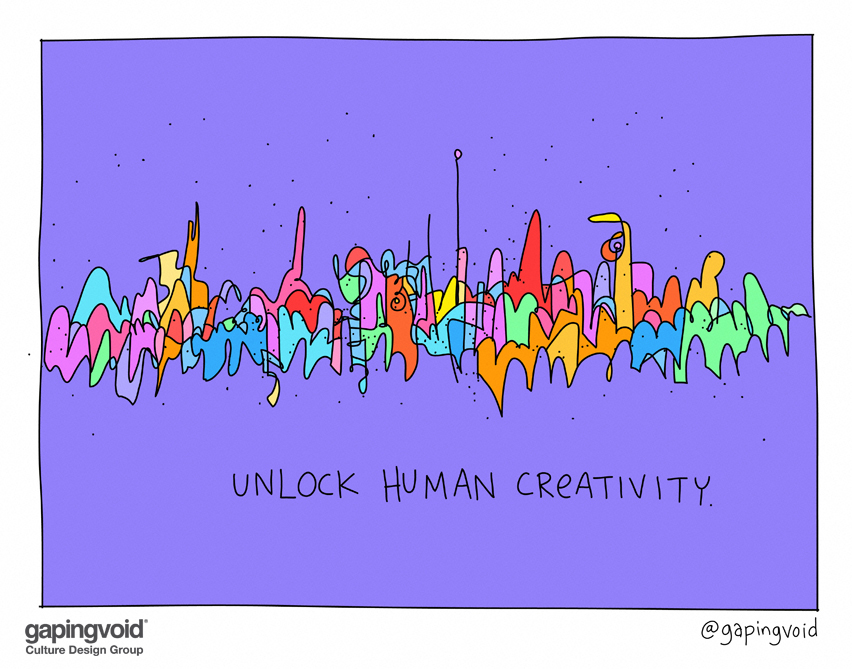
Illustration: gaping void
That's what we do
Idea Champions
Posted by Mitch Ditkoff at 09:27 PM | Comments (0)
August 20, 2018Hiding in Plain Sight?
Big thanks to Scott Cronin for the heads up
More about the power of context
Storytelling for the Revolution
Posted by Mitch Ditkoff at 08:08 PM | Comments (0)
July 09, 2018The Only Risk is Not to Risk



50 quotes on risktaking
Idea Champions
MitchDitkoff.com
Posted by Mitch Ditkoff at 07:16 PM | Comments (0)
June 07, 2018100 Simple Ways to Be More Creative on the Job

1. Ask the most creative people at work for their ideas.
2. Brainstorm with a co-worker.
3. Tape record your ideas on your commute to and from work.
4. Present your challenge to a child.
5. Take your team off-site for a day.
6. Listen to your inner muse.
7. Play music in your office.
8. Go for a daily brainstorming walk.
9. Ask someone to collaborate with you on your favorite project.
10. Exercise during your lunch break.
11. Turn on a radio at random times and listen for a message.
12. Invite your customers to brainstorming sessions.
13. Think of new ways to define your challenge.
14. Remember your dreams.
15. Reward yourself for small successes.
16. Introduce odd catalysts into your daily routine.
17. Get out of the office more regularly.
18. Give yourself an unreasonable deadline.
19. Take more naps.
20. Jot down as many ideas as possible in five minutes
21. Work in cafes.
22. Transform your assumptions into "How can I?" questions.
23. Conjure up a meaningful goal that inspires you.
24. Redesign your office.
25. Take regular daydreaming breaks.
26. Dissolve turf boundaries.
27. Initiate cross-functional brainstorming sessions.
28. Arrive earlier to the office than anyone else.
29. Turn a conference room into an upbeat think tank room.
30. Read odd books that have nothing to do with your work.
31. Block off time on your calendar for creative thinking.
32. Take a shower in the middle of the day.
33. Keep an idea notebook at your desk.
34. Decorate your office with inspiring quotes and images.
35. Create a headline of the future and the story behind it.
36. Choose to be more creative.
37. Recall a time in your life when you were very creative.
38. Wander around a bookstore while thinking about your challenge.
39. Trust your instincts more.
40. Immerse yourself in your most exciting project.
41. Open a magazine and free associate off of a word or image.
42. Write down your ideas when you first wake up in the morning.
43. Ask yourself what the simplest solution is.
44. Get fast feedback from people you trust.
45. Conduct more experiments.
45. Ask yourself what the market wants or needs.
46. Ask "What's the worst thing that could happen if I fail?"
47. Pilot your idea, even if it's not ready.
48. Work "in the cracks" -- small bursts of creative energy.
49. Incubate (sleep on it).
50. Test existing boundaries -- and then test them again.
51. Schedule time with the smartest people at work.
52. Visit your customers more frequently.
53. Benchmark your competitors -- then adapt their successes.
54. Enroll your boss or peers into your most fascinating project.
55. Imagine you already know the answer. What would it be?
56. Create ground rules with your team that foster new thinking.
57. Ask stupid questions. Then ask some more.
58. Challenge everything you do.
59. Give yourself a deadline -- and stick to it.
60. Look for three alternatives to every solution you originate.
61. Write your ideas in a notebook and review them regularly.
62. Make connections between seemingly disconnected things.
63. Use creative thinking techniques.
64. Play with the Free the Genie cards.
65 Use similes and metaphors when describing your ideas.
66. Have more fun. Be sillier than usual.
67. Ask "How can I accomplish my goal in half the time?"
68. Take a break when you are stuck on a problem.
69. Think how your biggest hero might approach your challenge.
70. Declare Friday afternoons a "no-email zone."
71. Ask three people how they would improve your idea.
72. Create a wall of images that inspires you.
73. Do more of what already helps you be creative off the job.
74. Laugh more, worry less.
75. Remember your dreams -- then write them down.
76. Ask impossible questions.
77. Eliminate all unnecessary bureaucracy and admin tasks.
78. Create a compelling vision of what you want to accomplish.
79. Work on hottest project every day, even if only 5 minutes.
80. Do whatever is necessary to create a sense of urgency.
81. Go for a walk anytime you're stuck.
82. Meditate or do relaxation exercises.
83. Take more breaks.
84. Go out for lunch with your team more often.
85. Eat lunch with a different person each day.
86. Ask for forgiveness, not permission.
87. Invite an outside facilitator to lead a brainstorming session.
88. Take more risks outside of the office (i.e. surf, ski, box etc.)
89. Ask for help when you need it.
90. Know that it is possible to make a difference.
91. Find a mentor.
92. Acknowledge all your successes at the end of each day.
93. Create an "idea piggy bank" and make deposits daily.
94. Have shorter meetings.
95. Try the techniques in Awake at the Wheel
96. Don't listen to or watch the news for 24 hours.
97. Make drawings of your ideas.
98. Bring your project or challenge to mind before going to bed.
99. Divide your idea into component parts. Then rethink each part.
100. Post this list near your desk and read it daily.
Illustration: Unsplash
Idea Champions
Posted by Mitch Ditkoff at 01:16 AM | Comments (9)
April 01, 2018The 10 Personas of an Effective Brainstorm Facilitator

Allow me to make a wild guess. You have participated in more than a few brainstorm sessions in your life. Yes?
And allow me to make another wild guess. Many of those sessions left you feeling underwhelmed, over-caffeinated, disappointed, disengaged, and doubtful that much of ANYTHING was ever going to happen as a result of your participation. Yes, again? I thought so.
There's a ton of reasons why most brainstorming sessions under-deliver, but the main reason -- the Mount Olympus of reasons (drum roll, please....) is the brainstorm facilitator. Armed with a short list of ground rules, a flipchart marker, and a muffin, most brainstorm facilitators miss the mark completely.
The reason has less to do with their process, tools, and techniques than it does with their inability to adapt to what's happening, real-time, in the room. In an all-too-professional attempt to be one-pointed, they end up being one-dimensional, missing out on a host of in-the-moment opportunities to spark the ever-mutating, collective genius of the group.
If only our well-intentioned brainstorm facilitators could abide by the words of Walt Whitman, when he confessed that he "contained multitudes."
Translation? If you or anyone you know is going to lead a diverse group of time-crunched, opinionated, multi-tracking, people through a process of originating breakthrough ideas, DON'T BE A ONE TRICK PONY! Be a multitude -- or, at the very least, be multi-faceted. Let it rip. Hang ten. Pull out the stops.
Use your right brain and your left. Let all the cats out of the proverbial bag -- and by so doing, exponentially increase your chances of sparking brainpower, brilliance, and beyond-the-obvious ideas.
OK. Enough bloggy pep talk. Let's get down to business. Take a few minutes now to rate yourself, on a scale of 1-10, for how skillful you are at embodying the following personas of a high flying brainstorm facilitator. Then tune into your biggest strength and ask yourself how you can amplify that quality. Then identify your biggest weakness and figure out how you can improve in that arena.

1.CONDUCTOR
A skilled brainstorm facilitator knows how to orchestrate powerfully creative output from a seemingly dissonant group of people. In the conductor mode, the facilitator includes everyone, evokes even the subtlest contributions from the least experienced participant, and demonstrates their commitment to the whole by offering timely feedback to anyone who "gets lost in their own song."
2.ALCHEMIST
A good brainstorm facilitator is able to transmute lead into gold -- or in modern terms -- knows how to help people "get the lead out." This talent requires an element of wizardry -- the ability to see without looking, feel without touching, and intuitively know that within each brainstormer lives a hidden genius just waiting to get out.
3.DANCER
Light on their feet, brainstorm facilitators move gracefully through the process of sparking new ideas. Able to go from the cha-cha to the polka to the whirling dervish spinning of a brainstorm group on fire, savvy facilitators take bold steps when necessary, even when there is no visible ground underfoot. "The path is made by walking on it," is their motto.
4. MAD SCIENTIST
Skillful brainstorm facilitators are bold experimenters, often taking on the crazed (but grandfatherly) look of an Einstein in heat. While respecting the realm of logic and the rational (the ground upon which most scientists build their homes), the enlightened facilitator is willing to throw it all out the window in the hope of triggering a "happy accident" or a quantum leap of thought. Indeed, it is often these discontinuous non-linear moments that produce the kind of breakthroughs that logic can only describe, never elicit itself.

5.DIAMOND CUTTER
Fully recognizing the precious gem of the human imagination (as well as the delicacy required to set it free), the high octave brainstorm facilitator is a craftsman (or craftswoman) par excellence -- focused, precise, and dedicated. Able to get to the heart of the matter in a single stroke without leaving anything or anyone damaged in the process.
6. ACTOR
Brainstorm facilitators are "on stage" whether they like it or not. All eyes are upon them, as well as all the potential critical reviews humanly possible. More often than not, the facilitator's "audience" will only be moved to act (perchance to dream) if they believe the facilitator is completely into his or her role. If the audience does not suspend this kind of disbelief, the play will close early and everyone will be praying for a fire drill or wishing they were back home eating a grilled cheese sandwich.
7.ENVIRONMENTALIST
Brainstorm facilitators are the original recyclers. In their relentless pursuit of possibility, they look for value in places other people see as useless. To the facilitator in full mojo mode, "bad ideas" aren't always bad, only curious indicators that something of untapped value is lurking nearby.
8. OFFICER OF THE LAW
One of the brainstorm facilitator's most important jobs is to enforce "law and order" once the group gets roaring down the open highway of the imagination. This is a fine art -- for in this territory speeding is encouraged, as is running red lights, jaywalking, and occasionally breaking and entering. Just as thieves have their code of honor, however, so too should brainstormers. Indeed, it is the facilitator's task to keep this code intact -- a task made infinitely easier by the ritual declaration of ground rules at the start of a session.''
9.SERVANT
Some brainstorm facilitators, intoxicated by the group energy and their own newly stimulated imagination, use their position as a way to foist their ideas on others -- or worse, manipulate the group into their way of thinking. Oops! Ouch! Aargh! Brainstorm facilitating is a service, not a personal platform. It is supposed to be a selfless act that enables others to arrive at their own solutions, no matter how different they may be from the facilitator's.
10. STAND-UP COMIC
Humor is one of the brainstorm facilitator's most important tools. It dissolves boundaries, activates the right brain, helps participants get unstuck, and shifts perspective just enough to help everyone open their eyes to new ways of seeing. Trained facilitators are always on the lookout for humorous responses. They know that humor often signals some of the most promising ideas, and that giggles, guffaws, and laughable side-talk frequently indicate a rich vein of possibility to explore. Humor also makes the facilitator much more "likable" which makes the group they are facilitating more amenable to their direction. Ever wonder why the words "Aha!" and "Ha-Ha" are so similar?
The book from which the article was excerpted
Idea Champions
Our clients
What they say
Our brainstorm training
Posted by Mitch Ditkoff at 12:11 AM | Comments (0)
March 23, 2018DO SCHOOLS KILL CREATIVITY?
Posted by Mitch Ditkoff at 12:29 AM | Comments (0)
January 15, 2018The Creative Personality

Here's an informative and inspiring article on the creative personality by the lifelong creativity researcher, renowned author of Flow (and the man with the hardest last name to pronounce in the world) -- Mihaly Csikzentmihalyi.
The aforementioned Professor C. offers deep insights into the complex and often polarized personality of creative people. Recognize yourself in any of his descriptions?
Awake at the Wheel
The Creative Mind Keynote
Illustration
Posted by Mitch Ditkoff at 03:42 PM | Comments (0)
December 06, 2017Why AHA and HAHA Are So Related

I don't think it's an accident that "aha" and "haha" are both almost spelled the same way. Indeed, there is a deep relationship between the Eureka moment and humor -- which is one of the reasons why Isaac Asimov once said "The most exciting phrase in science is not 'Eureka', but 'That's funny!'" And why? Because when something strikes you as funny it is often an indication that your assumptions are being challenged, as in what you were expecting to see was nothing more than a false conclusion cobbled together by the habitual ways in which you interpret the "data."
When a person has a Eureka moment (i.e. Archimedes in the bathtub, Newton under the apple tree), he or she experiences something that surprises them -- something beyond their logic and expectations. In a word, they are "dislocated" from their normal reality and it is this dislocation that sparks a new kind of perception.

It's the same with humor. When a person laughs upon hearing a story or a joke, it is usually because the storyteller or comedian, "dislocates" the listener. The listener is "set up" so to speak, lulled into believing the story or joke is going in one direction, only to have the logic of what they are listening to veer off in another direction. This unexpected moment of surprise often results in an involuntary reaction called "laughter." Indeed, it is the unexpected left turn or right turn that the storyteller makes -- via a well-told punchline -- that triggers a great release of laughter in the listener.
Bottom line, the AHA moment and the HAHA moment are both powered by the same phenomenon -- an unexpected turn of events... a surprise... a dislocation... and a sudden perceptual shift that opens the mind to new ways of seeing and feeling.
If you want to see your team, department, or organization be more innovative, consider bringing more humor into the workplace -- more opportunities for people to play with possibilities instead of being stuck in the "nose to the grindstone" position -- which, by the way, may give the appearance that people are working when, in fact, they are merely surviving. People who are laughing on the job are not necessarily slackers or goofballs. They may, in fact be out-of-the-box thinkers on the brink of a breakthrough.
A CEO, an ice skater, and proctologist walk into a bar...
Idea Champions
MitchDitkoff.com
What's funny about Ravel's Bolero
Posted by Mitch Ditkoff at 06:46 PM | Comments (0)
November 02, 2017The Best Definition of Creativity?

If you google the phrase definitions of creativity, guess how many definitions show up? 135 million! That's right, 135 million. And so, if you are looking for THE definition, give up now. You won't find it. It doesn't exist. What does exist is mucho people's attempts to define creativity -- definitions, by the way, that are influenced by their particular world view, expertise, profession, assumptions, mindset, nationality, and language skills.
That being said, it is still a useful exercise to zero in on a definition that floats your boat -- especially if you are charged with the responsibility of helping your team, department, organization, or own lone-wolf self become more creative.
Towards that end, what follows are 15 definitions I have curated on your behalf. Some are culled from the work of people whose names you will recognize. Some are from complete unknowns. It doesn't matter in the least. What matters is your willingness to think more deeply than usual about this fascinating topic and that you find (or create) a working definition for yourself to get the party started. Ready?
Dictionary.com: "The ability to transcend traditional ideas, rules, patterns, and relationships."
Rollo May: The process of bringing something new into being -- something that brings to our awareness what was previously hidden and points to new life."
Maria Popova: "The ability to connect the seemingly unconnected."
Roger van Oech: "Imagining familiar things in a new light. Digging below the surface to find previously undetected patterns and find new connections between unrelated phenomena."
Daniel Pink: "Giving the world something it didn't know it needed."
Elizabeth Gilbert: "The strange partnership between a human being's labor and the mystery of inspiration."
Henry Miller: "The occurrence of a composition which is both new and valuable."
Carl Rogers: "The emergence of a novel, relational product growing out of the uniqueness of the individual."
Mihaly Csikszentmhalyi: "An idea, act, or product which changes an existing domain or transforms an existing domain in a new way."
Bernadette: Jiwa: "Tapping into your soul and your intuition and allowing them to guide you what to make."
Michael Grybko: "An idea that is novel, good, and useful. Making connections between different ideas to solve a new problem."
Danny Sullivan: "Building universes out of nothing."
David Merman Scott: Seeing patterns that others don't and effectively communicating them.
Scott Godin: "This might not work."
God: "Let there be light."
The commonalities above? Bringing something new into existence. Transcending existing norms. Going beyond the status quo. Making new connections. Seeing unseen patterns. Tapping into inspiration and intuition. Using your imagination in fresh ways. Adding value to the lives of others.
For the moment, think of creativity as a two-sided coin. One side of the coin is all about the WHAT -- as in the product, service, or deliverable you are birthing. The other side of the coin is all about the HOW -- as in what you need to do in order to birth something new and brilliant in the world.
25 awesome quotes on creativity
Idea Champions
Posted by Mitch Ditkoff at 06:11 PM | Comments (0)
May 04, 2017Need a Breakthough? Unplug for a Moment. Take a Break!

True innovators rarely follow the straight and narrow path. Not only do they march to a different drummer, they're often not even on the same playing field as most people. Take Seymour Cray, for example, the legendary designer of high-speed computers.
According to John Rollwagen, ex-chairman of Cray research, Seymour used to divide his time between building the next generation super computer and digging an underground tunnel below his Chippewa Falls house.
Cray's explanation of his tunnel digging behavior is consistent with the stories of many other creatives -- inner-directed, boundary-pushing people who understand the need to go off-line whenever they get stuck.
Bottom line, whenever they find themselves struggling with a thorny problem, they walk away from it for a while. They know, from years of practical experience, that more (i.e. obsession, analysis, effort) is often less (i.e ideas, solutions, results).
Explained Cray, "I work for three hours and then get stumped. So I quit and go to work in the tunnel. It takes me an hour or so to dig four inches and put in the boards. You see, I'm up in the Wisconsin woods, and there are elves in the woods. So when they see me leave, they come back into my office and solve all the problems I'm having. Then I go up (to my lab) and work some more."
Explained Rollwagen, "The real work happens when Seymour is in the tunnel."
We help people dig their tunnel
And sometimes we do this via storytelling (like the one above)
MitchDitkoff.com
Posted by Mitch Ditkoff at 09:55 PM | Comments (0)
April 26, 2017Creativity Late in Life
Lots of people, over 50, think it's "too late" for them to be creative. Not true! You want proof? Check out the slide show above -- excerpts from a fabulous book by Gene Cohen: The Creative Age
Posted by Mitch Ditkoff at 01:39 PM | Comments (1)
April 16, 201714 Ways to Get Breakthrough Ideas

There's a lot of talk these days about the importance of innovation. All CEOs worth their low salt lunch want it. And they want it, of course, now.
What sparks innovation? People. What sparks people? Inspired ideas that meet a need, whether expressed or unexpressed -- ideas with enough mojo to rally sustained support. Is there anything a person can do -- beyond caffeine, corporate pep talks, or astrology readings -- to quicken the appearance of breakthrough ideas?
Yes, there is. And what follows are 14 catalysts -- simple guidelines, principles, and approaches that will help you on your way.
1. FOLLOW YOUR FASCINATION
If you find yourself fascinated by a new idea, chances are good that there's something meaningful about it for you to consider. Fascination, quite simply, is nature's way of getting our attention. Well beyond seduction or attraction, it's an indication that we are being called. Out of the thousands of ideas with the power to capture our imagination, the felt fascination for one of them is a clue that there's something worthy of our engagement.
Don't dismiss it as trivial. Give it room. Give it time to breathe. Honor it. If you have any doubt, consider the origins of the word "fascination". It comes from the Latin "fascinus," meaning to be "enchanted or delighted."
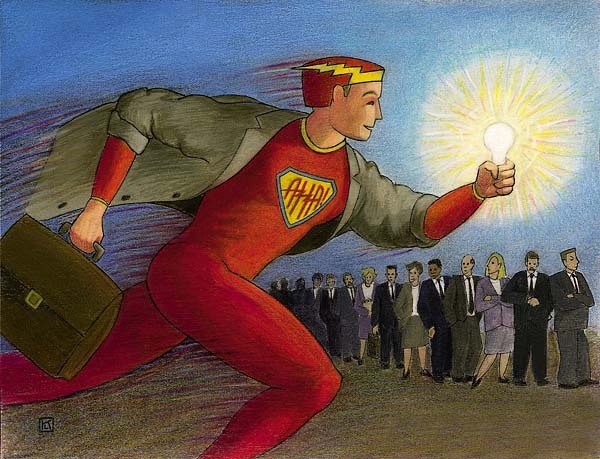
What enchants or delights us is sacred -- or could be sacred -- a clue that something significant is knocking on our door. Indeed, if we are willing to let fascination grow inside us, a kind of immaculate conception can occur, the illogical, miraculous becoming pregnant with possibility -- the bodily expression of the phenomenon that you are here to birth something extraordinary.
The idea is simply the first "waaaaaaah" to get you to notice.
What new idea is fascinating you? What new possibility has captured your attention? In what ways can you honor this inspiration today?
2. IMMERSE
Breakthrough ideas, like telemarketers or Jehovah's Witnesses, have a curious habit of showing up at odd times. And because they do, we're not always ready to receive them. To complicate matters, chances are good that when they do show up, we are multi-tracking our little tushies off -- checking email, microwaving dinner, or looking for our Smart Phone amidst the half-folded laundry. Not exactly the pre-conditions for breakthrough.
The alternative? Immersion -- the act of becoming completely involved or absorbed in something -- engrossed, enthralled, or preoccupied."
If you want to radically increase your odds of originating breakthrough ideas, you will need to immerse. Don't be a chicken, be a hen! Baby chicks break through the shell separating them from flight not because their mothers are rushing off to meetings on parenting skills, but because their mothers are immersed in the act of hatching. Mommy is sitting in one place for a looooooooong time. And baby chick is also sitting (curled up) in one place for a looooooooong time.
At Google, employees are given 20% of their time to immerse in projects that have nothing seemingly to do with their so-called day job. At 3M, it's 15%. W.L. Gore gives employees a half a day each week to immerse in projects that fascinate them.
Look at your calendar. Block out some time to focus on the development of your most inspired idea or venture. Unplug! Incubate! Hatch! Immerse!
3. TOLERATE AMBIGUITY
Breakthrough ideas are not always the result of a revolutionary Eureka moment. On the contrary, they are often the result of an evolutionary series of approximations or failed experiments. When Thomas Edison was asked how it felt to fail 800 times before coming up with tungsten as the filament for the light bulb, his answer was a revealing one.
"Fail?" he said. "I didn't fail once. I learned 800 times what didn't work."
Edison had the ability to tolerate ambiguity -- to "not know." Like most breakthrough thinkers, he had the ability to dwell in the grey zone. Confusion was not his enemy.
"Confusion," explained Henry Miller, "is simply a word we have invented for an order that is not yet understood."
If you are attempting to birth a breakthrough idea, get comfortable with discomfort. Give up your addiction to having all your ducks in a row, at least in the beginning of your discovery process. People may think you're a quack, but so what? Your chances of birthing a breakthrough idea (and result) exponentially increase the more you are able to tolerate ambiguity.
What new idea of yours is bubbling on the brink of breakthrough? In what ways can you stay with it, even if something in you is impatient for a breakthrough?

4. MAKE NEW CONNECTIONS
True creativity rarely happens in a vacuum. On the contrary it is the product of two or more variables connecting in a new way. It happens all of the time in nature. Water, for example, is really just the connection between hydrogen and oxygen. It happens in the human realm as well. Roller blading is nothing more than the connection between ice skating and roller skating. MTV? Nothing more than the connection between music and television. Drive in banking? Car + banking.
The originators of these breakthrough products didn't pull rabbits out of hats. All they did was see a new, intriguing (and potentially commercial) connection between already existing elements.
Why don't more of us make these kinds of connections? Because we usually stay within the confines of what we already know. We live in a box of our own creation -- whether that box be defined by our nationality, profession, concepts, cubicle, or astrological sign.
The more we are willing to get out of this box, the more likely it will be that powerful new connections will reveal themselves to us -- uncommon linkages between this, that, and the other thing -- kind of the way it was for Johannes Gutenberg when he noticed a previously undetected connection between the wine press and coin punch. And so the printing press was born.
Make three parallel lists of ten words. The first list? Nouns. The second list? Verbs. The third list? Adjectives. Then look for intriguing new connections between them.
5. FANTASIZE
In 1989, Gary Kasparov, the Soviet Union Grand Chess Master, played a two game match against "Deep Blue," the reigning supercomputer of the time. Kasparov won easily. When asked by the media what his competitive advantage was, he cited two things: intuition and the ability to fantasize. (And this, from a master strategic thinker!)
Few of us are ever encouraged to fantasize -- a behavior most commonly associated with children or perverts. And yet, fantasizing is exactly how many breakthrough ideas get their start -- by some maverick, flake, or dreamer entertaining the seemingly impossible.
I find it curious that business leaders want their employees to come up with fantastic ideas or solutions, but they don't want their employees to fantasize. And yet, the words "fantastic" and "fantasy" come from the same linguistic root, meaning to "use the imagination."
Think of a current challenge of yours. What would a fantasy solution to this challenge look like? What clues does this fantasy solution give you?
6. DEFINE THE RIGHT CHALLENGE
"It's not that they can't find the solution," said G.K. Chesterton, the renowned American philosopher and writer, "They can't find the problem!"
Translation? Most people, in their rush to figure things out, rarely spend enough time framing their challenge in a meaningful way. If they owned a GPS, they'd fail to take the time to program in their destination because they were so much into the hustle of getting out of town. Coming up with the right question is at least half of getting the right answer.
If you want a breakthrough idea, begin by coming up with a breakthrough question -- one that communicates the essence of what you're trying to create.
State your most inspired challenge or opportunity as a question beginning with words "How can I?" Then write it three different ways. Which is your real question?

7. LISTEN TO YOUR SUBCONSCIOUS
If you study the lives of people who have had Eureka moments, you'll note that their breakthroughs almost always came after extensive periods of intense, conscious effort. They worked, they struggled, they noodled, they gave up, they recommitted -- and then the breakthrough came. And often at unexpected moments. They weren't buying lottery tickets at their local deli, hoping to win a breakthrough fortune, they were digging for treasure in their own back yard.
Rene Descartes got the idea for the Scientific Method in a dream. Richard Wagner got the idea for Das Rhinegold while stepping onto a bus after long months of creative despair. Einstein used to conduct "thought experiments" (a fancy name for daydreaming) whenever he got stuck.
In other words, the conscious mind works overtime in an attempt to solve a problem or achieve a goal. Unable to come up with the breakthrough, the challenge gets turned over to the subconscious mind which then proceeds to figure it out in its own, sweet time.
Of course, all of this assumes that we are listening to the promptings of our subconscious mind.
This week, keep a log of your most inspired ideas, intuitions, and dreams. At the end of the week, review your log. See what insights come to you.
8. TAKE A BREAK
If you want a breakthrough, you will need to take a break. True innovators rarely follow the straight and narrow path. Not only do they march to a different drummer, they're often not even on the same playing field as most people.
Take Seymour Cray, for example, the legendary designer of high-speed computers. He used to divide his time between building the next generation super computer and digging an underground tunnel below his Chippewa Falls house. Cray's explanation of his tunnel digging behavior is consistent with the stories of many other creatives -- inner-directed, boundary-pushing people who understand the need to go off-line whenever they get stuck.
Bottom line, whenever they find themselves struggling with a thorny problem, they walk away from it for a while. They know, from years of experience, that more (i.e. obsession, analysis, effort) is often less (i.e. ideas, solutions, results).
Explained Cray, "I work for three hours and then get stumped. So I quit and go to work in the tunnel. It takes me an hour or so to dig four inches and put in the boards. You see, I'm up in the Wisconsin woods, and there are elves in the woods. So when they see me leave, they come back into my office and solve all the problems I'm having. Then I go up (to my lab) and work some more."
Next time you find yourself stuck on a thorny problem or project, walk away from it for a while. Stay conscious of new solutions coming to you during this down time.
9. NOTICE AND CHALLENGE PATTERNS AND TRENDS
There are many people these days who make their living from the pattern recognition business: futurists, meteorologists, air traffic controllers, and stock brokers just to name a few. And while their success rates may not always be 100%, it is clear that whatever success they enjoy is intimately tied to their ability to notice patterns and then interpret those patterns correctly for the rest of us.
The same holds true for breakthrough thinkers. The only difference? Breakthrough thinkers often hit the gravy train by challenging old patterns and then reconfiguring them in new ways.
"The act of creation," said Picasso, "is first of all an act of destruction."
"The genius," said American painter, Ben Shahn, "is merely the one able to detect the pattern amidst the confusion of details just a little sooner than the average man."
What trends in the marketplace most intrigues you? In what ways might these trends shift in the coming years -- and how might your most inspired idea be in sync with this imagined shift?

10. HANG OUT WITH A DIVERSE GROUP OF PEOPLE
Years ago Sony used to insist that their engineers spend at least 25% of their work time out of the office and mixing it up with people outside of the four walls of their industry. Keepers of the innovation flame at Sony understood that diverse inputs were essential to the origination and development of breakthrough ideas.
Unfortunately, most of us tend to stay within the intellectual ghettos of the familiar. We hang out with the same people day and night -- usually people who either agree with us, report to us or, through some indefinable act of karma, are joined to us at the hip.
If you want to increase your chances of getting a breakthrough idea, you will need to break the bonds of the familiar. Hang out with a different crowd. Go beyond the usual suspects. Seek the input of oddballs, mavericks, outcasts, or, at the very least, people outside your field. If you can let go of your need for comfort and agreement, you will find yourself catapulted into new ways of seeing, thinking, and acting -- all precursors to breakthrough ideas.
Make a list of ten people outside of your traditional posse that you can spend some time with this month.
11. BRAINSTORM
Breakthrough thinkers are often rugged individualists. They believe in their inalienable rights to think for themselves. They value their opinions, their perspectives, and their innate creativity. Their biggest fear is group think. All well and good.
But there is an important distinction to be made between group think and the phenomenon of inspired individuals getting together to spark each other's brilliance. Indeed, most great breakthroughs are more about inspired collaborations than they are about lone wolf genius.
Think Bill Gates and Paul Allen (Microsoft), Steve Jobs and Steve Wozniak (Apple), Sergey Brin and Larry Page (Google), David Filo and Jerry Yang (Yahoo), Watson and Crick (DNA), Lennon and McCartney (the Beatles), Hewlett & Packard.
All you need to do is frame a meaningful question, invite the right people, and facilitate the process for helping your think tank creatively jam. If you are not the right person to facilitate, you probably know someone who is. Ask them.
What is the topic of your next group brainstorm? Who will you invite? Who will facilitate? When?
12. LOOK FOR HAPPY ACCIDENTS
Breakthrough ideas are often less about the purposeful act of inventing new things that it is the art of noticing new things that happen accidentally -- those surprise moments when the answer is revealed for no particular reason.
The discovery of penicillin, for example, was the result of Alexander Fleming noting the formation of mold on the side of a Petri dish left unattended overnight. Vulcanized rubber was discovered in 1839 when Charles Goodyear accidentally dropped a lump of the polymer substance he was experimenting with onto his wife's cook stove.
Breakthroughs aren't always about inventions, but about the intervention required to notice something new, unexpected, and intriguing. For this to happen, you will need to let go of your expectations and assumptions and get curious. Give up being an expert. Let go of the past. See with new eyes.
What failed experiment or unexpected outcome might be interesting for you to reconsider?

13. USE CREATIVE THINKING TECHNIQUES
I live in the Northeast. In the Winter, it's common for old cars, especially on very cold mornings, not to start. When this happens, the best thing you can do is get a jump start. All you need are jumper cables and another car that's got its motor running.
Creative thinking techniques are like jumper cables. They spark ignition. They turn potential into kinetic energy. They get you going when you're stuck. If you're looking for a breakthrough idea, perhaps all you need is a jump start. That jump start can take many shapes. It can be a classic, creative thinking technique, of which there are many. It could be a "creative thinking coach" or a favorite book, or a quote. Ultimately, it doesn't matter what medium you choose, just as long as you choose something to get your motor running.
What is one creative thinking technique you might use the next time you need a jump start on the job?
14. SUSPEND LOGIC
Perhaps Einstein said it best when he declared: "Not everything that can be counted counts; and not everything that counts can be counted."
He was referring, of course, to the part of the human being that knows intuitively -- the part that is tuned in, connected, and innately creative. Kids live in this place. The rest of us just visit, preferring the left-brained world of rationality, logic, linearity, and analysis.
On some primal level, we're all from Missouri. We need proof. And while there is nothing inherently wrong with gathering data, the addiction to it subverts our ability to originate breakthrough ideas.
We know this. That's why we go to the movies, the pub, watch TV, read novels, dial 900 numbers, and daydream. We seek an altered state, one that is free of the normal gravity of daily life. That's why movie makers ask us to suspend disbelief. That's why brainstorm facilitators ask us to suspend judgment. That's why women (innately intuitive as they are) ask the men in their lives to stop being so damn practical for a change and actually feel something.
It is in this state of suspension that our innate creativity is free to percolate to the surface -- over, under and around all of the left brained guardians at the gate. And so... if you want to really birth a breakthrough idea, you too will need to enter into this state -- at least in the first phases of your new venture. Suspend judgment. Suspend evaluation. Suspend your addiction to the practical. What exists on the other side is fuel for the fire of your untapped creativity.
What can you do this week to suspend practicality, logic and rationality in service to birthing your big idea?
Posted by Mitch Ditkoff at 04:39 AM | Comments (1)
March 24, 2017Free Online Innovation and Creativity Summit 2017
Here's Nick Skillicorn introducing the upcoming, online Innovation and Creativity Summit 2017. I am happy to announce that I will be one of the 45 presenters. My topic? The power of storytelling to spark innovation. Cost? Zero. Zippo. Zilch. Click here to register. Summit begins on April 2.
MitchDitkoff.com
Storytelling at Work
Posted by Mitch Ditkoff at 10:53 AM | Comments (0)
March 10, 2017Making the Time to Be Creative
One of the biggest obstacles to creativity and, by extension, innovation, is the lack of time that is so prevalent in today's ADD culture. This two-minute video makes a very compelling case for you and all the people you work with to take some more time if you REALLY want to crank up the creativity.
25 quotes on creativity
Idea Champions
Posted by Mitch Ditkoff at 09:26 AM | Comments (0)
September 06, 2016David Lynch on Creativity
The animated version
Idea Champions
Posted by Mitch Ditkoff at 09:22 AM | Comments (0)
February 20, 201620 Things to Remember If You Love a Highly Creative Person

Good list of reminders for you if you love a highly creative person
Posted by Mitch Ditkoff at 07:40 PM | Comments (0)
August 18, 2015Wide-Eyed, Wide-Angled

If you are a regular (or irregular) reader of this blog, you now (as of this moment) have a once-in-a-lifetime opportunity to support the work of a gifted photographer and digital media maven, my son, Jesse, who will be traveling to eight countries for his next semester abroad. My blog is free. His wide angle lens is not. Anything you can contribute will be very much appreciated.
Jesse's crowdfunding campaign
Jesse's website
Posted by Mitch Ditkoff at 11:44 PM | Comments (0)
August 12, 2015Creativity Late in Life
A lot of people who assume they are "over the hill", may not be aware of the fact that there have been a ton of people, late in life, who have been extremely creative. The above slide show, adapted from Gene Cohen's The Creative Age, highlights this inspiring phenomenon. Watch full screen for most impact.
Idea Champions
One way to jump start creativity
Start now!
Posted by Mitch Ditkoff at 10:22 AM | Comments (0)
February 03, 2015The Secret to a Good TED Talk
Idea Champions
Ten Tips for Giving a Kick Ass Keynote
When Oversleeping Before a Keynote is the Right Thing to Do
Posted by Mitch Ditkoff at 11:22 PM | Comments (0)
April 26, 2014If You Need Graphic Design Help
Here is a 3-minute animation by my 19-year old son, Jesse Ditkoff. He is an aspiring digital artist, attending Hampshire College. He is available this summer for graphic design projects, photoshop, etc.
Posted by Mitch Ditkoff at 02:56 PM | Comments (0)
April 18, 2014On the Brink of a Breakthrough

The following piece, written by Thomas Wolfe, is the most moving thing I've ever read about what it takes to stand at the crossroads of one's creative calling -- utterly alone, howling at the void, and yet, at the same time, utterly supported. If you want to get the total value of this brilliant piece of writing, read it aloud and let it sink in. I find it hard not to cry whenever I read it.
"During this time I reached that state of naked need and utter isolation which every artist has got to meet and conquer if he is to survive at all.
Before this I had been sustained by that delightful illusion of success which we all have when we dream about the books we are going to write instead of actually doing them.
Now I suddenly realized that I had committed my life and integrity so irrevocably to this struggle that I must conquer now or be destroyed.
I was alone with my work and knew that no one could help me with it no matter how much anyone might wish to help.
For the first time I realized another naked fact which every artist must know, and that is in a man's work there are contained not only seeds of life, but the seeds of death, and that the power of creation which sustains us will also destroy us like a leprosy if we let it rot stillborn in our vitals. I had to get it out of me somehow.
I say that now. And now for the first time, a terrible doubt began to creep into my mind that I might not live long enough to get it out of me, that I had created a labor so large and so impossible that the energy of a dozen lifetimes would not suffice for its accomplishment.
During this time, I was sustained by one piece of inestimable good fortune. I had for a friend a man of immense and patient wisdom and a gentle but unyielding fortitude.
I think that if I was not destroyed at this time by the sense of hopelessness which these gigantic labors had awakened in me, it was largely because of the courage and patience of this man.
I did not give in because he would not let me give in, and I think it is true that at this particular time he had the advantage of being in the position of a skilled observer at a battle, covered by its dust and sweat and exhausted by its struggle, and I understood far less than my friend the nature and progress of the struggle in which I was engaged.
At this time there was little that this man could do except observe, and in one way or another keep me at my task, and in many quiet and wonderful ways he succeeded in doing this.
I was now at the place where I must produce.
Even the greatest editor can do little for a writer until he has brought from the secrete darkness of his own spirit into the common light of the day the completed concrete accomplishment of his imagining.
My friend has likened his own function at this painful time to that of a man who is trying to hang on to the fin of a plunging whale, but hang on he did, and it is to his tenacity that I owe my final release."
Posted by Mitch Ditkoff at 03:24 AM | Comments (2)
March 29, 2014That Big Beautiful Idea of Yours
What big, beautiful idea of yours needs just the right touch of collaboration, support, and immersion to see the light of day? Your next step? And when will you take it?
One way to get rolling
Brainstorm facilitation training
Idea Champions
Posted by Mitch Ditkoff at 10:00 AM | Comments (0)
November 18, 2013A Non-Traditional Proposal
Your business, organization, team, department, or community can learn a lot from this video. What, specifically, is for YOU to figure out. To increase the odds, ask yourself: "In what ways might we infuse a key project of ours with more fun, creativity, and collaboration?"
Posted by Mitch Ditkoff at 12:39 PM | Comments (0)
November 02, 2013Wake Up the Passion to Innovate
Innovation is a big fat generic concept in most corporations -- like life on other planets or trying to get teenagers to clean up their room.
Unless the individuals within an organization have a genuine sense of urgency, personal ownership, and an authentic passion for innovation, nothing much will happen.
Corporate initiatives that fail to awaken the human instinct to innovate are doomed, no matter how many pep talks, tote bags, or t-shirts proliferate.
For me, as an innovation consultant, it is clear that the short amount of time I have with my clients needs to be devoted to awakening the passion to innovate.
Tools, techniques, theory, data, models, bibliographies, business cases, best practices, and the fabulous muffins served on breaks are all fine, but it is the passion to innovate that is the real driver of success.
No passion, no innovation. Plain and simple.
Unfortunately, most organizations squash passion. That is why start-ups have a much easier time innovating than Fortune 500 companies. And that's why savvy Fortune 500 companies recreate the feeling of start-uppiness whenever they can.
The best thing any consultant can do when working with an organization is to hold up a mirror and ask their clients what they see.
Are they modeling what it means to be innovative? Or are they asking other people to do what they themselves have not done?
Idea Champions
Applied Innovation
Short videos of me
Posted by Mitch Ditkoff at 01:17 AM | Comments (0)
September 28, 2013Miles Davis on Mistakes

Idea Champions
50 quotes on failure
50 quotes on risk taking
Posted by Mitch Ditkoff at 11:43 PM | Comments (0)
April 15, 2013The Phoenicia Festival of the Voice
Our good friends, Maria Todaro and Louis Otey, two inspired visionaries, opera singers, and the Founders of the Phoenicia International Festival of the Voice, have launched a kickstarter campaign to bring a world class orchestra to perform at this year's Festival in August. Please consider making a donation today. The campaign ends on April 28th. Music! Celebration! Creativity! Love!
Posted by Mitch Ditkoff at 03:52 PM | Comments (0)
January 18, 2013Getting Back Into Our Right Brains
The following is by Val Vadeboncoeur, Idea Champions' Director of Training.
"May God us keep from single vision & Newton's sleep." - William Blake
The prolific Chris Hedges has written a powerful, new piece for Truthdig entitled "We Need Free Thinkers or Society Will Shrivel Up and Die".
I'd like to expand on it.
We need prophets and, as my good friend Roberta, a devoted student of the Torah, remarked the other day -- a "prophet" is not someone who foretells the future -- a prophet is someone who speaks the Truth right here in the moment, saying what needs to be said, whether it's popular or not (and it usually isn't).
We have had some prophets in recent times: comedian George Carlin was a prophet, for example, and so was Bill Hicks.
They told us what needed to be said, but they made us laugh about it so we didn't stone them to death when they did. Maybe Chris Hedges is a prophet.
But, today, we lack people who can see the bigger picture and help us make sense of things because, in great part, we have cut ourselves off from an essential part of ourselves.
We have neglected half of our human inheritance. In fact, we have dismissed it, made it an orphan, and cast it into exile.
The human being is a creature of balance. That's why we get so elated when our child takes his/her first steps.
After being born, this is the most significant event in a human life. It means we are learning about the fundamental reality of being human. We are mastering balance.
With every step we take in our lives, there is a moment where we have to find our balance or fall down. Once mastered, we do this so elegantly that we don't even notice this remarkable skill, much like a cheetah doesn't know how breathtakingly fast it runs, or a bird doesn't know how beautifully it flies. It just does it.
Physical balance is only one small part of it.
We are always balancing some kind of duality -- a duality of left/right, good/bad, up/down, wet/dry, smooth/rough, fast/slow, rich/poor, light/dark, hot/cold, positive/negative, me/you, us/them, etc.
We are always dealing with the reality of opposites. We also have two arms, two legs, two eyes, two ears, two nostrils, two vocal cords, and two brains -- and that's what I want to talk about here.
We don't have one brain. We have two. And they're supposed to work in tandem, like a team of horses.
But our society has lost a critical balance between our two brains. We are overworking one horse and ignoring the other, so it starves to death.
Or to put it another way, instead of using our hammer to do what it is designed to do and our screwdriver to do what it's designed to do, we are trying to do everything with the hammer alone.
It is not the hammer's fault that it can't deal with the application and removal of screws. It is ours for expecting the hammer to be able to do this at all.
In terms of our two brains, commonly referred to as the left brain and the right brain, we are a left-brained biased culture -- and that bias is, in the final analysis, killing us and everything else on the planet.
When our body gets out of balance in some way, that's commonly referred to as "illness". When our minds are out of balance, that should be understood as "mental illness". Our culture, being out of balance in the use of our brains, is, in some sense, mentally ill.
Our left brain is the brain that sees the individual, detects differences, categorizes, measures, experiences time, and follows a single line of thought.
It's the brain that tells us when to cross the street safely, which product is the better buy, and which clothes we should wear that will best suit the day's weather.
It's the brain that's created Science, Mathematics, Logic, Reason, and all manner of technology. It sees "things" and can count, measure, divide, multiply and categorize those things.
It's specialty is isolation and singularity. It's useful and convincing. So useful and convincing, that we have completely identified with it.
When you ask people who they are, they usually respond in a way that indicates that the sum collection of the workings of their left brain is their identity.
The left brain, however, cannot prophesy because it cannot see beyond the material, physical realm. It doesn't even know that anything else but the material realm exists.
It cannot see how the individual things it can see might be connected in unexpected, non-logical, non-spatial, non-temporal ways.
It can't even imagine such things. The left brain cannot empathize, since it sees others as separate entities -- as objects "out there". It cannot have hunches. It cannot create a metaphor. It cannot see the whole, just the parts.
If it wants to know more about a cat, it kills the cat, dissects the cat, takes out and measures all the parts of the cat, and then feels as if it understands what a cat is. It doesn't even entertain the idea that a better way to know what a cat is might be to live with a cat, watch the cat, and empathize with the cat -- an approach that has the additional benefit of still having a cat when all is said and done.
Those qualities of connectivity and wholeness and warmth all belong to the kingdom of the right brain.
The right brain has insights and can imagine what is not yet manifest. It can be inspired. It can connect with the heart so it can feel and experience joy or sadness and the entire range of emotion.
It can put this experience of connectivity and emotion into the language of music and form and movement. It can see possibility and the road not taken. It is somewhat magical, it is now (not burdened by a past or worried about a future), and it is what we often refer to as "love".
As a society, we have rejected the genius of the right brain and we are suffering this imbalance every single day in a myriad of ways.
We suffer with psychological isolation and drug addiction. We suffer when quantity trumps quality in our food, our sex lives, and our education. We suffer when we create extremes of wealth, health, and value that cause tensions in our society that explode into violence.
We suffer when we scapegoat people, and create fear-inducing enemies and bogeymen that we try to destroy -- creating war, injustice and chaos. We suffer when we exploit our planet, and our fellow living creatures, for profit, without realizing that we are destroying our own lifeline -- that we are cutting off the very branch we are sitting on.
It's way past the time when we have to recognize our full humanity and start paying a whole lot more attention to our ignored and belittled magical right brain.
We are suffering unnecessarily because we are not in balance with our own true nature.
We are the "thinking creature" only using half of our thinking ability, and it's not even the better half, in my opinion.
We are like the cheetah using only two of its four legs to run, or a bird trying to fly by flapping only one wing.
Is this prophecy? I don't know, but what I do know is that we need to find our balance in our thinking -- and soon -- or we will all fall down.
That's the bad news.
The good news is that we are designed to do exactly that.
Posted by Mitch Ditkoff at 10:11 PM | Comments (0)
November 25, 2012What Do You Want to Create?
Well, then, my friend, WHAT IS IT that YOU want to create?
Posted by Mitch Ditkoff at 02:39 AM | Comments (0)
November 19, 2012Layne Redmond's Kickstarter Project
Here is a link
to a very inspired Kickstarter project
originated by my good friend,
Layne Redmond,
author of
When the Women Were Drummers
and all around renaissance women.
Layne and her team
of talented musicians
and film makers
are making a documentary
celebrating the dance,
drumming, and chants
of traditional and sacred
Brazilian culture.
Click here to donate.
Posted by Mitch Ditkoff at 10:19 AM | Comments (0)
November 16, 2012VOTE FOR ME (I will not raise taxes, start a war, or give a boring speech)

Good news! A leading Speaker's Bureau has just nominated me as a TOP FIVE SPEAKER in the field of innovation & creativity. To win, I need your vote.
So... if you believe I've added value to this field and am speaking about it in a way that inspires and educates, I humbly ask for your vote.
All you need to do is click this link , then scroll down to the fifth category and check the box next to my name (MITCHELL DITKOFF). Then scroll to the bottom and enter your name etc. The whole thing will take you less than three minutes.
My ten tips for giving a great keynote.
Posted by Mitch Ditkoff at 12:12 AM | Comments (0)
October 20, 2012100 Simple Ways to Be More Creative On the Job
Here's the deal:
You are creative.
Really. I mean it.
You are.
Maybe you know it.
Maybe you don't know it.
But the fact remains:
you are creative.
Unfortunately, your creativity
doesn't always
show up on the job.
Work environments
tend to subvert creativity
and make it hard to access.
If this sounds familiar,
my newest article in
The Huffington Post
will be useful to you. Enjoy!
Posted by Mitch Ditkoff at 04:55 PM | Comments (0)
February 18, 2012The Romance of Creativity
If you are trying to bring something new into the world, know this:
The creative process is very much like a relationship.
And like most relationships, it usually begins with fascination -- that curious state of mind that keeps you spellbound, charmed, and aroused.
Whenever someone gets a new idea, a kind of romance begins.
For many of us, just thinking about a new idea is an aphrodisiac. It turns us on, psyches us up, and otherwise makes it hard to eat, sleep, or obsess about cash flow.
While some people involved in a new relationship are able to sustain this excitement for months, most of us are less fortunate. It's the rare person who knows how to savor and expand upon this feeling for years.
After the intoxication of the initial encounter wears off, a less-than-incredible reality sets in.
Where once we saw only beauty, now we see blemishes.
To make matters worse, a werid kind performance anxiety enters the picture.
"Will I be good enough to achieve my goal?" we ask. "Do I have what it takes?"
Call it doubt if you like, but any way you slice it, the honeymoon is over.
What follows is a painful period of re-evaluation.
Long-buried fears of being consumed by the "other" surface, driving us into withdrawal. Instead of enjoying the outpouring of creative energy that accompanies a new idea, we study it. We dissect about it. We doubt it. Anything but let go to it.
Before you know it, the approach/avoidance game is upon us. On Monday we're totally absorbed in our new venture. On Friday, we're sure it's a waste of time.
The plot soon thickens.
Instead of maintaining our commitment to our HOT new idea, we begin having flings.
We flirt with other ideas, other possibilities, other new loves. We get into everything and anything -- whatever it takes not to sustain our ongoing relationship with our original inspiration.
Is there any hope?
Yes, there is. And something a lot more powerful than hope -- awareness.
Simply by being aware of the mind games you play will go a long way towards making magic happen.
To begin with, understand that all romances, no matter how inspiring, are temporary. The trivial ones end. The good ones mature, often growing into committed relationships -- even marriages.
If you are serious about your current hot idea, be willing to get closer to it. Be willing to go from the romance stage to an intimate relationship.
Understand what the creative process is -- an impossible-to-deny encounter with yourself -- your fears, your power, your vision, and what drives you to play the game of life.
Know that you will have your falling out periods and your disagreements. Know that you will sometimes feel like a fraud. And know that the fuel for many creative breakthroughs has not only been passion, purpose, and power, but confusion, conflict, and collapse.
It's normal. It's human. It's part of the process.
Above all, do whatever it takes to put the elation back into your relationship to creativity.
Illustration
Photo
Photo
Idea Champions
Awake at the Wheel
Posted by Mitch Ditkoff at 07:09 AM | Comments (1)
December 09, 2011Give the Gift of Creativity
If you want to avoid the Holiday shopping hassle and are looking for some non-traditional gifts that will get your loved ones' creative juices flowing, you're in the right place.
This place. Here. Now.
All you need to do is click and order. Nancy (5th bio down) will do the rest.
Awake at the Wheel ($11.12)
Free the Genie app ($29)
It's AHAppening (pdf) $39.95
Free the Genie cards ($49)
It's AHAppening! ($59)
Silver Innovation Kit ($199)
Platinum Innovation Kit ($299)
Posted by Mitch Ditkoff at 02:11 PM | Comments (0)
November 16, 2011The Democratization of Creativity
Whaddya think?
Idea Champions
Posted by Mitch Ditkoff at 08:34 AM | Comments (0)
November 13, 2011Obvious to You, Amazing to Others
Derek Sivers, Founder of CD Baby, used to live one street away from me in Woodstock, NY. I saw him only once, walking on the road. Now here he is on YouTube. Yo, Derek! Thanks for this! So true...
Posted by Mitch Ditkoff at 12:01 AM | Comments (0)
July 15, 2011We Need More Poetry!
Poetry, like looking up at the moon instead of down at a Blackberry, is all too rare these days.
We need more poetry! We need more poets! We need more business people willing to express their "softer" side on the job -- especially if we want to raise the bar for creativity and bold new ideas.
We also need more YouTube videos like this one featuring the delightful words of Poet Laureate Billy Collins. Go, Billy, go!
Posted by Mitch Ditkoff at 02:10 AM | Comments (3)
April 14, 2011Beer and the Invention of the Wheel
You may not know it, but I wrote an award-winning book in 2008, Awake at the Wheel. It's a business fable about the creative process. Easy to read. Fun. A real support for aspiring innovators.
I'm guessing the caveman in the Bud Lite ad below would have found a better way of getting their beer to the party if they had read it.
But enough about me. Let's talk about YOU.
Do you have a creative venture that needs an infusion of mojo, inspiration, and clarity?
Yes? Good. Click. Buy.
Posted by Mitch Ditkoff at 02:22 PM | Comments (0)
September 23, 2010Unity Takes Two
Mitch Ditkoff and I have an interesting mercurial chemistry when we get together.
Certain things get completed when we riff and improvise. He and I, and the rest of the Idea Champions crew, have all been talking about what creates a culture of innovation for a few years now. Often, all it takes is two people who have what I call "creative resonance."
Show me any two people who can agree and disagree with equal enthusiasm and respect and I'll show you a duo who can brainstorm persistently at high heat.
A great new series on Creative Pairs at Slate talks eloquently about the dynamic balance and high energy the right two people can create when they "complete" each other.
As a successful professional songwriter, I grew up loving the songs of John Lennon and Paul McCartney, Mick Jagger and Keith Richards, and older teams like Rogers and Hammerstein, the Gershwin brothers, and Lerner and Lowe. It makes perfect sense to a songwriter that creative pairs would launch some of the most successful companies of the last 35 years.
The creative boom in digital technology started in the early 70's with Bill Gates and Paul Allen, Steve Jobs and Steve Wozniak, and continued a generation later when Larry Page and Sergey Brin created Google.
Great duos exist in every vocational and artistic field: Watson and Crick, Gilbert and Sullivan, Engels and Marx.
Two centuries ago, breakthrough composers often arrived in pairs, pacing each other even when they weren't working as teams: piano innovators Chopin and Schumann (both born 1810), opera titans Wagner and Verdi (both born 1813).
Creative pair chemistry ignites when two people spontaneously strike a agreement to both compete and collaborate with each other simultaneously. That tension between collaboration and competition is more easily achieved and managed in pair relationships than any other kind of team configuration.
Joshua Wolf Shenk's Creative Pairs series is now in its third installment at Slate. Part 1 of Inside the Lennon/McCartney Connection starts here and continues on to Part 2.
If you really want to see how simple the crucible of creativity can be, be sure to keep following Shenk's series. You'll think differently about that colleague you argue with all the time.
One little tweak, a mutual change in attitude and mindset, and something magical could happen.
-- Tim Moore
Posted by Tim Moore at 11:08 PM | Comments (0)
August 10, 2010Getting Down to the Business of Creativity
Here's a terrific article on creativity, based on the work of three Harvard researchers/professors.
According to Teresa Amabile's research, "inner work life" is one of the biggest determinants of creative output. In other words, a positive mood is a pre-condition for creativity in the workplace.
If you are attempting to establish a sustainable culture of innovation in your organization, you (and everyone else) would be well-served to do everything humanly possible to positively impact the mood (i.e. tone, feeling, atmosphere, vibe, spirit) of the environment in which you work.
And that begins, of course, with the individual.
When you treat people with respect, acknowledgment, and genuine positive reinforcement, you significantly increase the odds of creativity -- and by extension, innovation -- flourishing in your organization.
Common sense? For sure. But common sense is all too uncommon in most organizations these days. In our rush to produce, get an edge, and accomplish, we forget the most important thing -- and that is the quality of our interactions with others.
Posted by Mitch Ditkoff at 05:35 AM | Comments (0)
July 21, 2010Top 100 Amazon Reviewer Favorably Compares "Awake at the Wheel" to "Who Moved My Cheese?"

Nice review of my book from Thomas Duff, Top 100 Amazon reviewer:
Awake at the Wheel: Getting Your Great Ideas Rolling (in an Uphill World) can, in my opinion, be compared to the classic "Who Moved My Cheese?".
Ditkoff does for creativity what Johnson and Blanchard did for living with change... It gives the reader a short, humorous story loaded with meaning and concepts that hit the reader right where they live.
Ditkoff explores the world of ideas and creativity though the story of Og. Og is a caveman who spends more time thinking than the average Neanderthal.
He stumbles upon the concept of a circle, and becomes obsessed with what it could mean to the group. Of course, most of his fellow cavemen are more concerned about maintaining the status quo... hunting, eating, staying warm.
Og takes a journey to talk with a wise one, and from that trip the wheel is born.
But even then, others in his clan are more interested in shooting it down as something that will never work. But one person does figure out the practical application, and pretty soon everyone is "rolling along" with the greatest thing since dried mammoth...
I really did like this book.
Taking the concept of ideas and putting them in caveman terms freshens up what could be just another book on creativity.
At the end of the book are 35 "tools" you can use to spur your own idea machine, as well as how best to make sure these fleeting thoughts don't disappear like smoke from a campfire.
Like many companies have done with "Cheese", this should be a mass purchase, handed out toall employees, and then discussed in team meetings.
Those who are into this genre will love it, and the Neanderthals who are cynical will likely spend the 30 minutes or so it should take to read it.
And they might even come out of that experience as the new Og of your organization.
What others are saying about it.
Winner of Axiom Business Book Award: (scroll to category #22)
Posted by Mitch Ditkoff at 03:11 PM | Comments (0)
January 30, 2010Get Deeply In Touch With the Passion to Create!
If you want to CREATE something extraordinary, you're going to need some of the spirit that Dean Schambach exudes. When the true force of creativity is burning bright in every cell of your body, all the rest will follow. Hats off to David McDonald, Woodstock filmmaker, for this pearl of brilliance.
Posted by Mitch Ditkoff at 09:48 AM | Comments (2)
November 13, 2008Forget About the Box, Get Out of the Cave!
See the caveman to your left? That's Og. He's the protagonist of my new book, Awake at the Wheel: Getting Your Great Ideas Rolling (in an uphill world). The word "protagonist" is not in Og's vocabulary. Even I don't use the word "protagonist" all that much -- though I have used it three times in this paragraph.
Hmmm... That's pretty odd.
Then again, the experience of inventing the wheel was pretty odd, too. Which is what Og did. 24,000 years ago. Long before Game Boy, i-Pod, or Starbucks. And yes, long before the Mesopotamians -- the people who usually get all the credit for the wheel -- some 20,300 years after my main man, Og.
(Hey, when was the last time you used the word "Mesopotamian?" That's another word not in Og's vocabulary.)
Actually, Og didn't need a big vocabulary. He had something else going for him: Neanderthalic genius. Stone age brilliance. Originality. Og, you see, was the first innovator. Intrinsically motivated, he was. Fascinated. Inspired. Mojo-driven. And while he was not without imperfections, he needed no attaboys, cash awards, or stock options to follow his muse.
Back in Og's time, when men were men, and stones were stones, even the idea of an idea was unthinkable. And yet... somehow, he had one -- an IDEA, that is -- and not just your dime a dozen variety. Nope. A GREAT idea, a BIG idea, or what I like to call an "out of the cave" idea: The wheel.
Ah... but I go on too long. If Og were here, he'd be frowning by now, shrugging his stooped shoulders, wondering in his delightfully pre-verbal way what other new ideas and discoveries awaited his wonderfully hairy touch.
Want to order the book now? (Og gets 10% of every sale). Go ahead. Help him put bear meat on the table.
Posted by Mitch Ditkoff at 11:37 AM | Comments (1)
November 05, 2008Baking the Change and Innovation Cake

Last night, my 11-year old daughter, Mimi, and her good friend, Zoe, stayed up late to watch the election results. After Obama was declared the winner, they baked a cake in his honor and, in the morning, frosted it.
As they left the house this morning, Mimi stopped, cake in hand, and shouted out Obama's name at the top of her lungs. Something deep within her rose to the surface and begged to be expressed. Which, being 11 and free of the politically correct constraints that rule the lives of too many adults, she accomplished with great flair.
That same intrinsic motivation that moved Mimi and Zoe to bake their cake, needs to be alive and well in your company if you are truly serious about raising the bar for innovation and change. Mimi and Zoe didn't need to be TOLD to bake the cake. They wanted to. Even more than that, they HAD to.
FOOD FOR THOUGHT: In what ways can you create the kind of culture in your organization that will encourage everyone to bake their cake for change and innovation?
Posted by Mitch Ditkoff at 10:22 AM | Comments (0)
October 31, 2008Idea Champions' Creativity Tools Declared "Awesomest" Tools on the Web
Many thanks to gottAquirk for acknowledging us for having the "awesomest" creativity tools on the web. Of the nine tools they cited, our Jump Start and Idea Lottery tools were ranked #1 and #2. (By the way, the Idea Lottery tool came to us in a dream.)
If you like these tools, you'll probably like our others. Like Free the Genie. And our book, Awake at the Wheel (which includes 35 creative thinking techniques).
You might also like our Innovation Kits, It's AHAppening guidebooks, free downloads, or our innovation-sparking kick asss. You might also like our homemade split pea soup, but we've not yet figured out how to deliver it over the web.
PS: If you want to license Free the Genie cards or our Teamwork Cards for your intranet, call us: 800-755-IDEA.
"If not YOU, who? If not NOW, when?"
Posted by Mitch Ditkoff at 09:47 AM | Comments (1)
August 11, 2008Big Problem or Right Problem? The Egg Freckles Saga.
Have you ever spent hours trying to solve a problem only to find you've been working on the wrong problem? Try doing it for five years. That's what Apple Computer engineers did with the Newton handheld computer over a decade ago.
From 1993-1998, Apple made a valiant effort to break open a market for portable handheld pen computers. Unfortunately, they spent most of that time working on a problem that didn't really exist for consumers. And as they labored at it, their intended market was stolen by Palm Computing's PalmPilot.
What follows is a tale about a fatal assumption -- an obsession with a Big Problem that led to one of Silicon Valley's great product misfires.
Consider the moral first.
Solving a Big problem doesn't mean you're solving the Right problem.
Apple's team chose to tackle the biggest challenge in pen computing: high-level handwriting recognition. Newton would be the first portable computer people could write on directly using their natural hand. From anyone's scrawl, the computer would extract the standard ASCII characters computers need to work with. This posed a massive challenge in pattern recognition. Since every user's handwriting is different, the Newton would need to learn the particular way its user wrote each letter and number. IF it got all the letters in, say, the word "thing" right, Newton would compare that string of letters to words in its 10,000 word native memory. IF the word "thing" was stored there, Newton would find a match and "know" the word.
The Newton team was determined to build the world's most sophisticated pattern learning pen computer. But why were they doing it? And for who? Here they made one fatal assumption about their potential buyer, an assumption that would seal the Newton's fate.
The assumption went something like this:
"Users want to do things the way they've always done them. The user shouldn't have to learn anything new to adapt to a machine. A smart machine can and should adapt to the user (in this case, learn the user's handwriting)."
This assumption became a frame and the frame became a mindset. Without ever turning back to question their customer premise, Newton's team labored to build a noble, mind-blowing machine that could recognize the diverse scrawls of any and every human on Earth. But was this the Right Problem to solve?
When the Newton Message Pad debuted in 1993, its handwriting recognition fell way short of the mark, and a public drubbing ensued. The Doonesbury comic strip showed a character writing a six-word sentence on a Newton-like hand-held. The unit coughed up "Egg freckles?" Then The Simpsons piled on. The world laughed.
All through 1993, the Newton was skewered in the press. In October of that year, Apple CEO John Sculley left with freckled egg on his face. Humiliated, the Newton team redoubled their efforts to solve their core problem: getting Newton to learn better.
At the heart of Newton's learning challenge was the "second-stroke problem." Each time a user's pen lifted off the tablet and set back down, Newton's brain detected a pause and became uncertain. "What did that pause mean? Is this next stroke part of the current letter, or a new letter or word?" As it turns out, many alphabet characters need multiple strokes, leaving plenty of room for uncertainty. Capital "T" and "X" involve two strokes. "H" needs three. Add user hesitancy and writing quirks, and you have a thorny problem. And that's just English. Try Cyrillic or Japanese ideograms.
Because Newton's recognition engine was unsure so often, it routinely threw a list of possible words at the user. This was both inconvenient and embarrasing. Who wants their computer to say, "I'm confused. Take time out, scan these words and select the right one"? Worse, if you wanted Newton to learn a word outside its native 10,000 word database, you had to train it. You first had to write it your way, then type it letter by letter using an on-screen keyboard. All that to tell Newton, "This is what 'Hoboken' looks like when I write it."
The upshot? To "save" users from having to adapt their writing habits to machines, the Newton subjected ordinary people to drawn out and repetitive clarification and training routines; a tacit admission that Newton wasn't doing its core job cleanly.
None of this was lost on Jeff Hawkins, inventor of the Palm Pilot, who was carrying around a wooden block as a pretend pocket PDA and using a whittled down chopstick as a pen to imagine his interface.
Hawkins never lost sight of what consumers would want most in a pen computer: fast writing and true mobility - something they could fit in their shirt-pocket. He cut to the chase and questioned Apple's core assumption:"Why must the computer learn everything? Why can't users adapt? Why build a sophisticated learning machine at all? Let's get the job done. People learn faster than computers, so why can't people help the machine? People could easily get the hang of a new single-stroke alphabet. Hmm. One stroke per character and presto! No more second-stroke problem."
So that's what Jeff Hawkins did. With his Grafitti language, he simply redesigned the alphabet, turning centuries-old letters and numbers into single-stroke symbols that mostly kept the look of the original characters. Suddenly the computer had only one master rule to follow. "When the pen lifts up, the character is done. When the pen comes down again, it's a new character. Want to end a word? One stroke makes a space." Simple. And while we're at it - since each stroke is a new character, lets not even write along a line. Write letters on top of each other, in the same input space, and let them display as type in another. Presto - a smaller screen.
Hawkin's low-tech solution made Palm Pilot's pen input "good enough." (Apple even licensed Grafitti in 1995 as an input option for the Newton. Some say it kept the Newton alive.) But the real power of Grafitti was size. It shrank the screen, which shrank the box, which created a viable pocket-PDA market.
In March, 1996, when Newtons were selling as digital writing tablets for up to $1000, the first pocket-sized PalmPilots debuted for under $300. A million of them sold in the first 18 months. The Newton team countered with a much improved Newton 1000 and 2000, but by then it was too late. Two years after the PalmPilot was released, Apple cancelled the Newton product line on February 27, 1998. The project had cost the company half a billion dollars.
Hawkins "technology" was a low-tech workaround; it wasn't "handwriting recognition" in the high-level MIT sense. But while PhD's may have felt Grafitti was a cheat, ordinary people, not giving a hang about the technology issues, found PalmPilots handy and useful. While engineers rallied around solving the Big Problem, consumers swarmed to buy the solution to the Right Problem, which started with a chopstick and a block of wood.
By year 2000, Palm owned 70 percent of PDA sales and had sold well over five million units. At the peak of PDA use, white boards everywhere were covered with Grafitti symbols, which many considered faster to write for high-velocity brainstorming.
The Newton team spent five years working on the Big Problem, writing and rewriting untold lines of code to create a learning machine for the existing alphabet. Hawkins spent a few days designing a new alphabet any computer could easily understand.
Despite its truly impressive interface, Newton stumbled at the main task it promised to do - turn writing into standard ASCII characters quickly. And why did Apple paint themselves into this corner? Because they assumed consumers would want their handheld to adapt to their personal way of writing. Instead of biting into Apple's Big Problem, Jeff Hawkins assumed people would adapt. As he once put it, "It takes you weeks or months to learn how to type, so why not spend 15 minutes learning [how to talk to a computer] with a pen?"
The Lessons
In hindsight, Apple's underlying user assumptions made little sense. What makes people's standard routine (handwriting) so sacred? Who said people shouldn't adapt to machines? Who said you had to work with the existing English alphabet? Why make a program strain to recognize every possible variant of every letter and number? Who said your program had to recognize scrawled words by finding them in a limited word database? Engineers set up these problems, not users.
Great minds often get hijacked by their own brillliance and vision. They forget that simple is smart, dumb is basic and low-tech often beats high tech. We can get so obsessed with an elusive quarry and so enamored of our intelligence that we never go back up to the 20,000 foot level and see that we're hacking the wrong problem. The famous monkey trap metaphor is worth repeating here.
If a monkey reaches through a hole for a banana, but the hole is too small for her hand to withdraw with the banana, she's presented with a quandry. "Which do I want? - the banana or my freedom?" All she has to do is let go of the banana in order to be free of the trap. But the monkey doesn't let go of the banana. She sits there determined to extract it, even in the face of being captured.
Big Problems are like monkey traps. If your Solution quest starts feeling "heroic," or your Big Problem is "big" mostly because everyone is trying to solve it (big kudos await if YOU solve it), its likely you're trapped by the epic magnitude of your quest. In that mindset, the simplest options are likley to escape your notice. Check to see if your solving the Right Problem by running your mind through the following four steps:
1. Restore objectivity. Take time off and come back fresh later. Sleep on it.2. Once you're fresh, carefully and slowly go over your assumptions about the people who will use you product or service. Put yourself in their shoes. Separate your needs from theirs. Don't underestimate their intelligence or overestimate the rightness of your point of view. Break down every assumption you have about your prospective buyer and question it.
3. Especially question your assumptions about what your "users" expect. Often they don't know what they want. They rarely see the next development much less have an opinion about it. But they are ready for a surprise, a break in routine, a new challenge. Keep in mind that IF the payoff is strong, humans will learn new tricks. Are student drivers motivated learners? You bet.
4. Review your supposed technical limitations, challenges or goals to see if you can use lower-tech or human-scale solutions. Stretch for new metaphors that can change the problem, shift the frame, reverse figure and ground.
5. Simplify. Simplify again. Keep simplifying.
Whenever you're stuck or breathing hot and heavy about a solution, you're too close to your work. It's time to step out of problem-solving mode and reassess the problem you're trying to solve.
This excerpt is from the author's book-in-progress, Big Problem or Right Problem? Innovating For Real People.
Copyright © 2007 Tim Moore. All reproduction rights except blog linking are reserved.
Posted by Tim Moore at 02:03 PM | Comments (2)
June 10, 2008Getting All Googley
Interesting summary of Google CEO's speech to the Economic Club of Washington this Monday.
Among other things, Schmidt talked about his company's attempts to innovate, including allowing engineers to use 20 percent of their time to work on projects of their own choosing. Schmidt acknowledged that trusting the workforce to follow their fascination has resulted in many successes for the enterprise. "Part of Google's success is creating more luck," he said.
Success also needs a positive environment and encouragement for employees to be more creative and innovative, Schmidt said.
"It is possible to build a culture around innovation, it is possible to build a culture around leadership, and it is possible to build a culture around optimism," added the googley Mr. Schmidt
Posted by Mitch Ditkoff at 03:58 PM | Comments (0)
April 29, 2008Got The Email Blues?
At least once a week, one of my friends or one of my clients complains about email -- how they get too much of it and how too much of what they get is spam. I feel their pain. I really do. Which is what inspired me to write this little blues song, first performed by Face the Music, back in 2000.
THE EMAIL BLUES
I logged on this morning
And found out I'd been spammed,
Got 500 emails, Lord, my inbox was way too jammed,
Most of it was useless, the rest of it was jokes
Sent by friends with downtime to the rest of us working folks.
Oh baby, I'm so digitally cool,
Oh baby, I'm gonna start my own gene pool,
Oh baby, I'm a nanosecond fool,
Gonna download half the universe,
Challenge Bill Gates to a duel.
I logged on this morning, heard that familiar digital buzz,
Had to double check my password to find out who I was,
Read the stock quotes in a minute, the box scores and the news,
But all I really learned was... I had those email blues.
Oh baby, I'm so digitally hip,
Oh baby, I'm a dot com chocolate chip,
Oh baby, my life is just a blip,
Gonna download half the universe,
Don't you give me no more lip.
I logged on this morning and found out I was dead,
At least that's what I think my new webmaster said,
I guess it kind of shocked me since I haven't seen the light,
But when I get to heaven I'll just launch my new website.
Oh baby, I'm so digitally fine,
Oh baby, I got fiber optic up my spine,
Oh baby, my life is so divine,
Gonna download half the universe,
Don't know where to draw the line.
Want to listen to the Email Blues? Now's the time.
What kind of blues do you get? Let us know and we'll choose the most compelling topic, write a blues song about it, and post the lyrics here within the next 30 days.
Posted by Mitch Ditkoff at 01:40 AM | Comments (0)
April 18, 200824,000 Year Old Cave Man Invites You to a Book Signing in Woodstock
See that Neanderthal to your left? That's Og, the mythical inventor of the wheel and the hero of Mitch Ditkoff's new book which hits the book stores on May 1.
In honor of Og, I am inviting you to the book signing at the Golden Notebook in Woodstock, NY, Saturday, April 26th, 5:00 - 7:00 pm.
Here's what Og has to say about the book signing:
Morkel noophpa umphh! Kiaww noofti agu. Brrpp. Obama! Rok. Remu! Ditkoff sumphfta jabu.
Translation?
"Hey bipeds with Blackberries and cash flow problems! You don't even need to know how to read to enjoy a book signing! Free wine! Free cheese! The tribe reconvenes! And Mitch Ditkoff, who has recently developed full use of both opposable thumbs, will be signing books. Or eating crackers. Or talking too much.
Bring a friend. Bring two. Really, you don't have to buy a single book if you don't want to. Just come and be part of the fun.
And support the fabulous Golden Notebook!
If you want to listen to Mitch's two minute rap about the book, click here.
PS: If you can't make it to the book signing, so be it. You can still buy a copy here.
Posted by Mitch Ditkoff at 07:58 PM | Comments (0)
January 02, 2008Give Everything You Have
If you are looking for a breakthrough in 2008 -- whether it's in the realm of innovation, collaboration, business, or personal relationships, allow me to offer you one simple piece of advice: give everything you have. Yup. Go all the way. Let it rip. Put all your chips on the table. Go all in. "A monomaniac on a mission" is how Peter Drucker once put it.
Martha Graham said the same basic thing, but a bit more poetically: "There is a vitality, a life force, that is translated to you into action, and because there is only one of you in all time, this expression is unique. And if you block it, it will never exist through any other medium, and will be lost."
Yessiree. Now's the time -- the time to translate your life force into action no matter what form it takes. Book to write? Move to make? Idea to manifest? Business to turnaround? Whatever. The key is to go for it. Give it everything you have. And yet, the act of giving everything you have is only HALF the battle. The other half... is HOW you give it.
And so, for all Heart of Innovation readers and any one else who has somehow found their way to this virtual space and time, I offer the following as a gift to you for a life well-lived in 2008. Imbibe it's meaning and you will find yourself succeeding beyond your wildest dreams. Not only will your cash flow, but so will you...
GIVE EVERYTHING YOU HAVE
Give everything you have,
and after you have given,
give what's left.
After you give what's left,
give what remains.
After giving that,
give the feeling of having given.
After giving the feeling
of having given,
give what you get
for having given.
Then give again,
never stopping, always giving.
And should it come to pass that you forget,
forgive yourself immediately.
Then begin again,
giving everything you have,
and after you have given,
give what's left.
Posted by Mitch Ditkoff at 10:17 PM | Comments (0)
September 11, 2007The Best Ideas Poll: 2007

Einstein got his best ideas while shaving. Mozart used to exercise before composing. Rene Descartes came up with the Scientific Method in a dream. Three geniuses. Three totally different catalysts for breakthrough thinking.
How about you? Where and when do you get your best ideas? In the shower? Late at night? On vacation? Brainstorming?
Three years ago, I polled 200 people on this very same topic -- a poll that consisted of 34 items and one other category. What astounded me was how many other responses I received -- a veritable Jerry Lewis Telethon of times and places I never once considered as having anything to do with the act of creative thinking.
Which is why our 2007 BEST IDEAS POLL is way more comprehensive. (Notice I did not use the word robust to describe our poll. The word robust is hereby banned from this blog for all eternity). Where was I? Oh, yes -- this year's Best Ideas poll. Interested in taking it? Of course you are. All you need to do is click here. The whole thing will take you less than seven minutes. Its simple. Its fun. And it will likely spark at least a few insights into where and when YOU get your best ideas.
NOTE: The results of our research will be posted here sometime in November, so be sure to check back.
Posted by Mitch Ditkoff at 10:37 PM | Comments (1)
August 01, 2007Einstein Tip of the Week
If you find yourself working closely with predominantly left-brained, analytical, logical, linear, rational, data hungry, bottom-line focused business people, and you're sensing there is precious little openness to the state of mind affectionately known as "receptivity," you may find it useful to trot out the following quote from Albert Einstein, Idea Champions' patron saint of possibility. It works every time:
"Not everything that counts can be counted; and not everything that can be counted counts."
Ah... feels so good, doesn't it? Takes the pressure off. Opens doors. Expands horizons. Hey, who can argue with Big Al, the embodiment of brainpower, science, and all things yet to be known?
So, next time you find your "out of the box" approach being summarily dismissed by the number crunching, naysayers of the noosphere, boldly cite Einstein's point of view. And if you STILL find yourself on the receiving end of doubt, ask someone in the room to explain what the quote actually means.
In less than 60 seconds, the mood in the room will shift dramatically. Not only will you have invoked the spirit of wonder and exploration, you will have (at least for a few moments) diffused one of the biggest obstacles to innovation: shrink-wrapped addiction to data.
Posted by Mitch Ditkoff at 11:57 PM | Comments (0)
July 26, 2007InnovationTools' "Quote of the Week" is from Mitch
In a nice and unexpected coincidence with the kickoff of our blog here, the Quote of the Week in the current InnovationWeek newsletter is from our own Mitch Ditkoff, President and co-founder of Idea Champions. The newsletter is published by the respected InnovationTools.com.
Innovation Quote of the Week"In today's flattened, restructured, downsized organization, your role is much more than getting the best out of people. It's getting the best out of the best part of people - out of their inspired imaginations, their ability to dream, conjure and conceive - and transforming those inspired ideas into the products, services and improvements that will not only keep your business humming, but make the world an even better place for all of us to live."
- Mitch Ditkoff
The quote comes from near the end of an article of Mitch's, "Innovation Coaching, The Manager as Idea Midwife." The article also appears on the InnovationTools site (demonstrating at the very least what a thorough reader their Chuck Frey is).
Posted by at 07:12 PM | Comments (0)
July 23, 2007Welcome
Welcome to the Heart of Innovation, Idea Champions' new blog -- a place to slow down, take a breath, and spark new possibilities. If you're interested in what it takes to get past your limiting assumptions, access your brilliance, and turn creative thought into action, you've come to the right place.
This is an equal opportunity blog. Everyone is welcome. Whether you're left-brained, right-brained, whole-brained, or air-brained, you'll find plenty of inspiration, insights, and tools to help you on your way. We've been working with major corporations since 1986, and have gotten quite a guided tour of what enables innovation and what gets in its way -- both for individuals and for organizations. We'll be sharing lessons and tales from our epic saga here, with a special focus on what it takes for organizations to establish a sustainable culture of innovation.
So relax. For the moment, forget all the books you've read, pundits you've listened to, and best practices you've heard about. When it comes right down to it, innovation is all about you, a hopefully inspired human being committed to getting your most meaningful ideas out of your head and into the world. The world needs your ideas. Now's the time for you to connect with others, and do your best to make magic happen.
We hope you'll find the spark that lights your genius here.
Whatever we choose to focus on, you can count on one thing: we're going to keep it simple. As the great jazz musician, Charles Mingus, once said; "Making the simple complicated is commonplace; making the complicated simple, awesomely simple, that's creativity."
Welcome aboard!
Posted by Mitch Ditkoff at 05:27 PM | Comments (0) | TrackBack