A Sampling of Testimonials from Idea Champions Clients
Since 1987, Idea Champions has been designing and facilitating a wide range of brainstorming sessions, creative thinking trainings, and innovation workshops for more than 130 organizations in 11 different countries. During that time, we have worked with just about every industry on planet earth and every kind of mindset. What follows is a sampling of testimonials from our satisfied clients.
"Through your brainstorm facilitation, we gained more than 100 original ideas of high quality. The best of these will guide AT&T's development for years to come." - Robert Rubin, CCS Product Development, AT&T
"As a result of Idea Champions' efforts we have implemented more than 250 value-added Big Idea projects." - Joe Belinsky, Professional Development Manager, Goodyear Rubber and Tire
"Several of the ideas we came up with in the Idea Champions session are being developed into concrete projects that are looking like very profitable opportunities." - Rudy Villa, VP, GE/RCA Licensing
"Extremely engaging and enlightening brainstorming sessions." - Karen Lazan, Marketing Director, Pfizer
"The brainstorming session you facilitated helped us generate lots of great ideas to activate our positioning around the world." - Charlotte Oades, Director, Brand Marketing, The Coca Cola Company
"Idea Champions' virtual Ideation Jump Start session has been a cost effective and efficient tool that gets our teams right into the thick of idea generation and collaboration." - Jon Bidwell, Director of Innovation, Chubb Insurance
"Superb! Everyone was impressed with your ability to spark and harness the collective ingenuity of our group." - Craig Harden, Global Risk Manager, Scotia Capital
"I want to note how impressed we all were with Idea Champions' insight and understanding of our business and creative needs, as well as the varied and constructive techniques you used to take us through the creative process." - Gabrielle Del Sesto, VP, MTV Networks
"Several ideas generated in the Chubb Business School sessions facilitated by Idea Champions have been pitched to our Venture Fund Team and received funding for development and implementation. Definitely solid ROI!" - Mary Ann Heenehan, Corporate Groups Development Manager, Chubb Insurance
"Idea Champions helped us generate powerful new ideas and engage with such energy that six months later their impact still hasn't worn off." - Candida G. Brush, Chair: Entrepreneurship Division, Babson College
"The Idea Champions team brings a creative, energetic and fun approach to idea generation. The tools and techniques they have brought to Atlanticare are enabling us to build a true culture of innovation." - Terri Schieder, VP, Clinical Development and Integration, Atlanticare
"Your techniques and style left our people with a better understanding and working knowledge of the most valuable tool we all possess - the creative mind." - Tom Gowan, VP Communications, Emmis Broadcasting

"Idea Champions is the firm I recommend for anything to do with innovation." - Melody Mahoney, Center for Leadership and Organizational Excellence, GE Capital
"Idea Champions helped us harness our naturally innovative spirit and significantly improve the way we execute our ideation process." - Jody Johnson, Chief People Officer, MBooth & Associates
"We were looking for a miracle and then we found Idea Champions." - Paulette Esposito, Manager, Training and Development, Champion International
"I continue to find that the takeaways from a single day with Idea Champions have proved to be much more valuable to me than some of the more extensive consulting inputs I have received from large brand name consultants my company interacts with." - Harry Kiskaddon, Vice President, Alcoa

"Idea Champions is creative in their approach, experienced, willing to share their expertise readily, easy to work with, and delivers exactly what they promise." - Peter Clist, Head of Management Institute, Allianz
"Idea Champions offers pragmatic tools and insights that enable innovation. Their approach is engaging, encouraging and creates an impetus for participants to apply the learning immediately." - Michael Serino, Senior Director, Merck
"Idea Champions' process and practical tools helps people experience innovation in the moment, and more importantly, enables them to apply the learning back home with their own teams." - Mike Canning, Managing Director, Duke Corporate Education
"Idea Champions helped us unlock an even greater level of thinking for our clients across the board. Now it is more innovative, more strategic and reached more efficiently." - Andrew Rossi, Creative Director, MBooth & Associates
"The Idea Champions process not only worked, it exceeded our every expectation. Our CEO has already received over 100 emails from employees thanking her for the process." - Melinda McLaughlin, Senior Vice President, A&E Television Networks
"Idea Champions brings an infectious enthusiasm that will win over even the most cynical person in your organization!" - Kevin Reilly, President, NBC Universal
"As a result of your efforts, I now have the most highly motivated, self-driven, creative and fun team this division has seen in recent history." - Karen Buczek, Marketing Manager, General Mills
Idea Champions has the unique quality to combine zany out-of-box thinking with a pragmatic approach that appealed to every participant. Even those who relish the status quo couldn't help but relax, laugh, and lean into their untapped creativity." - Maureen Toshner, Director, Organizational Development & Learning, Charter Manufacturing

"Talk about out of the box thinking, it was out of this world!" - Eric Birnbaum, Sr. Packaging Engineer, Kraft Foods
"Idea Champions' ability to teach my colleagues and me how to facilitate brainstorming sessions changed the future of our business. We went from being viewed by our clients as their agency to being respected as essential teammates that help them arrive at big ideas." - Mandy Kalajian, Vice President, Mirrorball
"Spending a day with Idea Champions completely changed the way I think about brainstorming. They provided the insights and tools to conduct far more productive meetings, and reframed what it really means to "think creatively." - Mike Petite, Art Director, MWW
"The Idea Champions session was custom-built to fit the specific needs of our company. The outputs were realistic, tangible solutions that can be implemented immediately." - Jennie Liang, Senior Brand Planner, MWW
"The Idea Champions training gave us the tools to better unleash the full potential of our employees and clients. And we had fun while doing it!" - Natalie Giordano, Director, Purple Strategies
"My coworkers and I spent eight hours with Idea Champions. The learnings from that session instantly changed the way we run our ideation sessions -- both internally and externally with our clients. The techniques and processes we learned were beyond enlightening and have already garnered exponential returns." - Steve Papageorge, Creative Director, Mirrorball
"Idea Champions brainstorm facilitation training was, by far, the most fun, useful, productive, and engaging training I've ever attended." - M.K. Blue State Digital, Account Executive
"After the Idea Champions brainstorm facilitation training I felt energized, empowered, ready to lead a brainstorm session, and infuse my work with more creativity. Idea Champions are magicians and they passed some of that magic on to us." - T.W. Blue State Digital, Marketing Manager
CONTACT: genie@ideachampions.com
Introducing Free the Genie
Metaphors Be With You
How teams can brainstorm online
What's included in a Free the Genie for Teams engagement
Fabulous illustrations: gapingvoid
Posted by Mitch Ditkoff at 08:39 AM | Comments (0)
April 09, 202425 Reasons Why Brainstorming Sessions Fail in Your Company

Whenever I ask my clients to tell me about the quality of their company's brainstorming sessions, they usually roll their eyes and grumble, noting several of the phenomena below.
Recognize any of them in your organization?
1. Lame facilitation
2. Wrong problem statement
3. Unmotivated participants
4. Hidden (or competing) agendas
5. Insufficient diversity of participants
6. Addiction to the status quo
7. Lack of clear ground rules
8. Insufficient trust in the facilitator
9. No transition from "business as usual"
10. Lack of robust participation
11. The extroverts take over
12. Habitual idea killing
13. Attachment to pet ideas
14. Discomfort with ambiguity
15. Hyper-seriousness

16. Endless interruptions
17. People come late and leave early
18. Premature adoption of the first "right idea"
19. Group think
20. Hierarchy, turfs, and competing sub-groups
21. Imbalance of divergent and convergent thinking
22. No tools or techniques to spark creativity
23. Inadequate idea capture methods
24. Premature evaluation
25. No meaningful follow through
Free the Genie sessions eliminate all of the above
Posted by Mitch Ditkoff at 07:45 AM | Comments (5)
August 26, 2023Breakthrough Brainstorming Online

If you are looking for a breakthrough, quantum leap, or a way to open the floodgates, I can be of assistance.
For the past 35 years, I have been an "innovation provocateur" for thousands of people around the world -- most of whom worked in big organizations. Now, I am offering this service to individuals.
And it's simple -- a 60-90 minute online "Free the Genie" session.
Here's what others say about it.
Idea Champions
Brainstorm Champions
CONTACT: mitch@ideachampions.com
Posted by Mitch Ditkoff at 03:16 AM | Comments (0)
May 29, 2023FREE THE GENIE: Breakthrough Online Brainstorming Sessions

If you (or your team) need to get out of the box in an engaging way in order to originate bold, new, actionable ideas, keep reading.
This is precisely why Idea Champions has created Free the Genie -- a simple, affordable, time-efficient way for aspiring innovators to put their heads together to go beyond the status quo.
The service we've created is the distillation of 34 years of being innovation provocateurs for a wide variety of forward thinking organizations.
Bottom line, we've extracted the essence of three decades worth of real world experience and are making it available, online, to you and your team. In effect, we become the online catalysts of your creative process, greatly increasing the odds of you and your team tapping into its collective brilliance.
What people are saying about it.
It's fun. It's simple. And it works. Here's a simple (free) way to get started.
Posted by Mitch Ditkoff at 09:54 AM | Comments (0)
April 07, 2023The Awesome Power of Immersion

"If I had an hour to solve a problem," explained Albert Einstein, "I'd spend the first 55 minutes thinking about the problem, and the last five solving it."
Translation? One of the secrets to having a big breakthrough is immersion -- "the state of being deeply engaged, involved, or absorbed."
Immersion is the ocean in which our fabulous insights, ideas, and illuminations are swimming. That's why Yogis seek out caves, embryos gestate, and writers go on retreat.
And that's why my business partner, Steven McHugh, and I rented a townhouse in Boulder, Colorado for 30 days and 30 nights when it was time for us to start up Idea Champions. We knew we had a great idea for a business, but we also knew that ideas were a dime a dozen and that unless we really immersed we'd end up with nothing much more than a charming story to tell at cocktail parties -- the idea for a business, but not the business itself.
Armed with little more than a flip chart, a few marking pens, and a burning desire to create something new, we unplugged from all our other commitments and jumped in with both feet.

We talked. We walked. We walked our talk. We noodled. We conjured. We brainstormed, blue-skied, dialogued, role played, invented, read, sang, stretched, drank coffee, wine, the crisp Colorado air, and whatever else it took to free ourselves from the gravity of what we already knew. If this was Rocky 1, our townhouse was the Gym, Adrienne nowhere in sight.
And every night before we went to bed, blissed out of our trees, we'd remind each other to remember our dreams and speak them aloud the first thing in the morning.
CLUES. We were looking for clues, hints, perfumed handkerchiefs dropped by our muse while we slept and anything else that bubbled to the surface of the imaginal stew we found ourselves now swimming in.
Crackpots? No. More like crockpots, simmering in our own creative juices, unimpaired by the almost infinite amount of distractions we had grown accustomed to calling our life.
Immersed. We were completely immersed -- two eggs submerged in the boiling water of creation, heat turned up, lid on, timer off.
Our walls? The walls of our abode? Covered with paper, sketches, scribbles, post-its, quotes, pictures, lists, charts, diagrams, questions, and take out menus -- the barely decipherable hieroglyphics of our journey into who knows where.
The floors? Our mothers would have had a heart attack, littered as they were with anything we didn't have a place for. Rube Goldberg meets Fellini. Yin meets Yang meets Jung -- the flora and fauna of two aspiring entrepreneurs on fire with possibility.

But our immersion went far beyond the four walls of our abode. It was a state of mind, not a geographical location. It didn't really matter where we were. Walking by the creek or sitting in a bar was all the same to us, ruled as we were by our shared fascination, random silken threads of conversation with complete strangers, and the increasingly apparent sense that we were on to something big.
And then, on the morning of the 19th day, very much at ease in our townhouse abode, there was a knock on the door -- a loud and insistent knock, a knock both of us found rather odd since nobody knew where we lived -- or so we thought.
"It's open," Steven shouted from across the room. "Go ahead and let yourself in."
And there, at the threshold, stood a woman neither of us knew, a woman boldly announcing that, for the past three days, she'd been hearing about "these two creativity guys" and she just had to meet us, her business now on the cusp of either breaking through or breaking down.
I don't remember a single thing of we said, but whatever it was hit the nail on the head.
The next day, there was another knock on the door. Apparently, someone else had heard about our whereabouts. This guy had a business, too, or was trying to have a business. He spoke. We listened. He spoke some more. We listened some more, occasionally asking a question or two and sharing some insight. He too, got what he needed.
On the third day, Jesus did not rise from the grave, but, yes, there was another knock on the door -- just enough proof to the logical part of our minds that the previous two visits were not random events, but part of some kind of emerging pattern -- what fans of Rupert Sheldrake might refer to as manifestations of the morphogenetic field, or what less metaphysical folks might describe as our very own "field of dreams."
Steven and I had done nothing at all to draw these people to us -- no ads in the paper, no posters on poles, no calls, no emails, no flyers, no social marketing campaigns. The only thing we'd done was immerse -- dig deeply into our own highly charged process of creating something new.
But this "nothing at all" wasn't nothing at all. It was something -- something grand and glorious. Something extraordinarily attractive.

Is a mother hen sitting on her egg doing nothing at all? Is she slacking? Is her seeming disappearance from the poultry marketplace a sign of irresponsibility?
To the casual observer, maybe that's what it looks like, but nothing could be further from the truth. Sitting is exactly what the mother hen needs to do in order to bring new life into the world. Stillness, not action, is her path.
Did Steven and I accomplish what we set out to do during our 30 days of immersion? Yes, we did. In spades. Beyond the inspiration, collaboration, and good feelings we experienced, we emerged with the design of our first product -- a creative thinking training we ended up licensing to AT&T just two years later for a truck load of money.
Was our immersion time all fun and games? No way. Chaos and confusion were our housemates, but the rent they paid sparked a ton of learning, creativity, discovery, and a new found willingness to make friends with the unknown -- what Henry Miller was referring to when he defined confusion as "simply a word we've invented for an order that is not yet understood."
In today's business world, immersion is a very rare commodity. ADD rules the day. Time is sliced and diced. We don't have time. Time has us. We tweet, we delete, we tap our feet, but all too often nothing much beyond the status quo ever really happens. Downtime has become an anathema -- the province of "B list" players. Busy-ness and business have become synonymous.
The assumption? The more we do and the faster we do it, the more success we'll have. Boil an egg? Ha! We microwave it -- even if it tastes like shit. Dive in? No way. We hydroplane.
But it doesn't have to be that way. It really doesn't.
Slowing down and going deep trumps speeding up and going crazy. Immersion trumps diversion. It's possible. Yes, it is. I have proof. And so do YOU, if only you would pause long enough to remember those extraordinary times when you unplugged, tuned in, and dove into your own process of creating something new and wonderful.
A QUESTION FOR YOUR CONSIDERATION:
What can you do, this week, month, or quarter, to unplug from the daily grind and give yourself the luxury of immersion? Where will you go? When? And who will you invite to accompany you, if anyone?
Excerpted from my forthcoming book: WISDOM AT WORK: How Moments of Truth on the Job Reveal the Real Business of Life.
Excerpted from Storytelling at Work
MitchDitkoff.com
IdeaChampions
Posted by Mitch Ditkoff at 08:58 PM | Comments (0)
November 03, 2021Brainstorming vs. Braincalming

If you work in a big organization, small business, freelance, or eat cheese, there's a good chance you've participated in at least a few brainstorming sessions in your life.
You've noodled, conjured, envisioned, ideated, piggybacked, and endured overly enthusiastic facilitators doing their facilitator thing. You may have even gotten some results. Hallelujah!
But even the best run brainstorming sessions are based on a questionable assumption -- that the origination of powerful, new ideas depends on the facilitated interaction between people.
You know, the "two heads are better than one" syndrome.
I'd like to propose an alternative for the moment: "two heads are sometimes better than one."
For the moment, I invite you to consider the possibility that the origination of great, new ideas doesn't take place in the storm, but in the calm before the storm... or the calm after the storm... or sometimes, even in the eye of the storm itself.
Ever wonder why so many people get their best ideas during "down time" -- the time just before they go to sleep... or just after waking... or in dreams... or in the shower... or in the car on the way home from work?
Those aren't brainstorming sessions, folks. Those are braincalming sessions. Incubation time.
Those are time outs for the hyperactive child genius within us who is always on the go. Methinks, in today's over-caffeinated, late-for-a-very-important-date business world, we have become addicted to the storm.
"Look busy," is the mantra, not "look deeply."
We want high winds. We want lightning. We want proof that something is happening, even if the proof turns out to be nothing more than sound and fury. High winds do not last all morning. Sometimes the storm has to stop.
That's why some of your co-workers like to show up early at the office before anyone else has arrived. For many of us, that's the only time we have to think.
"The best thinking has been done in solitude," said Thomas Edison. "The worst has been done in turmoil."
I'm not suggesting that you stop brainstorming (um... that's 20% of our business). All I'm suggesting is you balance it out with some braincalming. The combination of the two can be very, very powerful.
HERE'S A FEW WAYS TO GET STARTED:
1. In the middle of your next brainstorming, session, restate the challenge -- then ask everyone to sit in silence for five minutes and write down whatever ideas come to mind. (Be ready for the inevitable joking that will immediately follow your request). Then, after five minutes are up ask everyone to state their most compelling idea.
2. Ask each member of your team to think about a specific business-related challenge before they go to bed tonight and write down their ideas when they wake up. Then, gather your team together for a morning coffee and see what you've got.
3. Conduct your next brainstorming session in total silence. Begin by having the brainstorming challenge written on a big flip chart before people enter the room. Then, after some initial schmoozing, explain the "silence ground rule" and the process: People will write their ideas on post-its or flip charts. Their co-workers, also in silence, will read what gets posted and piggyback. Nobody talks.
It's your decision, at the end of the idea generating time, if you want the debrief to be spoken -- or if you want people to come back the next day for a verbal debrief.
"Let us be silent, that we may hear the whispers of the gods." - Ralph Waldo Emerson
The Mothership: Idea Champions
Posted by Mitch Ditkoff at 10:23 PM | Comments (6)
July 13, 202110 Ways to Help Left Brainers Tap Into Their Creativity

If your job requires you to lead meetings, brainstorming sessions, or problem solving gatherings of any kind, chances are good that most of the people you come in contact with are left-brain dominant: analytical, logical, linear folks with a passion for results and a huge fear that the meeting you are about to lead will end with a rousing chorus of kumbaya.
Not exactly the kind of mindset conducive to breakthrough thinking.
Do not lose heart, oh facilitators of the creative process. Even if you find yourself in a room full of 10,000 left brainers, there are tons of ways to work with this mindset in service to bringing out the very best of the group's collective genius:
1. Diffuse the fear of ambiguity by continually clarifying the process
Most left-brain-dominant people hate open-ended processes and anything that smacks of ambiguity.
Next time you find yourself leading a creative thinking session, make it a point to give participants, early is the session, a mental map of the process you'll be using. Explain that the session will consist of two key elements: divergent thinking and convergent thinking.
In the divergent segment, you'll be helping people consider non-traditional approaches. In the convergent segment, you'll be helping people analyze, evaluate, and select from the multiplicity of ideas they have generated.
If participants are going to get uneasy, it will happen during the divergent segment. Your task? Periodically remind them of where they are in the process. "Here's our objective," you might say. "Here's where we've been. Here's where we are. And here's we're going. Any questions?"
2. Get people talking about AHAS! they've had
No matter how risk averse or analytical people in your sessions may be, it's likely that all of them -- at some time or another -- have had a really great idea.  "Creativity" really isn't all that foreign to them (although they may think it is). All you need to do to get them in touch with that part of themselves is help them recall a moment when they were operating at a high level of creativity.
Get them talking about how it felt, what were the conditions, and what preceded the breakthrough. You'll be amazed at the stories you'll hear and how willing everyone will be, after that, to really stretch out.
3. Transform limiting assumptions
One of the biggest obstacles to creativity is the assumption-making part of our brain -- the part that is forever drawing lines in the sand -- the part that is ruled by the past. Most people are not aware of the assumptions they have -- in the same way that most drivers are not aware of the blind spot in their mirror.
If you want people to be optimally creative, it is imperative that you find a way to help them identify their limiting assumptions about the challenge they are brainstorming. "Awareness cures," explains psychologist Fritz Perls. But DON'T get caught in a lengthy discussion about the collective limiting assumptions of the group. This is often just another way that left-brain dominant participants will default to analyzing and debating.
Instead, lead a process that will help participants identify and explore their limiting assumptions. Then, time allowing, help them transform each of these limiting assumptions into open-ended "How can we?" questions for brainstorming.
4. Encourage idea fluency
Dr. Linus Pauling, one of the most influential chemists of the 20th century, was once asked, "How do you get a good idea?" His response? "The best way to get a good idea is to get lots of ideas and throw the bad ones away."
That's why "Go for a quantity of ideas" is the first rule of brainstorming. You want to encourage people, early and often, to go for quantity. This will short circuit participants' perfectionistic, self-censoring tendencies -- two behaviors that are certain death to creativity.
5. Invite humor
The right use of is a great way to help people tap into their right brains. Indeed, "haha" and "aha" are closely related. Both are the result of surprise or discontinuity. You laugh when your expectations are confronted in a delightful way.
Please note, however, that your use of humor must not be demeaning to anyone in the room. Freud explained that every "joke" has a victim and is used by the teller to gain advantage over the victim -- a way to affirm power. And when a group finds itself in the realm of power (and the yielding of power), it will undoubtedly end up in left brain territory.
You don't want to feed that beast.
Instead, set the tone by telling a victimless joke or two, or by your own self-deprecating humor. But even more important than "joke telling" is to allow and encourage a free flowing sense of playfulness.

6. Do the right brain/ left brain two-step
Brainstorming for 3, 4 or 5 hours in a row is unusually exhausting, resulting in the "diminishing returns" syndrome. Creative thinking, like life itself, follows natural laws. Day is followed by night, winter by spring, inbreath by outbreath.
That's why the design of your creative thinking session needs to alternate between the cerebral and the kinesthetic -- between brainstorming and some kind of hands-on, experiential activity. By doing this two-step, participants will stay refreshed and engaged.
7. Periodically mention that chaos precedes creative breakthroughs
Left-brained, logical people are rarely comfortable with ambiguity, chaos and the unknown. It seems messy. Disorganized. Downright unprofessional. Indeed, much of the Six Sigma work being done in corporations these days is to reduce variability and increase predictability.
Paradox alert!
If you want to get really creative, you will need to increase variability and help participants get more "out of control." Picasso said it best, "The act of creation is first of all an act of destruction." Tom Peters said it second best, "Innovation is a messy business."
So, when you sense that your session is filled with ambiguity-phobic people, remember to mention how it's normal for ambiguity to precede a creative breakthrough. You may even want to mention how you will be purposefully infusing the session with moments of ambiguity, just to prime the creative pump.
8. Establish criteria for evaluation
The reason why ideas are usually considered a dime a dozen is because most people are unclear about their process for identifying the priceless ones. That's why a lot of brainstorming sessions are frustrating. Tons of possibilities are generated, but there is no clear path for winnowing and choosing.
Let's assume, for example, that the session you facilitate generates 100 powerful, new ideas. Do you have a process for helping participants pare the 100 down to a manageable few? If not, you need one. Ideally, the criteria for selecting ideas will be clarified before the session and introduced to participants early in the session.
Please note that there is some debate amongst brainstorm mavens as to when to offer the criteria. Some say this should happen at the beginning of the session (to help assuage the left brain need for logic and boundaries). Others suggest delaying the identification of criteria until just before the idea evaluation process. Either way will work. Your call.
9. Be a referee when you have to
No matter how many ground rules you mention about "suspending judgment" or "delaying evaluation," you are going to have some heavy hitters in the room just waiting for a moment to doubt your approach or "the process."
Indeed, one of the favorite (often unconscious) strategies of some left-brainers is to debate and question the facilitator every step of the way. While you want to honor their concerns and right to speak their truth, you also want to hold the bar high for the intention behind the brainstorming session -- and that is to challenge the status quo, entertain the new, and create space for imaginations to roam.
Don't be afraid to be firm with participants who want to control the session. At the very least, ask them to suspend their need for "convergence" (i.e. evaluation, judgment, decision making) to the end of the session when there will be plenty of time to exercise that very important muscle.
10. Consult with the tough people on the breaks
Every once in a while, a really opinionated person shows up in a session -- someone who is probably very smart, competent, experienced, with a big BS detector, and just enough arrogance to make you feel uncomfortable. These people can really affect the group, especially if they hold positions of power in the organization.
In the best of all worlds, these people would always be on your side. They won't be. Be careful about playing to these people in a neurotic attempt to get their approval. You won't get it. But DO seek them out on breaks and engage them. Get them talking. Pay attention. See if you can pick up any useful feedback or clues about revising your agenda or approach.
Even though you wouldn't choose to be trapped on a desert island with them, these folks may turn out to be a huge blessing -- because they are carriers of a particular sensibility that needs to be honored. More than likely, some of the other people in the room are feeling the same thing, but have been too polite to show their true colors. So, don't be afraid of these people. They can be a very valuable resource.
Idea Champions
Brainstorming for left-brainers
Right-brain teaching stories
Posted by Mitch Ditkoff at 10:43 PM | Comments (3)
June 21, 2021Online Brainstorm Facilitation Training for the Time-Crunched

Idea Champions is thrilled to announce the launch of an exciting new offering -- an elegant way for its time-crunched, innovation-leaning clients to upgrade the impact of their (on-site) brainstorming sessions -- just in time, as some of our clients, post-pandemic, begin gathering together, in the flesh, again. Oh boy!
We call it Conducting Genius -- the simplest, most time-efficient way we can think of to help our clients become masterful brainstorm facilitators.
Bottom line, we've distilled down the best of what we've learned during the past 30 years of facilitating creative thinking sessions for these organizations, and translated it into a series of live, online 60-minute modules. No off-sites required. No two-day training sessions. No bad hotel muffins.
And because we know our clients have different needs, we offer four different options:
BRONZE: 5 modules ($2,500)
SILVER: 10 modules ($4,500)
GOLD: 15 modules ($6,000)
PLATINUM: 20 modules ($7,000)

THE PROCESS FROM HERE:
1. A 30-minute phone conversation with you to explore the possibilities
2. You decide on how many modules you want (5, 10, 15, or 20)
3. We agree on a schedule of trainings (1-2 times per week)
4. We email you a Letter of Engagement for your signature
5. We conduct a needs assessment to further tune into your needs
6. We custom design the training (from this curriculum)
Client testimonials
More client testimonials
CONTACT US:
info@ideachampions.com
Illustration: Sidney Perry, Unsplash
Posted by Mitch Ditkoff at 03:11 PM | Comments (0)
June 10, 2021How to Jump Start Organizational Innovation During Covid-19

Covid-19 hasn't just disrupted businesses around the world, it has also disrupted their ability to innovate. And one of the biggest reasons WHY can be traced to one simple factor: isolation.
With most people working from home and scrambling to survive, the opportunities for "thought partners" to connect with each other in meaningful ways have radically declined -- and along with it opportunities to ideate, problem solve, and think out of the box.
Pre-Covid, this was the main thrust of Idea Champions' work. We designed and facilitated a wide range of creative thinking sessions for our clients -- opportunities for them to unleash their collective brilliance and make significant progress on a specific goal, initiative, or opportunity.

Those days, at least for now, are over. Everything is virtual. Zoomified. And that is precisely why we have reinvented HOW we deliver services to our clients.
Enter Free the Genie -- the distillation of 34 years of sparking innovation for organizations in 11 different countries.
Free the Genie, quite simply, is a facilitated online brainstorming session -- a way for our clients to get a fresh look at what they do and how they do it -- a way to generate the kind of game changing ideas, mindset, and commitment required to make a quantum leap.
TAKEAWAYS FROM A FREE THE GENIE SESSION:
- Increased clarity re: the problem you're trying to solve
- A much clearer vision of the outcomes you're looking for
- A wide variety of actionable ideas
- At least one breakthrough insight or AHA
- Deeper access to your own untapped brilliance
- A dependable way to enter into a creative mindset
- Tons of positive momentum
- New tactics to use in brainstorming sessions
- Techniques to "free the genie" on your team
- Increased collaboration
Sessions are 60-90 minutes long, preceded by a 30-minute needs assessment call and 15 minutes of pre-work. Includes a free deck of Free the Genie cards.
To schedule a Free the Genie session: office@ideachampions.com
Our clients
What our clients say
Idea Champions
Brainstorm Champions
Posted by Mitch Ditkoff at 09:47 AM | Comments (0)
August 22, 2020Idea Champions Helps All Kinds of People Originate Great Ideas

Since 1987, Idea Champions has been helping a wide variety of forward thinking organizations tap into their innate creativity and originate breakthrough ideas.
"Through your brainstorm facilitation, we gained more than 100 original ideas of high quality. The best of these will guide AT&T's development for years to come." - Robert Rubin, Product Development, AT&T
"Several of the ideas we came up with in the Idea Champions session are being developed into concrete projects that are looking like very profitable opportunities." - Rudy Villa, VP, GE/RCA Licensing
"As a result of Idea Champions'efforts we have implemented more than 250 value-added Big Idea projects." - Joe Belinsky, Professional Development Manager, Goodyear
"Extremely engaging and enlightening brainstorming sessions." - Karen Lazan, Marketing Director, Pfizer

"Your session definitely helped us generate lots of great ideas to activate our positioning around the world." - Charlotte Oades, Director, Brand Marketing, The Coca Cola Company
"Your techniques and style left our people with a better understanding and working knowledge of the most valuable tool we all possess: the creative mind." - Tom Gowan, VP Communications, Emmis Broadcasting
"Participants continue to leave your course excited about their new implementable ideas and innovations re: new and existing products and services." - Jim Schultz, Managing Director, NYNEX
"Idea Champions' ideation webinar has been invaluable in helping diverse and remote teams around the globe focus on the essentials of great idea generation." - Jon Bidwell, Director of Innovation, Chubb Insurance
"Your High Velocity Brainstorming sessions were wonderful. We achieved all the goals we set out to accomplish and more." - Sue Mongeon, Staff Manager, AT&T
"Idea Champions tone, demeanor, and presentation style allowed us to maximize our brainstorming efforts." - Rich Battista. President, Fox National Cable Networks
"The Idea Champions process not only worked, it exceeded our every expectation" - Melinda McLaughlin, Senior Vice President, A&E Television Networks

"I want to note how impressed we all were with Idea Champions' insight and understanding of our business, as well as the techniques you used to take us through the creative process." - Gabrielle Del Sesto, VP, MTV Networks
"Idea Champions helped us generate powerful new ideas and engage with such energy that, six months later, their impact still hasn't worn off! - Candida G. Brush, Chair: Entrepreneurship Division, Babson College
"Idea Champions brings a creative, energetic and fun approach to idea generation. The tools and techniques they brought to Atlanticare are enabling us to build a true Garden of Innovation." - Terri Schieder, VP, Clinical Development and Integration, Atlanticare
"Idea Champions has the unique quality to combine zany out-of-box thinking with a pragmatic approach that appealed to every participant. Even those who relish the status quo couldn't help but relax, laugh, and lean into their untapped creativity." - Maureen Toshner, Director, Organizational Development & Learning, Charter Manufacturing
ZoomStorming
Idea Champions
Brainstorm Champions
Posted by Mitch Ditkoff at 08:29 AM | Comments (0)
June 15, 2020ZOOMSTORMING WITH MITCH: Get Big Ideas in Very Little Time

If you are a Team Leader at Al Siraat College and want to book a 45-60 minute ZOOM brainstorming session with Mitch, this is your lucky day.
All you need to do is send him an email that includes your "HOW CAN I?" and he will get back to you with some available time slots after September 12th.
What's especially cool about ZoomStorming sessions is that you get instant access to Free the Genie, the fun, idea generation tool he designed for people like you -- soulful educators with big challenges, but precious little time to figure them out.
"Some people are afraid of new ideas. I'm afraid of the old ones." - John Cage
What my clients say
50 awesome quotes on possibility
50 quotes on the power of ideas
20 awesome quotes on beginning
Posted by Mitch Ditkoff at 08:39 AM | Comments (0)
June 14, 2020WHAT'S THE BIG IDEA? An Introduction to ZoomStorming

Greetings! Mitch Ditkoff here, creator of ZoomStorming, an enjoyable, creative, and productive way to generate new ideas, insights, and ahas.
More specifically, it's a 20, 40, or 60-minute creative thinking session that I facilitate, online, for people wanting a breakthrough or, at the very least, hoping to get unstuck on a meaningful project, challenge, or opportunity.
Dominoes delivers pizzas. FedEx delivers packages. ZoomStorming delivers powerful new possibilities that radically increase the odds of you tapping into your creative mojo.
WHO'S IT FOR? Homo sapiens. Anyone wanting a spark, push, or pull to take their next step or make a quantum leap. Ideal for entrepreneurs, career-changers, people in transition, writers, artists, teachers, students, caregivers, social media mavens, inventors, librarians, welders, left-handed people, Uber drivers, cooks, teenagers, tightrope walkers, and anyone else wanting to free up their creative genius in service to making a difference it the world.

HOW IT WORKS:
1. You identify a challenge, opportunity, or project of yours that can be framed as a "How Can I?" question.
2. You email your question to me (mitch@ideachampions.com), along with a list of four days/times you are available for a session.
3. I get back to you with a confirmed date/time & the Zoom link.
4. I facilitate the session, with the aid of my online genie.
5. I email you the recording and summary of your ideas.
WHO AM I? Co-Founder and President of Idea Champions, with 33 years experience as an innovation provocateur for forward-thinking organizations. Creator of Free the Genie and Brainstorm Champions. Author of Storytelling for the Revolution. Author of Storytelling at Work. Co-Author of Conducting Genius. Creator of Wisdom Circles. Dust particle. Flake. Humorist.
Posted by Mitch Ditkoff at 07:53 AM | Comments (0)
April 01, 2020Why Train People to Become Masterful Brainstorm Facilitators
Our brainstorm website
Brainstorm facilitation training
What our clients say
Posted by Mitch Ditkoff at 09:39 PM | Comments (0)
January 13, 2020The Two-Hour Online Brainstorm Facilitation Training

Let's start with a few assumptions: 1) You are a "change agent," facilitator, or team leader; 2) Your organization's brainstorm sessions are lame: 3) You want to upgrade your brainstorm facilitation skills; 4) Your budget is tight; 5) You cringe at the thought of taking 1-3 days off to attend a training.
If this describes you, keep reading.
Idea Champions, a recognized world leader in the field of brainstorm facilitation training, is now offering a two-hour online training -- a distillation of the very best of what we've learned, since 1987, leading creative thinking sessions for these organizations.
What can happen in 120 minutes? Enough for you get to the next level of brainstorm facilitation mastery, especially since the design for your minute training will be customized, based on your current skill set, experience, and learning needs.
Client testimonials
What PR and Marketing Firms Say About Our Training
WHAT'S INCLUDED IN THE TRAINING:
1. Our 142-page workbook
2. An online subscription to Free the Genie
3. A deck of our Free the Genie Cards
4. Micro-Learning for Innovators
5. One hour of post-training coaching
Your next step? A 20-minute phone call with the Founder and President of Idea Champions, Mitch Ditkoff, in order for you to determine if our two-hour, online training is a good fit for you.
CONTACT: info@ideachampions.com
What to send decision-makers who doubt the value of brainstorming
Posted by Mitch Ditkoff at 01:17 PM | Comments (0)
November 18, 2019IDEATION 2020: Online, Just-In-Time Brainstorm Facilitation Coaching

In honor of the year 2020 and the classic meme it represents (i.e. clear vision), Idea Champions is thrilled to announce the launch of an exciting new offering -- an elegant way for its time-crunched, Conducting Genius graduates to upgrade the quality and impact of their brainstorming sessions.
We call it Ideation 2020 -- the simplest, most time-efficient way we can think of to help our clients get the kind of results they want from their in-house, ideation sessions.
Simply put, we're offering live, online brainstorm facilitation coaching sessions in 20, 40, and 60 minute increments to help you:
-- Prepare for upcoming, high profile ideation sessions
-- Design brainstorm sessions that get results
-- Catalyze big, bold, breakthrough ideas
-- Learn and practice new creative thinking techniques
-- Sharpen your group facilitation skills
-- Better understand the fine art of emergent design
-- Quickly gain the confidence of difficult groups
-- Fully engage even the most curmudgeonly participants
-- Stay energized, focused, and on the leading edge of brilliance
-- Email your questions to us and get our responses ASAP
INTRIGUED? HERE'S THE PROCESS GOING FORWARD
1. We schedule a conversation to explore the possibilities with you
2. You decide on what topics you want our coaching support
3. We agree on a date for your first coaching session
4. You sign and return our Letter of Agreement

WHO ARE WE?
Idea Champions is one of the world's premiere facilitators and trainers of organizational brainstorming sessions. Ideas generated in our sessions have resulted in millions of dollars of revenue and cost savings for our clients. And we've worked with just about every industry on planet earth: high tech, insurance, transportation, education, telecommunications, pharmaceutical, manufacturing, chemical, construction, retail, health care, entertainment, public relations, marketing, consulting, and financial services.
Our story
Our clients
Client testimonials
More client testimonials
What PR firms say about our impact
A few case studies
Our 142-page brainstorm facilitation workbook
One of our online creative thinking tools
Our response to brainstorm session naysayers
Posted by Mitch Ditkoff at 01:23 PM | Comments (0)
November 15, 2019IDEATION 2020: Just-in-Time Brainstorm Facilitation Coaching

In honor of the year 2020 and the classic meme it represents (i.e. clear vision), Idea Champions is thrilled to announce the launch of an exciting new offering -- an elegant way for its time-crunched, Conducting Genius graduates to upgrade the quality and impact of their brainstorming sessions.
We call it Ideation 2020 -- the simplest, most time-efficient way we can think of to help our clients get the kind of results they want from their in-house, ideation sessions.
Simply put, we're offering live, online brainstorm facilitation coaching sessions in 20, 40, and 60 minute increments to help you:
-- Prepare for upcoming, high profile ideation sessions
-- Design brainstorm sessions that get results
-- Catalyze big, bold, breakthrough ideas
-- Learn and practice new creative thinking techniques
-- Sharpen your group facilitation skills
-- Better understand the fine art of emergent design
-- Quickly gain the confidence of difficult groups
-- Fully engage even the most curmudgeonly participants
-- Stay energized, focused, and on the leading edge of brilliance
-- Email your questions to us and get our responses ASAP
INTRIGUED? HERE'S THE PROCESS GOING FORWARD
1. We schedule a conversation to explore the possibilities
2. You decide on what topics you want our coaching support
3. We agree on a date for your first coaching session
4. You sign and return our Letter of Agreement
WHO ARE WE?
Idea Champions is one of the world's premiere facilitators and trainers of organizational brainstorming sessions. Ideas generated in our sessions have resulted in millions of dollars of revenue and cost savings for our clients. And we've worked with just about every industry on planet earth: high tech, insurance, transportation, education, telecommunications, pharmaceutical, manufacturing, chemical, construction, retail, health care, entertainment, public relations, marketing, consulting, and financial services.
Our story
Our clients
Client testimonials
More client testimonials
What PR firms say about our impact
A few case studies
Our 142-page brainstorm facilitation workbook
One of our online creative thinking tools
Our response to brainstorm session naysayers
Posted by Mitch Ditkoff at 09:25 PM | Comments (0)
IDEATION 2020: Online Brainstorm Facilitation Coaching
In honor of the year 2020 and the classic meme it represents (i.e. clear vision), Idea Champions is thrilled to announce the launch of an exciting new offering -- an elegant way for its time-crunched, Conducting Genius graduates to upgrade the quality and impact of their brainstorming sessions.
We call it Ideation 2020 -- the simplest, most time-efficient way we can think of to help our clients get the kind of results they want from their in-house, ideation sessions.
Simply put, we're offering live, online brainstorm facilitation coaching sessions in 20, 40, and 60 minute increments to help you:
-- Prepare for upcoming, high profile ideation sessions
-- Design brainstorm sessions that get results
-- Catalyze big, bold, breakthrough ideas
-- Learn and practice new creative thinking techniques
-- Sharpen your group facilitation skills
-- Better understand the fine art of emergent design
-- Quickly gain the confidence of difficult groups
-- Fully engage even the most curmudgeonly participants
-- Stay energized, focused, and on the leading edge of brilliance
-- Email your questions to us and get our responses ASAP
INTRIGUED? HERE'S THE PROCESS GOING FORWARD
1. We schedule a conversation to explore the possibilities
2. You decide on what topics you want our coaching support
3. We agree on a date for your first coaching session
4. You sign and return our Letter of Agreement
WHO ARE WE?
Idea Champions is one of the world's premiere facilitators and trainers of organizational brainstorming sessions. Ideas generated in our sessions have resulted in millions of dollars of revenue and cost savings for our clients. And we've worked with just about every industry on planet earth: high tech, insurance, transportation, education, telecommunications, pharmaceutical, manufacturing, chemical, construction, retail, health care, entertainment, public relations, marketing, consulting, and financial services.
Our story
Our clients
Client testimonials
More client testimonials
What PR firms say about our impact
A few case studies
Our 142-page brainstorm facilitation workbook
One of our online creative thinking tools
Our response to brainstorm session naysayers
Posted by Mitch Ditkoff at 12:47 AM | Comments (0)
November 14, 2019IDEATION 2020: Just-in-Time Brainstorm Facilitation Coaching

In honor of the year 2020 and the classic meme it represents (i.e. clear vision), Idea Champions is thrilled to announce the launch of an exciting new offering -- an elegant way for its time-crunched, Conducting Genius graduates to upgrade the quality and impact of their brainstorming sessions.
We call it Ideation 2020 -- the simplest, most time-efficient way we can think of to help our clients get the kind of results they want from their in-house, ideation sessions.
Simply put, we're offering live, online brainstorm facilitation coaching sessions in 20, 40, and 60 minute increments to help you:
-- Prepare for upcoming, high profile ideation sessions
-- Design brainstorm sessions that get results
-- Catalyze big, bold, breakthrough ideas
-- Learn and practice new creative thinking techniques
-- Sharpen your group facilitation skills
-- Better understand the fine art of emergent design
-- Quickly gain the confidence of difficult groups
-- Fully engage even the most curmudgeonly participants
-- Stay energized, focused, and on the leading edge of brilliance
-- Email your questions to us and get our responses ASAP
INTRIGUED? HERE'S THE PROCESS GOING FORWARD
1. We schedule a conversation to explore the possibilities
2. You decide on what topics you want our coaching support
3. We agree on a date for your first coaching session
4. You sign and return our Letter of Agreement
WHO ARE WE?
Idea Champions is one of the world's premiere facilitators and trainers of organizational brainstorming sessions. Ideas generated in our sessions have resulted in millions of dollars of revenue and cost savings for our clients. And we've worked with just about every industry on planet earth: high tech, insurance, transportation, education, telecommunications, pharmaceutical, manufacturing, chemical, construction, retail, health care, entertainment, public relations, marketing, consulting, and financial services.
Our story
Our clients
Client testimonials
More client testimonials
What PR firms say about our impact
A few case studies
Our 142-page brainstorm facilitation workbook
One of our online creative thinking tools
Our response to brainstorm session naysayers
Posted by Mitch Ditkoff at 09:31 PM | Comments (0)
November 13, 2019IDEATION 2020: Just-in-Time Brainstorm Facilitation Coaching

In honor of the year 2020 and the classic meme it represents (i.e. clear vision), Idea Champions is thrilled to announce the launch of an exciting new offering -- an elegant way for its time-crunched, Conducting Genius graduates to upgrade the quality and impact of their brainstorming sessions.
We call it Ideation 2020 -- the simplest, most time-efficient way we can think of to help our clients get the kind of results they want from their in-house, ideation sessions.
Simply put, we're offering live, online brainstorm facilitation coaching sessions in 20, 40, and 60 minute increments to help you:
-- Prepare for upcoming, high profile ideation sessions
-- Design brainstorm sessions that get results
-- Catalyze big, bold, breakthrough ideas
-- Learn and practice new creative thinking techniques
-- Sharpen your group facilitation skills
-- Better understand the fine art of emergent design
-- Quickly gain the confidence of difficult groups
-- Fully engage even the most curmudgeonly participants
-- Stay energized, focused, and on the leading edge of brilliance
-- Email your questions to us and get our responses ASAP
INTRIGUED? HERE'S THE PROCESS GOING FORWARD
1. We schedule a conversation to explore the possibilities
2. You decide on what topics you want our coaching support
3. We agree on a date for your first coaching session
4. You sign and return our Letter of Agreement
WHO ARE WE?
Idea Champions is one of the world's premiere facilitators and trainers of organizational brainstorming sessions. Ideas generated in our sessions have resulted in millions of dollars of revenue and cost savings for our clients. And we've worked with just about every industry on planet earth: high tech, insurance, transportation, education, telecommunications, pharmaceutical, manufacturing, chemical, construction, retail, health care, entertainment, public relations, marketing, consulting, and financial services.
Our story
Our clients
Client testimonials
More client testimonials
What PR firms say about our impact
A few case studies
Our 142-page brainstorm facilitation workbook
One of our online creative thinking tools
Our response to brainstorm session naysayers
Posted by Mitch Ditkoff at 09:35 PM | Comments (0)
November 10, 2019IDEATION 2020: Just-in-Time Brainstorm Facilitation Coaching

In honor of the year 2020 and the classic meme it represents (i.e. clear vision), Idea Champions is thrilled to announce the launch of an exciting new offering -- an elegant way for its time-crunched, Conducting Genius graduates to upgrade the quality and impact of their brainstorming sessions.
We call it Ideation 2020 -- the simplest, most time-efficient way we can think of to help our clients get the kind of results they want from their in-house, ideation sessions.
Simply put, we're offering live, online brainstorm facilitation coaching sessions in 20, 40, and 60 minute increments to help you:
-- Prepare for upcoming, high profile ideation sessions
-- Design brainstorm sessions that get results
-- Catalyze big, bold, breakthrough ideas
-- Learn and practice new creative thinking techniques
-- Sharpen your group facilitation skills
-- Better understand the fine art of emergent design
-- Quickly gain the confidence of difficult groups
-- Fully engage even the most curmudgeonly participants
-- Stay energized, focused, and on the leading edge of brilliance
-- Email your questions to us and get our responses ASAP
INTRIGUED? HERE'S THE PROCESS GOING FORWARD
1. We schedule a conversation to explore the possibilities
2. You decide on what topics you want our coaching support
3. We agree on a date for your first coaching session
4. You sign and return our Letter of Agreement
WHO ARE WE?
Idea Champions is one of the world's premiere facilitators and trainers of organizational brainstorming sessions. Ideas generated in our sessions have resulted in millions of dollars of revenue and cost savings for our clients. And we've worked with just about every industry on planet earth: high tech, insurance, transportation, education, telecommunications, pharmaceutical, manufacturing, chemical, construction, retail, health care, entertainment, public relations, marketing, consulting, and financial services.
Our story
Our clients
Client testimonials
More client testimonials
What PR firms say about our impact
A few case studies
Our 142-page brainstorm facilitation workbook
One of our online creative thinking tools
Our response to brainstorm session naysayers
Posted by Mitch Ditkoff at 09:41 PM | Comments (0)
November 09, 2019IDEATION 2020: Just-in-Time Brainstorm Facilitation Coaching

In honor of the year 2020 and the classic meme it represents (i.e. clear vision), Idea Champions is thrilled to announce the launch of an exciting new offering -- an elegant way for its time-crunched, Conducting Genius graduates to upgrade the quality and impact of their brainstorming sessions.
We call it Ideation 2020 -- the simplest, most time-efficient way we can think of to help our clients get the kind of results they want from their in-house, ideation sessions.
Simply put, we're offering live, online brainstorm facilitation coaching sessions in 20, 40, and 60 minute increments to help you:
-- Prepare for upcoming, high profile ideation sessions
-- Design brainstorm sessions that get results
-- Catalyze big, bold, breakthrough ideas
-- Learn and practice new creative thinking techniques
-- Sharpen your group facilitation skills
-- Better understand the fine art of emergent design
-- Quickly gain the confidence of difficult groups
-- Fully engage even the most curmudgeonly participants
-- Stay energized, focused, and on the leading edge of brilliance
-- Email your questions to us and get our responses ASAP
INTRIGUED? HERE'S THE PROCESS GOING FORWARD
1. We schedule a conversation to explore the possibilities
2. You decide on what topics you want our coaching support
3. We agree on a date for your first coaching session
4. You sign and return our Letter of Agreement
WHO ARE WE?
Idea Champions is one of the world's premiere facilitators and trainers of organizational brainstorming sessions. Ideas generated in our sessions have resulted in millions of dollars of revenue and cost savings for our clients. And we've worked with just about every industry on planet earth: high tech, insurance, transportation, education, telecommunications, pharmaceutical, manufacturing, chemical, construction, retail, health care, entertainment, public relations, marketing, consulting, and financial services.
Our story
Our clients
Client testimonials
More client testimonials
What PR firms say about our impact
A few case studies
Our 142-page brainstorm facilitation workbook
One of our online creative thinking tools
Our response to brainstorm session naysayers
Posted by Mitch Ditkoff at 09:44 PM | Comments (0)
November 07, 2019IDEATION 2020: Just-in-Time Brainstorm Facilitation Training

In honor of the year 2020 and the classic meme it represents (i.e. clear vision), Idea Champions is thrilled to announce the launch of an exciting new offering -- an elegant way for its time-crunched, Conducting Genius graduates to upgrade the quality and impact of their brainstorming sessions.
We call it Ideation 2020 -- the simplest, most time-efficient way we can think of to help our clients get the kind of results they want from their in-house, ideation sessions.
Simply put, we're offering live, online brainstorm facilitation coaching sessions in 20, 40, and 60 minute increments to help you:
-- Prepare for upcoming, high profile ideation sessions
-- Design brainstorm sessions that get results
-- Catalyze big, bold, breakthrough ideas
-- Learn and practice new creative thinking techniques
-- Sharpen your group facilitation skills
-- Better understand the fine art of emergent design
-- Quickly gain the confidence of difficult groups
-- Fully engage even the most curmudgeonly participants
-- Stay energized, focused, and on the leading edge of brilliance
-- Email your questions to us and get our responses ASAP
INTRIGUED? HERE'S THE PROCESS GOING FORWARD
1. We schedule a conversation to explore the possibilities
2. You decide on what topics you want our coaching support
3. We agree on a date for your first coaching session
4. You sign and return our Letter of Agreement
WHO ARE WE?
Idea Champions is one of the world's premiere facilitators and trainers of organizational brainstorming sessions. Ideas generated in our sessions have resulted in millions of dollars of revenue and cost savings for our clients. And we've worked with just about every industry on planet earth: high tech, insurance, transportation, education, telecommunications, pharmaceutical, manufacturing, chemical, construction, retail, health care, entertainment, public relations, marketing, consulting, and financial services.
Our story
Our clients
Client testimonials
More client testimonials
What PR firms say about our impact
A few case studies
Our 142-page brainstorm facilitation workbook
One of our online creative thinking tools
Our response to brainstorm session naysayers
Posted by Mitch Ditkoff at 09:49 PM | Comments (0)
November 04, 2019IDEATION 2020: Just-in-Time Brainstorm Facilitation Coaching

In honor of the year 2020 and the classic meme it represents (i.e. clear vision), Idea Champions is thrilled to announce the launch of an exciting new offering -- an elegant way for its time-crunched, Conducting Genius graduates to upgrade the quality and impact of their brainstorming sessions.
We call it Ideation 2020 -- the simplest, most time-efficient way we can think of to help our clients get the kind of results they want from their in-house, ideation sessions.
Simply put, we're offering live, online brainstorm facilitation coaching sessions in 20, 40, and 60 minute increments to help you:
-- Prepare for upcoming, high profile ideation sessions
-- Design brainstorm sessions that get results
-- Catalyze big, bold, breakthrough ideas
-- Learn and practice new creative thinking techniques
-- Sharpen your group facilitation skills
-- Better understand the fine art of emergent design
-- Quickly gain the confidence of difficult groups
-- Fully engage even the most curmudgeonly participants
-- Stay energized, focused, and on the leading edge of brilliance
-- Email your questions to us and get our responses ASAP
INTRIGUED? HERE'S THE PROCESS GOING FORWARD
1. We schedule a conversation to explore the possibilities
2. You decide on what topics you want our coaching support
3. We agree on a date for your first coaching session
4. You sign and return our Letter of Agreement
WHO ARE WE?
Idea Champions is one of the world's premiere facilitators and trainers of organizational brainstorming sessions. Ideas generated in our sessions have resulted in millions of dollars of revenue and cost savings for our clients. And we've worked with just about every industry on planet earth: high tech, insurance, transportation, education, telecommunications, pharmaceutical, manufacturing, chemical, construction, retail, health care, entertainment, public relations, marketing, consulting, and financial services.
Our story
Our clients
Client testimonials
More client testimonials
What PR firms say about our impact
A few case studies
Our 142-page brainstorm facilitation workbook
One of our online creative thinking tools
Our response to brainstorm session naysayers
Posted by Mitch Ditkoff at 03:04 PM | Comments (0)
IDEATION 2020: Just-In-Time Online Brainstorm FacilitationCoaching
In honor of the year 2020 and the classic meme it represents (i.e. clear vision), Idea Champions is thrilled to announce the launch of an exciting new offering -- an elegant way for its time-crunched, Conducting Genius graduates to upgrade the quality and impact of their brainstorming sessions.
We call it Ideation 2020 -- the simplest, most time-efficient way we can think of to help our clients get the kind of results they want from their in-house, ideation sessions.
Simply put, we're offering live, online brainstorm facilitation coaching sessions in 20, 40, and 60 minute increments to help you:
-- Prepare for upcoming, high profile ideation sessions
-- Design brainstorm sessions that get results
-- Catalyze big, bold, breakthrough ideas
-- Learn and practice new creative thinking techniques
-- Sharpen your group facilitation skills
-- Better understand the fine art of emergent design
-- Quickly gain the confidence of difficult groups
-- Fully engage even the most curmudgeonly participants
-- Stay energized, focused, and on the leading edge of brilliance
-- Email your questions to us and get our responses ASAP
INTRIGUED? HERE'S THE PROCESS GOING FORWARD
1. We schedule a conversation to explore the possibilities
2. You decide on what topics you want our coaching support
3. We agree on a date for your first coaching session
4. You sign and return our Letter of Agreement
WHO ARE WE?
Idea Champions is one of the world's premiere facilitators and trainers of organizational brainstorming sessions. Ideas generated in our sessions have resulted in millions of dollars of revenue and cost savings for our clients. And we've worked with just about every industry on planet earth: high tech, insurance, transportation, education, telecommunications, pharmaceutical, manufacturing, chemical, construction, retail, health care, entertainment, public relations, marketing, consulting, and financial services.
Our story
Our clients
Client testimonials
More client testimonials
What PR firms say about our impact
A few case studies
Our 142-page brainstorm facilitation workbook
One of our online creative thinking tools
Our response to brainstorm session naysayers
Posted by Mitch Ditkoff at 12:53 PM | Comments (0)
November 03, 2019IDEATION 2020: Just-in-Time Brainstorm Facilitation Coaching

In honor of the year 2020 and the classic meme it represents (i.e. clear vision), Idea Champions is thrilled to announce the launch of an exciting new offering -- an elegant way for its time-crunched, Conducting Genius graduates to upgrade the quality and impact of their brainstorming sessions.
We call it Ideation 2020 -- the simplest, most time-efficient way we can think of to help our clients get the kind of results they want from their in-house, ideation sessions.
Simply put, we're offering live, online brainstorm facilitation coaching sessions in 20, 40, and 60 minute increments to help you:
-- Prepare for upcoming, high profile ideation sessions
-- Design brainstorm sessions that get results
-- Catalyze big, bold, breakthrough ideas
-- Learn and practice new creative thinking techniques
-- Sharpen your group facilitation skills
-- Better understand the fine art of emergent design
-- Quickly gain the confidence of difficult groups
-- Fully engage even the most curmudgeonly participants
-- Stay energized, focused, and on the leading edge of brilliance
-- Email your questions to us and get our responses ASAP
INTRIGUED? HERE'S THE PROCESS GOING FORWARD
1. We schedule a conversation to explore the possibilities
2. You decide on what topics you want our coaching support
3. We agree on a date for your first coaching session
4. You sign and return our Letter of Agreement
WHO ARE WE?
Idea Champions is one of the world's premiere facilitators and trainers of organizational brainstorming sessions. Ideas generated in our sessions have resulted in millions of dollars of revenue and cost savings for our clients. And we've worked with just about every industry on planet earth: high tech, insurance, transportation, education, telecommunications, pharmaceutical, manufacturing, chemical, construction, retail, health care, entertainment, public relations, marketing, consulting, and financial services.
Our story
Our clients
Client testimonials
More client testimonials
What PR firms say about our impact
A few case studies
Our 142-page brainstorm facilitation workbook
One of our online creative thinking tools
Our response to brainstorm session naysayers
Posted by Mitch Ditkoff at 03:09 PM | Comments (0)
November 01, 2019IDEATION 2020: Just-in-Time Brainstorm Facilitation Training
In honor of the year 2020 and the classic meme it represents (i.e. clear vision), Idea Champions is thrilled to announce the launch of an exciting new offering -- an elegant way for its time-crunched, Conducting Genius graduates to upgrade the quality and impact of their brainstorming sessions.
We call it Ideation 2020 -- the simplest, most time-efficient way we can think of to help our clients get the kind of results they want from their in-house, ideation sessions.
Simply put, we're offering live, online brainstorm facilitation coaching sessions in 20, 40, and 60 minute increments to help you:
-- Prepare for upcoming, high profile ideation sessions
-- Design brainstorm sessions that get results
-- Catalyze big, bold, breakthrough ideas
-- Learn and practice new creative thinking techniques
-- Sharpen your group facilitation skills
-- Better understand the fine art of emergent design
-- Quickly gain the confidence of difficult groups
-- Fully engage even the most curmudgeonly participants
-- Stay energized, focused, and on the leading edge of brilliance
-- Email your questions to us and get our responses ASAP
INTRIGUED? HERE'S THE PROCESS GOING FORWARD
1. We schedule a conversation to explore the possibilities
2. You decide on what topics you want our coaching support
3. We agree on a date for your first coaching session
4. You sign and return our Letter of Agreement
WHO ARE WE?
Idea Champions is one of the world's premiere facilitators and trainers of organizational brainstorming sessions. Ideas generated in our sessions have resulted in millions of dollars of revenue and cost savings for our clients. And we've worked with just about every industry on planet earth: high tech, insurance, transportation, education, telecommunications, pharmaceutical, manufacturing, chemical, construction, retail, health care, entertainment, public relations, marketing, consulting, and financial services.
Our story
Our clients
Client testimonials
More client testimonials
What PR firms say about our impact
A few case studies
Our 142-page brainstorm facilitation workbook
One of our online creative thinking tools
Our response to brainstorm session naysayers
Posted by Mitch Ditkoff at 03:18 PM | Comments (0)
IDEATION 2020: Just-in-Time Brainstorm Facilitation Coaching
In honor of the year 2020 and the classic meme it represents (i.e. clear vision), Idea Champions is thrilled to announce the launch of an exciting new offering -- an elegant way for its time-crunched, Conducting Genius graduates to upgrade the quality and impact of their brainstorming sessions.
We call it Ideation 2020 -- the simplest, most time-efficient way we can think of to help our clients get the kind of results they want from their in-house, ideation sessions.
Simply put, we're offering live, online brainstorm facilitation coaching sessions in 20, 40, and 60 minute increments to help you:
-- Prepare for upcoming, high profile ideation sessions
-- Design brainstorm sessions that get results
-- Catalyze big, bold, breakthrough ideas
-- Learn and practice new creative thinking techniques
-- Sharpen your group facilitation skills
-- Better understand the fine art of emergent design
-- Quickly gain the confidence of difficult groups
-- Fully engage even the most curmudgeonly participants
-- Stay energized, focused, and on the leading edge of brilliance
-- Email your questions to us and get our responses ASAP
INTRIGUED? HERE'S THE PROCESS GOING FORWARD
1. We schedule a conversation to explore the possibilities
2. You decide on what topics you want our coaching support
3. We agree on a date for your first coaching session
4. You sign and return our Letter of Agreement
WHO ARE WE?
Idea Champions is one of the world's premiere facilitators and trainers of organizational brainstorming sessions. Ideas generated in our sessions have resulted in millions of dollars of revenue and cost savings for our clients. And we've worked with just about every industry on planet earth: high tech, insurance, transportation, education, telecommunications, pharmaceutical, manufacturing, chemical, construction, retail, health care, entertainment, public relations, marketing, consulting, and financial services.
Our story
Our clients
Client testimonials
More client testimonials
What PR firms say about our impact
A few case studies
Our 142-page brainstorm facilitation workbook
One of our online creative thinking tools
Our response to brainstorm session naysayers
Posted by Mitch Ditkoff at 03:15 PM | Comments (0)
October 31, 2019IDEATION 2020: Just-in-Time Brainstorm Facilitation Coaching

In honor of the year 2020 and the classic meme it represents (i.e. clear vision), Idea Champions is thrilled to announce the launch of an exciting new offering -- an elegant way for its time-crunched, Conducting Genius graduates to upgrade the quality and impact of their brainstorming sessions.
We call it Ideation 2020 -- the simplest, most time-efficient way we can think of to help our clients get the kind of results they want from their in-house, ideation sessions.
Simply put, we're offering live, online brainstorm facilitation coaching sessions in 20, 40, and 60 minute increments to help you:
-- Prepare for upcoming, high profile ideation sessions
-- Design brainstorm sessions that get results
-- Catalyze big, bold, breakthrough ideas
-- Learn and practice new creative thinking techniques
-- Sharpen your group facilitation skills
-- Better understand the fine art of emergent design
-- Quickly gain the confidence of difficult groups
-- Fully engage even the most curmudgeonly participants
-- Stay energized, focused, and on the leading edge of brilliance
-- Email your questions to us and get our responses ASAP
INTRIGUED? HERE'S THE PROCESS GOING FORWARD
1. We schedule a conversation to explore the possibilities
2. You decide on what topics you want our coaching support
3. We agree on a date for your first coaching session
4. You sign and return our Letter of Agreement
WHO ARE WE?
Idea Champions is one of the world's premiere facilitators and trainers of organizational brainstorming sessions. Ideas generated in our sessions have resulted in millions of dollars of revenue and cost savings for our clients. And we've worked with just about every industry on planet earth: high tech, insurance, transportation, education, telecommunications, pharmaceutical, manufacturing, chemical, construction, retail, health care, entertainment, public relations, marketing, consulting, and financial services.
Our story
Our clients
Client testimonials
More client testimonials
What PR firms say about our impact
A few case studies
Our 142-page brainstorm facilitation workbook
One of our online creative thinking tools
Our response to brainstorm session naysayers
Posted by Mitch Ditkoff at 03:56 PM | Comments (0)
October 06, 2019A Real Life Example of the Power of Giving Feedback

Most Fortune 500 companies have some kind of corporate strategy in place for ratcheting up their innovation efforts. Consultants are hired. CEOs give pep talks. And internal initiatives are launched.
To the casual observer, it all looks good, but few of these initiatives ever amount to anything In fact, research indicates that 70 percent of all change initiatives fail.
Why such a low percentage? It depends on who you ask. Senior leaders see it as a workforce issue. The workforce sees it as a senior leader issue. Consultants see it as an issue their company is best suited to resolve. And the occasional in-house astrologer sees it as a Gemini in Pluto issue. Bottom line, nobody really knows.

Here's how I see it: one of the biggest (and least addressed) reasons why most change initiatives fail can be traced back to the cro-magnon way most innovation-seeking people give and receive feedback -- especially when it comes to pitching high concept ideas.
Case in point: Some years ago, Lucent Technologies asked me to facilitate a daylong "Products of the Future" ideation session for 75 of their best and brightest. The pay was good. The challenge was compelling. And I was going to have carte blanche to design the session just the way I wanted.
Or so I thought.
The woman who had contacted me, I quickly found out, reported directly to the CEO. So far, so good. And her concept of the session was spot on -- that the CEO and his Direct Reports (a new rock band?), would make an appearance at the end of the day to listen to five BIG IDEA pitches and then give their feedback, real-time.
Theoretically, this made perfect sense. But theory and reality are two very different things -- kind of like the difference between asking your teenage daughter to clean up her room and her actually doing it.
The harsh reality is this: The vast majority of Senior Leaders are not very skillful when it comes to giving feedback -- especially in response to ideas that challenge the status quo. "Feedback," for them, has become code for "With all due respect, let me tell you why your idea sucks".
As a facilitator of high profile brainstorming sessions, I cannot, in good faith, allow this all-too-predictable dynamic to play itself out. Not only will potentially profound ideas be prematurely dismissed, the hard-working, brilliant people who have spent all day generating and developing these ideas will become royally pissed, disempowered, humiliated, passive/aggressive, and depressed. The result? Very few of them will want to participate in future sessions.
So I told the consultant-seeking woman from Lucent that I, in service to the outcomes she was about to hire me to ensure, needed to meet with her CEO so I could teach him and his team how to give effective, humane feedback to a roomful of 75 future product generating optic fiber geniuses.
 "Impossible!" was her response. "Our CEO is very busy man -- and besides... he doesn't like consultants."
"Got it," I said, quickly assessing my options. "And thank you, so much, for your kind invitation to facilitate the session, but I must respectfully decline" -- and, with that, I began packing up my briefcase.
This, shall we say, caught her slightly off guard. "I... don't understand where you are going with this," she replied.
"Look," I said. "If you want to get meaninful results from an all-day brainstorming session, especially if you are flying people in from who knows where, we've got to be absolutely sure that the feedback at the end of the day is done well. I am not going to walk 75 of your best and brightest people off the plank."
I could tell that my unexpected feedback was registering. "OK, OK...but the best I can do is get you five minutes with him during the coffee break just before the report outs".
"Great," I said. "I'll take it."
Fast forward two months.
From 8:30 am -- 3:00 pm, 75 of Lucent's most brilliant technologists conjured up products that made my head spin. The room was abuzz with glorious possibilities. The sense of accomplishment was palpable. At 2:45 they selected five of their best ideas and summarized them on flipcharts. At 3:00, it was time for coffee and sugar, me craning my head for the CEO and his merry band of direct reports.
I envisioned him to be a tall man, silver-haired, with a large Rolex and a steely look in his eyes -- someone who might be good friends with the Governor and eventually have his portrait hanging in the lobby at headquarters. He was, much to my surprise about 5'6", wearing a Mickey Mouse t-shirt, loafers, and no socks. My kind of guy.
"Rich," I began, extending my hand. "Welcome, Mitch Ditkoff here from Idea Champions, facilitator of today's extraordinary ideation session, "how would you like to learn a simple technique in the next five minutes that will not only take all the dread out of giving feedback, but spark some seriously powerful idea development on the spot?"
He looked at me as if I'd just given him the holy grail. "You're on!"
"Great. Here's how it works," I began. "When an idea is pitched, first say what you LIKE about it -- the upside, what's promising. After a few genuine likes, then express your CONCERNS -- the stuff you probably wanted to say in the first place. But for each concern you express, it will be your responsibility to follow it with a SUGGESTION, a way that would resolve your concern and keep the idea alive Got it?"
"Got it."
"Oh... one more thing, Rich. If you forget to use the method, do I have your permission to remind you?"
"Absolutely".
The senior team took their place on stage, sitting behind a table, draped in black, that reminded me of the Nuremberg Trials. The 75 brilliant brainstormers took their seats at round tables -- everyone attentively listening to me describe the feedback process that was just about to unfold.

The first BIG IDEA pitch was excellent -- a compelling idea for a telecommunications platform of the future that was utterly mind blowing. The audience applauded, I acknowledged the presenter, and then gave the floor to the CEO, reminding him to use the feedback technique I'd taught him just a few minutes ago -- which he proceeded to do for, oh, maybe 30 seconds or so.
After that? It was Apocalyse Now meets The Godfather, with a little Don Rickles in Vegas thrown in for good measure, a scene I'd witnessed countless times before in corporate America -- the kneejerk, reptilian-brained, go-for-the-jugular tendency most senior executives have to focus on what's wrong with a new idea before what's right.
Speaking into the mic in my best baritone imitation of the Wizard of Oz, I quickly intervened.
"Oh Mr. CEO of a very large and profitable telecommunications company. Remember the LCS technique! First your LIKES, then your CONCERNS, then your SUGGESTIONS."
In an optic fiber nanosecond, he sheepishly smiled, thanked me for the reminder, and returned to the technique.
The rest of the session went off without a hitch. Five powerful ideas got pitched. Seven of Lucent's top executives weighed in with insight, honesty, and graciousness. And 75 aspiring innovators experienced something they had probably never experienced before -- that it was possible to spend all day brainstorming "out there" possibilities and get the kind of feedback from senior leadership that was honorable, empowering, easy-to-listen to, and immediately helpful.
SO WHAT? Ever hear the phrase "ideas are a dime a dozen." Of course you have. It's one of the classic truisms we were all brought up to believe. That old saw, however, is less about ideas being inconsequential, than it is about people not knowing how to elicit their value. Granted, not every idea is worth developing, but far too many good ones are lost along the way because the person to whom the idea is pitched is blinded by their own knee jerk reactions.
The literature is filled with examples of great ideas whose value was not immediately recognized. The steam engine. The MacIntosh. FedEx. And the Post-It Note just to name a few. All of them were pitched to the "powers-that-be" and all were victims of knee jerk, naysaying, idea killing behavior. Yes, it's true, many senior leaders beat the drums for "out of the box thinking". But when push comes to shove, as it often does, their drumming is more like fingernails on the edge of an office desk than a conga player with fire in his eyes. So let's give our senior leaders what they need to make the shift from theory to practice -- and that is a simple method for them to respond to new and untested ideas in a way that increases the odds of innovation actually happening.
NOW WHAT? Think about your style of responding to new ideas. Do you listen? Do you pause long enough to see the seed of innovation? Do you give meaningful feedback in a humane way? And what about your organization? Do people know how to give and receive feedback? Do they take the time? Does the process increase the odds of innovation becoming a reality? If not, what can you about it this week to turn things around?
Posted by Mitch Ditkoff at 06:46 PM | Comments (0)
June 29, 2019What PR Firms Say About Our Brainstorm Facilitation Training
Idea Champions has trained quite a few PR and Marketing firms in the art and science of facilitating breakthrough brainstorming sessions. What follows is a sampling of the feedback we have received.

"At the risk of sounding hyperbolic, Idea Champions' ability to quickly and effectively teach my colleagues and me how to facilitate brainstorming sessions changed the future of our business. We went from being viewed by our clients as their agency to being respected as essential teammates that help them arrive at BIG IDEAS. I can't wait to learn more from Idea Champions. So many good things to come!" - Mandy Kalajian, Vice President, Mirrorball
"Our success as a firm depends on our ability to think about tough challenges in new and creative ways, often on short timelines. The Idea Champions Conducting Genius training gave us the tools to better unleash the full potential of our employees and clients. And we had fun while doing it! Thanks to Val and Mitch, we're challenging our assumptions, asking the right questions, and using creative thinking techniques to bring our best ideas forward." - Natalie Giordano, Director, Purple Strategies
"Idea Champions' three-day Conducting Genius training was engaging, fun and informative. I feel empowered as a facilitator and confident in my skills and ability. Mitch and Val were fantastic teachers -- I was sad when it was over!" - Blue State Digital
"Idea Champions came to consult with MBooth just weeks after we were named 'Creative Agency of the Year' and helped us unlock an even greater level of thinking for our clients across the board. The creative shift came almost immediately after our sessions with Idea Champions began and continued to grow exponentially with each session. Now, our thinking is more innovative, more strategic and reached more efficiently." - Andrew Rossi, Creative Director, MBooth & Associates

"In just a few weeks since we completed the Conducting Genius training, our facilitators have received numerous pieces of feedback from clients and colleagues saying that the training enabled us to extract more creative and strategic thinking from teams than had been the norm prior to the training." - Diana Muggeridge, Account Coordinator, Purple Strategies
"My co-workers and I spent exactly eight consecutive hours with Idea Champions. The learnings from that session instantly changed the way we run our ideation sessions -- both internally and externally with our clients. The techniques and processes we learned were beyond enlightening and have already garnered exponential returns. And speaking for a business that's fueled on creative thinking, I can think of no better investment of our time." - Steve Papageorge, Creative Director, Mirrorball
"Conducting Genius gave me the foundational skills needed to understand the underlying purpose of building and conducting effective brainstorms and how to apply those skills within my teams." - Caroline Sage, Account Manager, Purple Strategies

"The skills that Idea Champions taught our group have been invaluable and have changed the way that we do business both externally and internally. They strengthened our ability to lead brainstorm sessions, ensuring that we are asking the most valuable questions, creating the proper environment, and building an agenda of techniques that will best elicit our clients' insights and ideas. The techniques we learned have also been built into our internal brainstorms. The LCS technique has single-handedly changed the way that we approach ideas that we may have had an initial negative reaction to. We are true believers in the power of effective brainstorming, and plan to continue investing in these skills as a company!" - Hillary Daniel, Cultural Programs Director, Mirrorball
"We did the three-day version of Conducting Genius, and I wish it could've been even longer! By far the most fun, useful, productive, and engaging training I've ever attended." - Blue State Digital
"We found Idea Champions in a desperate search for brainstorm facilitation training and haven't looked back. During the past few months, they've helped us harness our naturally innovative spirit and significantly improved the way we execute our ideation process. We now have the tools and process we need to dig deeper into our creativity -- adding a lot more value and power to our company culture." - Jody Johnson, Chief People Officer, M Booth & Associates
"It felt like summer camp for creative nerds." - Blue State Digital
"Everyone who participated in the training felt they walked away with new skills to bring back to the office. I will be leading the charge to change the way our company brainstorms as a result of your training." - Meggan Lawler, BSMG Worldwide
"Not only was the Idea Champions training session extremely informative, it was super fun and engaging. I left the room not only as a more creative thinker, but am also more comfortable and confident in my ability to help others be more creative." - Jennie Liang, Senior Brand Planner, MWW
"After the session, I felt energized and empowered -- ready to lead a brainstorm, boss a meeting, and infuse my work with more creativity and thought. Val and Mitch are magicians -- and they passed some of that magic on to us." - Blue State Digital
"Working with Idea Champions was awesome. Our team walked away from the training with an arsenal full of inspirational tools that we're excited to begin sharing agency-wide. With our takeaways from the training we have a lot of exciting opportunities to use the tools give to us to inspire the adoption of a new collaborative and collective mindset agency-wide." - Laura Hansen, Marketing Manager, MWW
"The Idea Champions training was well-planned with pre-session surveys done of each member, allowing the training to be customized to our specific needs. The training was targeted and informative, resulting in us learning multiple brainstorm tactics to assist in getting better results." - Molly Monceaux, Ideation Manager, Just Marketing International
"The most impactful takeaway for me personally from our team's Idea Champions' training was that something as basic to business as the brainstorm can have an impact on a much larger scale. As an agency-wide team, if we're all willing to accept a new and collective mindset, the act of brainstorming then becomes a catalyst for creating a culture of collaboration and creativity which extends well beyond the brainstorm - it will become ingrained within our agency culture." - Mike Petite, Art Director, MWW

"Spending a day working with Idea Champions completely changed the way I thought about brainstorming. They provided the insights and tools we needed to conduct far more productive meetings, and reframed what it really means to think creatively. I'm looking forward to putting their techniques into action and coming away with more robust, better informed and far more relevant solutions for our clients' needs.' - Anthony Sorrentino, Director of Data & Analytics, MWW
"The Idea Champions training session was a great one-day experience. I learned a ton of new techniques and exercises that will definitely help spur some innovative and creative thinking at MWW!" - Colleen Finley, Senior Account Executive
"Idea Champions' Conducting Genius training program guided my team and I in four key areas: 1) Specific brainstorming exercises; 2) Best practices in facilitation; 3) Structuring agendas, and; 4) Ways to bring fun and energy to the group. The training played an instrumental role in the success of our future sessions." - Sebastian Koper, Project Manager, Roland Berger Strategy Consultants
Our clients
Our brainstorming website
Contact us
Posted by Mitch Ditkoff at 04:43 PM | Comments (0)
May 16, 2019Brainstorm Facilitation Training for PR and Marketing Companies

Here's what three savvy PR professionals at Purple Strategies had to say about Idea Champions' highly engaging brainstorm facilitation training: Conducting Genius.
"Our success as a firm depends on our ability to think about tough challenges in new and creative ways, often on short timelines. The Idea Champions Conducting Genius training gave us the tools to better unleash the full potential of our employees and clients. And we had fun while doing it! Thanks to Val and Mitch, we're challenging our assumptions, asking the right questions, and using creative thinking techniques to bring our best ideas forward." -- Natalie Giordano, Director
"In just a few weeks since we completed the Conducting Genius training, our facilitators have received numerous pieces of feedback from clients and colleagues saying that the training enabled us to extract more creative and strategic thinking from teams than had been the norm prior to the training." -- Diana Muggeridge, Account Coordinator
"Conducting Genius gave me the foundational skills needed to understand the underlying purpose of building and conducting effective brainstorms and how to apply those skills within my teams." -- Caroline Sage, Account Manager
Testimonials from other PR firms:
Blue State Digital
Mirrorball
Bonus Links
Our customizable curriculum
Our client list
In defense of brainstorming
Interested? info@ideachampions.com
23 reasons why nothing happens after a brainstorming session
Posted by Mitch Ditkoff at 05:28 PM | Comments (0)
March 16, 2019The Good Thing About Bad Ideas

One of the inevitable things you will hear at a brainstorming session is "there are no bad ideas." Not true. There are plenty of bad ideas. Nazism, for instance. Arena football. Bow ties.
What well-meaning "keep hope alive" brainstorming lovers really mean is this: Even bad ideas can lead to good ideas if the idea originators are committed enough to extract the meaning from the "bad".
Do you think that War and Peace was written in one sitting? No way. There were plenty of earlier drafts that were horrid, but eventually led to the final outcome.
The key? Finding the value in what seems to be a "bad idea" and then using that extracted value as a clue or catalyst for further exploration. The following technique, excerpted from Awake at the Wheel, shows you how...
HOW IT WORKS:

1. Identify a challenge worth brainstorming.
2. Conjure up a bad idea in response to it.
3. Tell someone about your bad idea.
4. Ask the other person to express something redeemable about your bad idea -- an aspect of it that has merit.
5. Using this redeemable essence as a clue, brainstorm some new possibilities
Idea Champions
Brainstorm Champions
Brainstorm now, online!
Posted by Mitch Ditkoff at 06:59 AM | Comments (0)
February 12, 2019A Super Simple Way to Upgrade Your Brainstorming Sessions
Looking for a simple, low-cost way to upgrade the quality and impact of brainstorming sessions in your organization. Here it is!
Other ways to upgrade your ideation sessions
Our clients
Idea Champions
Posted by Mitch Ditkoff at 12:33 PM | Comments (0)
January 30, 2019The Art of REALLY Showing Up at a Brainstorm Session

So... you've just been invited to participate in a brainstorm session. Congratulations!
SOMEBODY out there thinks you're smart. SOMEBODY out there thinks you're creative. SOMEBODY out there thinks you can help them with... whatever. So, Congratulations! You should feel complimented, honored.
Want a bit of advice from someone who's been facilitating brainstorming sessions since 1990? (Well, you're gonna get it, anyway!) Take advantage of the opportunity!
Show up ready to give 100% of your attention to the task. Show up as if the success of the session depends on YOU... because it kind of does.
Organize your schedule so you won't have nagging issues or problems back on the job tugging at your attention. Clear your head going in. Leave your worries and title at the door. Leave your cellphone in the upright, locked position as well. Be ready for takeoff.
Bring your best focus and energy to the process. Listen to the ideas of others and see if you can piggyback on them. Come up with an improvement, or tweak, to another's idea or come up with a related idea. Heck, come up with a seemingly unrelated idea as well. Just generate ideas... one after the other.
Realize that, in a brainstorm session, the group is trying to create a LOT of ideas, at least at the start. So, if an idea comes to mind, articulate it immediately. Don't delay because of your own fear that the idea may not be big, new, or cool enough. Your idea, such as it is, may spark someone else to come up with a BIG idea. So, out with it!
Don't be a passenger or extra baggage. Lean in and help... even if it's just with your attention. Every time your mind wanders, for whatever reason, you're hurting the session. Every time you're paying attention, you're helping. So, help.
Don't be the leak in the bucket. Take pride in your own ability to originate and develop ideas. And take pleasure in helping others do the same. Expect others to be great.
Use the session as an opportunity to practice concentration. Use the session as an opportunity to practice creativity. Be open to magic happening. There's magic in several people focusing on one thing together. The key is that they're all FOCUSING on the same thing at the same time!
Be in the moment. Be present. Be playful! Have fun! Explore new possibilities!
Be the guy or gal who EVERYONE wants in their brainstorm session because you bring so much to the table... as in so much of yourself.
Val Vadeboncoeur
Brainstorm facilitation training
What our clients say
What's the Problem?
Posted by Mitch Ditkoff at 10:23 PM | Comments (0)
January 08, 2019IDEATION 2020: Just-in-Time Brainstorm Facilitation Training

In honor of the year 2020 and the classic meme it represents (i.e. clear vision), Idea Champions is thrilled to announce the launch of an exciting new offering -- an elegant way for its time-crunched, Conducting Genius graduates to upgrade the quality and impact of their brainstorming sessions.
We call it Ideation 2020 -- the simplest, most time-efficient way we can think of to help our clients get the kind of results they want from their in-house, ideation sessions.
Simply put, we're offering live, online brainstorm facilitation coaching sessions in 20, 40, and 60 minute increments to help you:
-- Prepare for upcoming, high profile ideation sessions
-- Design brainstorm sessions that get results
-- Catalyze big, bold, breakthrough ideas
-- Learn and practice new creative thinking techniques
-- Sharpen your group facilitation skills
-- Better understand the fine art of emergent design
-- Quickly gain the confidence of difficult groups
-- Fully engage even the most curmudgeonly participants
-- Stay energized, focused, and on the leading edge of brilliance
-- Email your questions to us and get our responses ASAP
INTRIGUED? HERE'S THE PROCESS GOING FORWARD
1. We schedule a conversation to explore the possibilities
2. You decide on what topics you want our coaching support
3. We agree on a date for your first coaching session
4. You sign and return our Letter of Agreement
WHO ARE WE?
Idea Champions is one of the world's premiere facilitators and trainers of organizational brainstorming sessions. Ideas generated in our sessions have resulted in millions of dollars of revenue and cost savings for our clients. And we've worked with just about every industry on planet earth: high tech, insurance, transportation, education, telecommunications, pharmaceutical, manufacturing, chemical, construction, retail, health care, entertainment, public relations, marketing, consulting, and financial services.
Our story
Our clients
Client testimonials
More client testimonials
What PR firms say about our impact
A few case studies
Our 142-page brainstorm facilitation workbook
One of our online creative thinking tools
Our response to brainstorm session naysayers
Posted by Mitch Ditkoff at 09:47 PM | Comments (0)
December 08, 2018Why Leaders Shouldn't Lead Brainstorming Sessions

Here's one of the dirty little secrets of corporate brainstorm sessions: When they are led by upper management, department heads, or project leaders, they usually get manipulated.
Because honchos and honchettes are so heavily invested in the topic being brainstormed, it is common for them to bend the collective genius of the group to their own particular point of view. Not a good idea.
Participants -- out of respect for the expertise (or position or parking space) of the facilitator -- will invariably moderate their input. The results? Same old same old.
That's why brainstorm facilitators need to remain neutral. Not neutral like vague. Neutral like free of any pre-determined concept or outcome. An open window, not an empty suit.
A facilitator's role is to facilitate (from the Latin word meaning "to make easy") the process whereby brilliance manifests -- not use their platform to foist their ideas on others.
In the best of all worlds, brainstorm facilitators wouldn't be the people who care the most about the topic. They wouldn't be the content expert, team leader, department head, senior officer, or anyone whose job is described by a three-letter acronym.
There's a HUGE difference between facilitating and leading a brainstorming session. Leaders get people to follow them. Facilitators get people to follow the yellow brick road of their own imagination.
Here are four classic ways that some brainstorm facilitators manipulate the ideation process. Any of them familiar to you?
1. They verbally judge ideas as they are presented
2. They scribe only the ideas they approve of
3. They spend more time pitching their own ideas than listening to the ideas of others
4. They develop only ideas consistent with their own assumptions
High Velocity Brainstorming
Brainstorm facilitation training
Idea Champions
Posted by Mitch Ditkoff at 11:18 PM | Comments (0)
November 22, 2018What Porcelain Dogs Can Teach Us About Brainstorming
Idea Champions
Brainstorm Champions
Posted by Mitch Ditkoff at 01:17 PM | Comments (0)
November 02, 2018Learn How to Facilitate Breakthrough Brainstorming Sessions in 10 Minutes a Day
Once upon a time donut manufacturers just sold donuts and threw the donut holes away, considering them to be disposable. Then, some donut industry genius realized that donut holes were also a product and there was a market for this so-called "disposable." Voila! A new product line was born. Donut holes!
Well, the good people at Idea Champions (that's us!) have just had our own donut hole moment. Historically, we have bundled our 142-page "How to Facilitate Breakthrough Brainstorming Sessions" workbook with our train-the-trainer program. In other words, you could only get the workbook if you bought the training. Those days are over. Now we are offering our Conducting Genius workbook as a standalone, "donut hole." You don't need to buy the whole donut to get the donut hole. D'oh!
And if you decide to buy five or more of our workbooks, we will be happy to discount our 1-day, 2-day, or 3-day training by 10%. Such a deal. Workbooks are $150 each, plus shipping. For more information, contact office@ideachampions.com
PS: You get your choice of eight different workbook covers -- any combination of them you like. Scroll down to see (and up, too).



Our brainstorm training
Client testimonials
Who we are
Our clients
THE IDEA FOR THIS? Val Vadeboncoeur, our Director of Training
Posted by Mitch Ditkoff at 09:25 AM | Comments (0)
October 25, 2018Brainstorm Facilitation Training for Idiot Savants (and other wise ones)

This just in! Brainstorming in most organizations sucks. Or, if "sucks" is the wrong word, how about "severely under-delivers"? The good folks of Idea Champions (that's us) have found a way to put an end to this madness. Yes, we have. And yes, we can. Click here for a taste of where we're coming from -- 13 brief videos of us laying it all on the line. Think brainstorming is a waste of time? Click here.
Posted by Mitch Ditkoff at 06:59 PM | Comments (0)
August 28, 2018Why Nothing Happens After a Brainstorming Session

How many times have you participated in a brainstorming session, only to be underwhelmed by the utter lack of follow up? Unfortunately, in most businesses, this is often the norm. Here's why:
1. The output of the session is underwhelming.
2. No one has taken the time, pre-brainstorm, to consider follow-up.
3. No criteria is established to evaluate output.
4. No next steps are established at the end of the session.
5. No champions are identified.
6. The champions are not committed.
7. The champions are committed, but under-estimate the effort.
8. The ideas are too threatening to stakeholders.
9. No one is accountable for results.
10. The project leader doesn't stay in contact with key players and "out of sight, out of mind" takes over.
11. The "steering committee" takes their hands off the wheel.
12. The next brainstorming session is scheduled too quickly.
13. The output of the session is not documented.
14. No sponsors are on board.
15. Participants' managers are not supportive of the effort
16. It takes too long to document the output of the session.
17. The output is not distributed to stakeholders in a timely way.
18. Participants and stakeholders do not read the output.
19. Bureaucracy and company politics rule the day.
20. Somebody, in the session, is disengaged and sabotages the effort.
21. Teamwork is in short supply.
22. Small wins are not celebrated. People lose heart.
23. Participants perceive follow-up as "more work to do" instead of a great opportunity to really make a difference.
24. Unspoken agendas take over.
25. Workloads are unreasonable. Even well-intentioned participants have no time to follow up.
Excerpted from Conducting Genius
Our brainstorming website
Idea Champions: the mothership
Posted by Mitch Ditkoff at 08:04 AM | Comments (11)
August 23, 2018A Brainstorm Facilitation Training that Works (and is enjoyable!)

What follows is some juicy feedback we received from Blue State Digital, a client of ours who participated in our Conducting Genius brainstorm facilitation training:
"The three-day Conducting Genius training was engaging, fun and informative. I feel empowered as a facilitator and confident in my skills and ability. Mitch and Val were fantastic teachers -- I was sad when it was over!"
"We did the three-day version of Conducting Genius, and I wish it could've been even longer! By far the most fun, useful, productive, and engaging training I've ever attended."
"It felt like summer camp for creative nerds."
"After the session, I felt energized and empowered -- ready to lead a brainstorm, boss a meeting, and infuse my work with more creativity and thought. Val and Mitch are magicians -- and they passed some of that magic on to us."
The website
What other clients say
About the training
Tell us about your need
Posted by Mitch Ditkoff at 01:30 AM | Comments (0)
June 20, 2018How to Spark Innovation in Your Company in 10 Minutes Per Week

Do you work in an organization that is trying to raise the bar for innovation, teamwork, storytelling, and leadership, but doesn't have the budget to pay for trainings, keynotes, and workshops? Here's an alternative -- Idea Champions' Micro-Learning for Innovators service. It all happens online. At your own pace.
The price? YOU decide on the value of our service and make us an offer. 95% of the time we go with what our prospective clients suggest. 5% of the time we decline. Interested? mitch@ideachampions.com
Posted by Mitch Ditkoff at 10:23 AM | Comments (0)
February 01, 2018The Best Written 142-Page Book on Brainstorming That Is Not For Sale
This is the only 142-page book we know of that teaches people how to facilitate kick-ass brainstorming sessions -- including 18 creative thinking techniques, tips, tools, guidelines, checklists, rants, and the happy distillation of 27 years worth of what we've learned leading ideation sessions for companies like these who have all been very pleased with our services.
Oh, I almost forget, you cannot buy this book anywhere. It's not for sale.
We thought about selling it, but that felt like a sell-out. So we're not selling it. We are, however, giving it away if you bring us in to train your movers and shakers how to run brainstorm sessions. Reading the book is fine, but it's a little like watching a Bruce Lee movie and expecting to break bricks five minutes later. Ain't gonna happen. For that, you need to go to the dojo.
Want to know more? Here's what we're offering. Here's what people say. And here's the whole enchilada. PS: You get your choice of nine covers.
Posted by Mitch Ditkoff at 07:21 PM | Comments (1)
December 15, 2017The $995 Online Brainstorm Facilitation Training
Looking for a simple, inexpensive, time-efficient way to raise the bar for brainstorming, ideation, and creative thinking in your organization? Voila! Here it is! Intrigued? I am just an email away: mitch@ideachampions.com
Our brainstorming website
What our clients say
The onsite version
Posted by Mitch Ditkoff at 06:52 AM | Comments (0)
November 15, 2017Everything You Need to Know About Brainstorm Facilitation

Voila! Here are 13 of Idea Champion's brief, upbeat, entertaining videos on the art and science of brainstorm facilitation.
Our brainstorming website
What our clients say
A sampling of case studies
Posted by Mitch Ditkoff at 12:32 PM | Comments (0)
August 22, 2017A Great Brainstorming Technique
Click here for a very lucid description of one of the most popular brainstorming techniques on planet Earth. Easy to remember. Easy to use. Easy to facilitate. A great way to spark creative thinking in your future ideation sessions. Brought to you by the extraordinary Chuck Frey -- long time aficionado of creative thinking, innovation, and business growth.
Posted by Mitch Ditkoff at 08:35 PM | Comments (0)
August 10, 2017Brainstorm Training Reinvented

We could tell you how awesome our brainstorm facilitation training is, but we're not sure you would believe us. So here's what one of our favorite clients has to say about it -- the fabulous folks from Mirrorball. And, if you don't believe them (since they are one of our favorite clients), how about these people?
 "At the risk of sounding hyperbolic, Mitch Ditkoff's ability to quickly and effectively teach my colleagues and me how to facilitate brainstorming sessions changed the future of our business. We went from being viewed by our clients as their agency to being respected as essential teammates that help them arrive at BIG IDEAS. I can't wait to learn more from Idea Champions. So many good things to come!"-- Mandy Kalajian, Vice President
 "My coworkers and I spent exactly eight consecutive hours with Mitch Ditkoff of Idea Champions. The learnings from that session instantly changed the way we run our ideation sessions -- both internally and externally with our clients. The techniques and processes we learned from Mitch were beyond enlightening and have already garnered exponential returns. And speaking for a business that's fueled on creative thinking, I can think of no better investment of our time." -- Steve Papageorge, Creative Director

"The skills that Mitch taught our group have been invaluable and have changed the way that we do business both externally and internally. Mitch strengthened our ability to lead brainstorm sessions, ensuring that we are asking the most valuable questions, creating the proper environment, and building an agenda of techniques that will best elicit our clients' insights and ideas. The techniques he taught us have also been built into our internal brainstorms. The LCS technique has single-handedly changed the way that we approach ideas that we may have had an initial negative reaction to. We are true believers in the power of effective brainstorming, and plan to continue investing in these skills as a company!" -- Hillary Daniel, Cultural Programs Director
On leading brainstorm sessions for your clients
More about our training
Other client testimonials
What Blue State Digital says about our training
What MWW says about the value we add
Posted by Mitch Ditkoff at 08:58 AM | Comments (0)
July 26, 2017Take Your Brainstorming Sessions to the Next Level of Wow

If your company is like most companies we have worked with, its brainstorming sessions leave something to be desired. Yes, ideas are bandied about and, yes, coffee is consumed and jokes are made. And, yes, people incessantly check their email under the table. THIS JUST IN! Brainstorming sessions can be a lot more powerful than that.
To goose you on your way, here are four brief blog posts and a video of ours on the art and science of brainstorming. If you could use some more help in this arena, we are available. Our Conducting Genius training is top of the line. Click here if you want to get the ball rolling. Or leave a message for us: 845.679.1066
The DNA of Brainstorming and the Power of Three
Why Nothing Happens After a Brainstorming Session
Why Leaders Shouldn't Lead Brainstorming Sessions
The 10 Personas of an Effective Brainstorm Facilitator
VIDEO: Preparing the Ground
Posted by Mitch Ditkoff at 01:52 PM | Comments (0)
July 25, 2017THE DNA OF BRAINSTORMING and The Power of Three

Every brainstorm session you will ever facilitate or attend, like any good movie you will ever see, can be divided into three parts: the beginning, the middle, and the end. No matter what the topic, who's in the room, or how stale the muffins, you will cycle through the same three phases again and again. How well you will cycle through these phases is another story.
Three. Not two. Not four. Not one. Three. The more attuned you are to threeness, the more likely it will be that the sessions you facilitate will be successful. Here's a quickie overview:

1. THE BEGINNING: This is the "foreplay" stage of brainstorming -- the mood and context setting effort that will either make or break the session.
While the specific "look and feel" to the beginning may vary from session to session, the outcomes you are aiming for will not: 1) Establishing a sense of relaxation and rapport; 2) Agreeing on ground rules for participation; 3) Clarifying the history and current reality of the topic to be brainstormed; 4) Framing the challenge in the most powerful way; 5) Establishing yourself as the facilitator of the creative thinking process.
2. THE MIDDLE ("Divergence"): This is the heart of the matter -- why people were invited to the session in the first place -- to think outside the box and generate compelling ideas.
What you actually do in the middle phase of your brainstorming session is up to you. I recommend the right mix of "group geometry" (solo, dyad, triad, or full group), creative thinking triggers, and the skillful application of facilitation savvy.
Remember, the goal of this phase is an abundance of ideas -- not just discussion, debate, philosophizing, or long-form storytelling.
3. THE END ("Convergence"): Just like most people would prefer to plant a garden than weed it, the end game of a brainstorm session requires more "roll-up-the-sleeves" effort than most facilitators want to deal with -- the application of some left-brain mojo after the right brain has had its say.
The end game of creative thinking is all about jump starting the process of making order out of chaos and clearing the way forward.
Depending on the amount of time you have, this order making stage might include: idea review, idea evaluation, idea selection, identifying idea champions, clarifying next steps, and deciding who's going to generate a brainstorm report -- and by when.
There's no need to make people cranky by trying to do too much convergence during this closure phase, but it's definitely good to get things grounded as a prelude to whatever follow up effort will be made.
Three phases to a brainstorming session. Three.
Brainstorm Facilitation Training
Have Problem, Will Travel
The Innovation Accelerator
Idea Champions
Posted by Mitch Ditkoff at 10:49 PM | Comments (0)
April 27, 2017You CAN Tell a Book By It's Cover
THIS JUST IN! Idea Champions is one of the few companies in the world that teaches people how to become masterful brainstorm facilitators. Since we couldn't agree on which image to use for the cover of the book, we made eight different covers -- and people get to choose the one they like the most. So far, the dog covers have been the most popular. Woof!
Posted by Mitch Ditkoff at 11:27 PM | Comments (0)
April 22, 2017FREE ONLINE POLL: How to Improve Your Company's Ideation Process
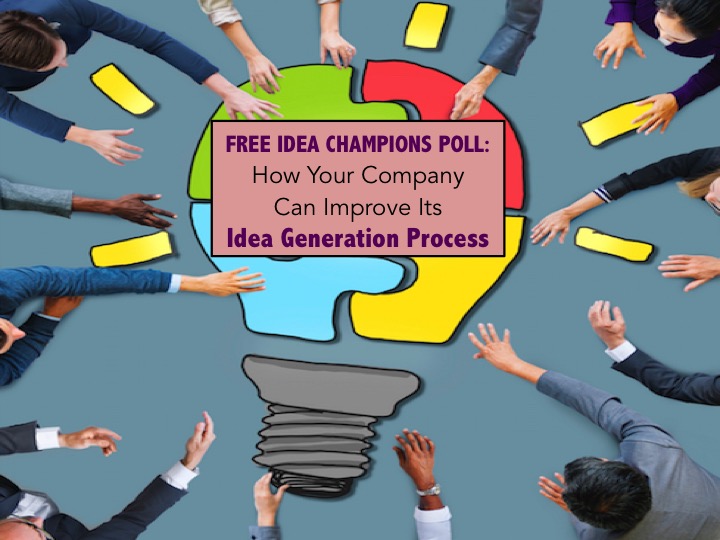
Here's the simplest way to figure out how to improve your company's ideation process: Enter Idea Champions' FREE IDEATION POLL CONTEST. Just send an email to office@ideachampions and write "Ideation Poll" in the subject line. We'll put your name in the proverbial hat on May 1st and, blindfolded, pick out three winners.
If YOU are one of the winners, we'll send you a link to our ideation poll which you, in turn, will forward to your workforce. A week after that we'll send you the results along with a some useful "food for thought". The value? You will better understand where the holes are in your company's idea generation bucket so you can patch them up or begin figuring out how to get a different bucket. Sneaky marketing shtick from us? None. Nada. Zero. Zilch.
What our clients say about us.
50 quotes on the power of ideas
More about ideation process
Posted by Mitch Ditkoff at 01:34 PM | Comments (0)
March 03, 2017Learn to Lead Breakthrough Brainstorming Sessions from the Leader in the Field

If you need to radically upgrade your ability to facilitate kick-ass brainstorm sessions -- either internally, for your own company, or externally for clients looking to you to work some magic, look no further. Mitch Ditkoff (that's me), Co-Founder and President of Idea Champions, is now offering customized, live, one-on-one, just-in-time online tutorials for committed catalysts of brilliance. Highly engaging. Affordable. Fun. And immediately applicable to real-time business needs. Curious? Intrigued? info@ideachampions.com
PS: Longer, onsite, small group trainings also available.
Shout out from the PR World
Brainstorm or Shitstorm?
Client list
Happy brainstorming clients
Happy innovation-seeking clients
Posted by Mitch Ditkoff at 05:08 PM | Comments (0)
February 26, 2017The $750 Online Brainstorm Facilitation Training
More about the training
What our clients say
Posted by Mitch Ditkoff at 09:32 AM | Comments (0)
January 24, 2017HOW EFFECTIVE ARE YOUR COMPANY'S BRAINSTORM SESSIONS? Find Out in 10 Minutes

Whenever I ask clients to describe the quality of their brainstorm sessions, they usually role their eyes, shake their head, and use words like "suck", "boring", or "pitiful." But when I ask them WHY, they don't know. And they have very few clues about how to turn things around.
Idea Champions aims to change all that -- at least for the first three companies who respond to this blog post and request a FREE online Brainstorm Participant poll from Idea Champions -- the simplest way we could think of to help forward thinking organizations get a pulse check on the quality of their in-house brainstorm sessions.
Here's how it works:
1. Email info@ideachampions with "Brainstorm Poll" in the subject line.
2. We'll send you a custom link to our Brainstorm Poll
3. You forward the poll to anyone in your organization who has attended an in-house brainstorming session in the past year.
4. We'll send you the poll results, along with our observations.
5. If you want to find out how we can train your people to become masterful brainstorm facilitators, we'll talk.
Brainstorming game changer
Our training
Client testimonials
Posted by Mitch Ditkoff at 08:17 AM | Comments (0)
December 17, 2016How to Facilitate Breakthrough Brainstorming Sessions for Your Clients in Three Hours or Less

Here's the deal: You are one of the creatives in a high flying PR, Marketing, or Communications company and have been asked by one of your clients to lead an upcoming brainstorming session. That's the good news. The-not-so-good news? Even though you're an idea-generating machine, facilitating sessions that bring out brilliance in others is not your forte. And to raise the stakes even higher, your client wants more than just "ideas". Your client wants remarkable, actionable ideas and wants the session to be highly engaging, energizing, and worth their precious time. Get it? The heat is on, big time.
Idea Champions can teach you how
Posted by Mitch Ditkoff at 04:08 PM | Comments (0)
July 17, 2016The 60-Minute Brainstorm Training

We are happy to announce our new strategic alliance with GenieCast, and the launch of our new 60-minute brainstorm facilitation training. Fast. Very fast. No caffeine required. Includes a custom set of self-study videos and articles. Like this.
Our GenieCast session
Our longer Brainstorm facilitation training
What our clients (briefly) say
What's next after Twitter

Posted by Mitch Ditkoff at 12:47 PM | Comments (0)
July 11, 2016ENERGY and FOCUS: Two Keys to Great Brainstorming Sessions

A brainstorm session is a lot like trying to get from one place to another in a lighter-than-air balloon. With both of them, you have a destination, a vehicle, and the need to continuously make course corrections.
Fortunately, brainstorm facilitators have two dependable resources at their disposal to keep their "ideation balloon" aloft: Energy and focus.
Focus is the balloon itself. Energy is the helium that gets pumped into the balloon to provide it's lighter-than-air capability -- the element that gets it off the ground.
These two resources should be zealously maintained throughout any brainstorm session you facilitate. Any leak of energy or focus sets you on a course for premature grounding. In other words, you won't reach your destination if you've got energy or focus leaks.
In order to monitor the energy of any session you facilitate, you will need to pay close attention to three main phenomena: body language, engagement, and interaction. You want positivity. You want active participation. And want inter-connectedness.
Here's 8 ways to ensure that participants stay focused.

1. Ensure that participants know what the brainstorm is going to be about before the session begins. Communicate the specific challenge to be addressed and your hoped-for outcomes of the session.
2. Frame the topic to be brainstormed in the form of a "How can we?" question.
3. Write the question to be brainstormed in big letters on a flip chart so it is always visible to participants.
4. Repeat the "How can we?" question whenever the flow of ideas slows down. In other words, restate the problem being addressed at varying intervals throughout the session
5. Reinforce the ground rules established at the beginning of the session.
6. Make sure participants know what the agenda is and what process you will be using to ensure results. This will decrease doubt, increase trust, and keep minds from wandering.
7. Remind participants, from time to time, where they are in the process. Reaffirm that the group is on their way to resolution.
8. Use some simple, structured ideation techniques that allow everyone to participate.
Big thanks to Val Vadeboncoeur, Idea Champions' Director of Training for this timely piece of writing. Up, up, and away!
Brainstorm Facilitation training
Our brainstorming website
Our clients speak
High Velocity Brainstorming
Posted by Mitch Ditkoff at 08:21 AM | Comments (0)
June 07, 2016HOW TO GET PEOPLE OUT OF THE BOX: A 5-Minute Tutorial

Ever heard the expression "get out of the box?" Of course you have. Ever wonder what the six sides of that so-called box actually are? If not, here's your 5-minute tutorial of the day. Once you're clear about what the sides of the box are, you will be significantly more able to help people (and yourself) get out of it.
One way to get out of the box
Another way
My book on the subject
Boxes
Posted by Mitch Ditkoff at 11:24 AM | Comments (0)
May 06, 2016A Very Cool Brainstorm Facilitation Training for People in the Fast Lane
Our brainstorm website
More about the training
What our clients say
Tell us more about your need
Our client list
VIDEO: The eight dimensions of a brainstorming session
Posted by Mitch Ditkoff at 12:49 PM | Comments (0)
April 12, 2016When Dogs Spark Big Ideas

During the past 25 years I have facilitated more than 1,000 brainstorming sessions for a wide variety of heavy hitting organizations -- everyone from MTV to GE to government think thanks. I've worked with left-brained people, right-brained people, and reptilian-brained people.
As you might imagine, I've developed quite a few techniques to get people out of their heads and into a more robust realm of possibility. But the biggest breakthroughs I've seen have had less to do with my methods than they did with spontaneous occurrences.
Like the time a Porcelain Hotel Dog became the catalyst for a game changing product idea.

Here's the deal:
I was leading a daylong ideation session for a large telecommunications company when it was time for lunch. Everyone left the room, visions of tuna wraps in their head, when I noticed a peculiar looking porcelain dog, next to a plastic fern, in the corner of the room -- the kind of kitschy piece of Americana you'd walk by at a yard sale, mumbling under your breath that this was absolutely the last time you'd ever attend a yard sale.
Somehow, I found myself drawn to the dog and, being in a particularly playful mood, picked it up and placed it on a folding chair in the middle of the room.
Tickled by its absolute uselessness and lack of beauty, I put my hat on it's weird, little head, and went about my business of getting ready for the afternoon session.
Five minutes later, the head of HR walks into the room, takes off his power tie, and places it, with a chuckle, around the dog's neck.
Then an IT guy enters, removes his "Hello My Name Is" badge and sticks it on the dog's chest. A well-dressed marketing woman removes her necklace and wraps it around the dog's waist.
There, in the middle of the room, unleashed, unbarking, but no longer unloved, sits the perfect brainstorm session mascot -- a 3D embodiment of our collective mind at that moment in time.

The rest of the participants return soon enough and gather around the porcelain dog as if it was the Holy Grail. A Blackberry gets taped to his back, a scarf gets wrapped around his neck. Someone puts a bandaid over his mouth.
Something is happening that has absolutely nothing to do with my agenda for the day. A curious kind of creativity portal is opening up right before my eyes.
"OK!" I blurt, as soon as the last person returns from lunch. "What cool, new product ideas come to mind when you look at good ole' Fido here?"
Ideas start flooding the room. Big ideas. Bold ideas. Totally ridiculous ideas.
In just a few minutes, it is clear that a big idea is emerging -- an idea for a niche telecommunications market no one in this room has ever considered before -- animals -- more specifically, dogs who live with blind or disabled people -- the kind of dogs who could easily be trained to push a large red button on a one-button phone any time their Master was unable to -- what soon became known to all of us in that room, as the Paw Phone.
Pet idea conceived, we spend the next ten minutes fleshing it out, adding it to the list of the other big ideas to be presented at the end of the day to an independent focus group.
The funny thing? Of the ten ideas we pitched to the focus group that day, the Paw Phone was the third highest rated. Woof woof.
COMMENTARY

Good ideas can come from anyone at any time and any place. While it is impossible to predict precisely when and where the good ideas will manifest, it is possible to predict the conditions that will make it more likely for the good ideas to make their appearance.
In the Paw Phone session, one of these conditions was the spirit of playfulness and spontaneity that manifested itself so gloriously during the lunch break.
At that time, I simply followed my hunch that the porcelain dog, was, somehow, part of the creative process. I didn't know how things would unfold. I could only trust my instincts and past experience that, often, seemingly random catalysts are the DNA for breakthrough. That, and the fact, that when we manage to enter the state of not trying we often get the best results.
Carl Jung understood this phenomenon: "The creation of something new," he said, "is not accomplished by the intellect, but by the play instinct arising from inner necessity. The creative mind plays with the object it loves."
Play! The creative mind plays with the object it loves! Yes!
And yet, in the corporate world, playfulness is often demonized, marginalized, and ignored -- branded "unprofessional" -- as if it was a symptom of the worst kind of anti-business slacker mentality.
Indeed, if you find yourself laughing on the job, many of the people around you will think you aren't taking your job seriously. No wonder 62% of all Americans characterize themselves as being dissatisfied with work.
The roots of this weirdness can be traced all the way back to the Garden of Eden.
What happened to Adam when he took a bite of the forbidden fruit? He was condemned, for life, to earning his living by "the sweat of his brow". The free lunch was over. Adam's spontaneity doomed him to a life of heavy lifting and we are the ones who have gotten the hernia.
It's time to shed the notion that work always has to be so serious -- that grunting and groaning is the preferred response and that laughter, in the workplace, means you're not working. Baloney. Untrue. Bogus. Cro-magnon. Insane.
This just in: Life is supposed to be fun. And since work is a part of life, it too needs to be fun -- especially when you find yourself in the middle of a brainstorming session, trying to originate the kind of ideas that will make a difference in the world.
FOOD FOR THOUGHT:
On a scale of 1-10, with 10 being the highest, how serious is your workplace? The brainstorming sessions you attend?. And if it's 7 or more, what can you do to lighten things up?
BONUS QUESTION: What laughable idea of yours may have more merit in it if you just dig a little deeper into the essence of what that idea is really all about?
Excerpted from Storytelling at Work
Brainstorm facilitation training
What our clients say
Idea Champions
High velocity brainstorming
Posted by Mitch Ditkoff at 10:45 PM | Comments (0)
April 07, 2016Upgrade Your Brainstorm Facilitation Skills the Simple Way
Want to upgrade the quality of your company's brainstorm sessions? Looking for a simple way to open the creative floodgates? Here's one way.
Read this if you think brainstorming is bogus.
Covers for our new 142-page facilitator guidebook
A fun read
Posted by Mitch Ditkoff at 07:37 AM | Comments (0)
March 31, 2016Want to Upgrade Your Company's Brainstorming Sessions?

"We found Idea Champions in a desparate search for brainstorm facilitation training and haven't looked back. During the past few months, they've helped us harness our naturally innovative spirit and significantly improved the way we execute our ideation process. We now have the tools and process we need to dig deeper into our creativity -- adding a lot more value and power to our company culture."
-- Jody Johnson, Chief People Officer, M Booth & Associates
"Idea Champions came to consult with M Booth just weeks after we were named 'Creative Agency of the Year' and helped us unlock an even greater level of thinking for our clients across the board. The creative shift came almost immediately after our sessions with Idea Champions began and continued to grow exponentially with each session. Now, our thinking is more innovative, more strategic and reached more efficiently."
-- Andrew Rossi, Creative Director, MBooth & Associates
Brainstorm Facilitation Training
More about our training
What our clients say
Posted by Mitch Ditkoff at 12:39 AM | Comments (0)
March 29, 2016Brainstorming Revisited
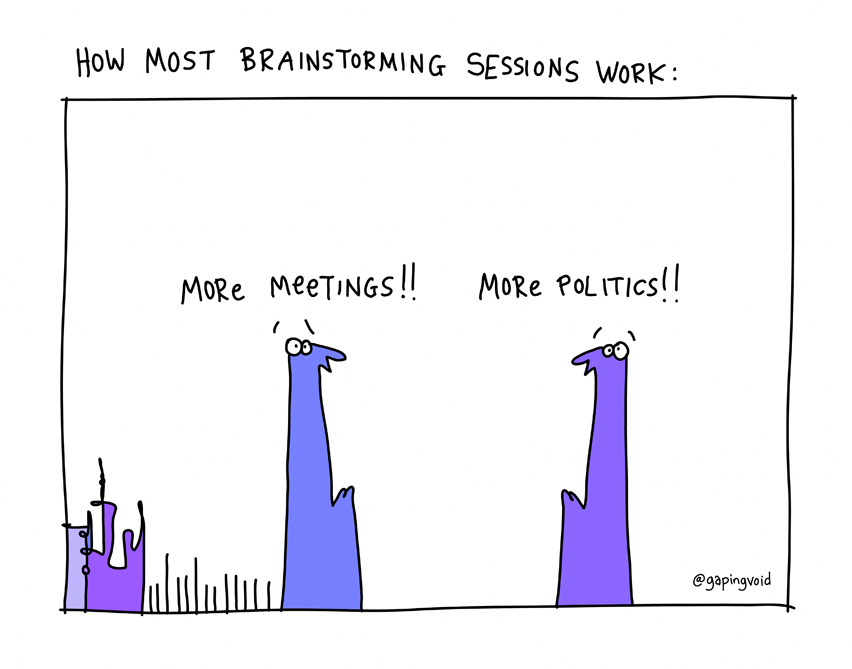
The good news? Idea Champions brainstorming sessions are not like most brainstorming sessions. What our clients say. Brainstorm, not shitstorm.
Brainstorming illustration: Gaping Void
Posted by Mitch Ditkoff at 07:47 PM | Comments (0)
March 14, 2016Time to Upgrade Your Brainstorm Facilitation Skills

YOU are creative. Always have been. Cool, new ideas come to you all the time. In the shower. On the way to work. Even in your dreams. Where others see problems, you see possibilities. You're flexible, funny, and think on your feet. Which is why you were tapped to lead brainstorming sessions in your company.
You said YES of course, and are glad you did, but over time your sessions have become... well... er... uh.. a bit predictable. Same people. Same process. Same creeping sense that you need to try something different.
After all, you're in the business of the new. Right? That's how you've won new business in the past -- and that's how you've kept your clients coming back for more. Yes?
Towards that end, I invite you to take a few minutes to reflect on the following questions:
"How can I upgrade my brainstorm facilitation skills?"
"How can I learn new ways to tease out brilliance in others?"
"How can I become a catalyst for breakthrough thinking?"
PS: Here's how
More about our approach
Case studies
How we got started
Posted by Mitch Ditkoff at 12:43 PM | Comments (0)
March 09, 2016How to Keep Small Group Brainstorming On Track

If you are planning to lead any kind of ideation or brainstorming session in the near future and will be dividing the group into sub-groups, here's one thing to keep in mind:
No matter how clear the instructions you give or how much you reinforce the ground rules of brainstorming, there is a 95% chance that the small groups will default to any of the following instead of brainstorming: conversation, debate, storytelling, schmoozing, philosophizing, venting, and question-asking. Bet on it.
WHY does this happen? Because there is precious little time, in most organizations, for people to simply get together and TALK about their issues, problems, and concerns in a meaningful way. Too many people work alone and don't have enough opportunities to get input, information, non-threatening feedback, and the perspective of others.

Bottom line, most people are subject to their own version of Maslow's Hierarchy of Needs (i.e. physiological, safety, love/belonging, esteem, self-actualization).
In other words, before diving into the "higher octave stuff" (i.e. creative thinking), people need to deal with the basics of their business life -- the stuff that is "on their minds."
If you only have a little while for a brainstorming session, you, as facilitator, of course, want to "cut to the chase" and get people ideating, but THEIR need usually involves something else, something more immediate that needs expression and an audience.
WHAT CAN YOU DO ABOUT THIS?
1. Create more opportunities, on the job, for people to share their experiences, information, and perspectives with each other.
2. Schedule longer brainstorming sessions, so people have the time to "stretch out."
3. Include some "hierarchy of needs" time early in your session (i.e. small group sharing that had nothing to do with ideation).
4. Before dividing into small groups, be very upfront about this non-ideation phenomenon. Let people know their deliverable is ideas, not conversation, venting, or storytelling.
5. Ask each group to identify a "brainstorm facilitator" to keep things on track. Explain that role clearly.
6. State the brainstorming ground rules very clearly and project them onto a big screen for all people to see.
7. Create a "venting wall" where people can post their gripes and complaints on post-it notes before the brainstorming groups begin.
8. Give people a measurable goal for their small group brainstorming sessions (i.e. each person needs to jot down at least 10 new ideas).
9. After the brainstorming begins, wander around the room and observe the groups. If they are getting off track, remind them of the goal. (PS: Before the brainstorming begins, alert people people to the fact that you will be doing this, so they don't feel "singled out.")
10. Train a select group of in-house change agents how to facilitate effective brainstorming sessions.
Posted by Mitch Ditkoff at 08:49 AM | Comments (1)
March 02, 2016WOOF! Go Beyond Your Pet Ideas!

If your company runs brainstorming sessions, know this: too many of them have become veiled opportunities for people to trot out their pet ideas.
Because everyone is so ridiculously busy these days and real listening is at a premium, people use brainstorming sessions as a way to foist their pre-existing ideas on others.
And while this sometimes leads to results, it doesn't make best use of the opportunity a brainstorm session provides. The way around this phenomenon?
Give people a chance to express their pre-existing ideas at the beginning of a session. Clear the decks. Then use the rest of the time to explore the unknown. Woof! Woof!
High Velocity Brainstorming
Conducting Genius
Idea Champions
Posted by Mitch Ditkoff at 07:48 AM | Comments (2)
October 14, 2015In Defense of Brainstorming

In the past few years I have noticed a curious trend in the media -- one I can no longer ignore -- and that is the appearance of seriously derisive articles about brainstorming by self-declared pundits and free lance writers.
Citing selected research on the subject and paying brief homage to Alex Osborne, the father of brainstorming, they make bold assertions about the ineffectiveness of the method, often claiming that "it does not work" and making grand declarations like "people are more creative away from the crowd" and "over 50 years of research shows that people often reach irrational decisions in a group."
While the previous two quotes do have some degree of truth associated with them, likening a brainstorm session to a "crowd" is not only a poor choice of metaphors, it is patently untrue.

And while many irrational decisions have been made in groups since the beginning of time, to assume that irrational decisions will necessarily be made in a brainstorming session is only more proof that the writers of the recent spate of anti-brainstorming screeds have either never participated in a skillfully facilitated brainstorm session or are hopelessly late for their next journalistic deadline, refusing to take the time to go beyond their specious all-or-nothing conclusions drawn from someone else's research -- some of which is more than 50 years old.
To blatantly conclude that brainstorming sessions don't work is as absurd as saying that marriages don't work because 50% end in divorce or tourists shouldn't visit New York City because sometimes the traffic is bad.
What I'm guessing that brainstorming naysayers really mean is that bad brainstorming sessions don't work... or poorly facilitated brainstorming sessions don't work... or brainstorming sessions with the wrong mix of unprepared participants (marriage, anyone?) don't work.
Brainstorming critics like to cite a 1958 study, at Yale, that showed that students thinking on their own came up with twice as many solutions as brainstorming groups -- and their solutions were deemed to be more effective and feasible.

Fine. Good. Terrific. I'm all for people thinking on their own in their dorm room... or Starbucks... or the zoo. That's a good thing. But as a replacement for a well-run brainstorming session? Why the either/or syndrome? Why not both?
Just because you had breakfast this morning doesn't necessarily mean you should skip dinner tonight, does it?
And besides, even a casual scan of the literature will reveal an extraordinary number of innovation-leaning people who joined forces with others to conceive something brilliant that none of them could have conjured on their own.
Think Jobs and Wozniak. Think Watson and Crick, Hewlett and Packard, John, Paul, George, and Ringo -- and any number of less famous ad hoc groups of aspiring innovators, working in all kind of organizations, who came out of their corporate dorm rooms long enough to jam with other seekers of possibility to jump start bold new advances in just about every industry on planet Earth.
But wait! There's more!
The anti-brainstorming forces are also fond of asserting that creativity is stifled in a brainstorming session.
Hello! Earth to journalists on deadline writing about brainstorming for a flight magazine. To claim that creativity will invariably be stifled in a brainstorming session is like saying that creativity will invariably be stifled in a marriage... or in a school... or in an organization. Possible? Yes. Whenever two or more people with egos get together, creativity has the potential to be stifled. But inevitable? No.
On the contrary, creativity is often sparked in a group -- even groups that are cranky, competitive, and strong-willed. Indeed, "creative dissonance" is often the catalyst for breakthrough -- NOT lone wolf, ivory tower idea generators sitting alone in their room attempting to conjure up the next big thing.
Brainstorm detractors -- as least the ones I've read -- are fond of citing "social loafing', "social blocking", "free riding", and other group-centric sociological phenomenon as proof of why brainstorming sessions should cease to exist.
Yes, I agree that some people who work in organizations fit this slacker stereotype. But there is no room for this kind of energy-sucking behavior in a well-run brainstorming session -- one that has been thoughtfully prepared, the right people invited, and with a skillful facilitator catalyzing the creative process.

Would brainstorm detractors suggest that we get rid of cities because some of them are polluted, or get rid of marriages because some couples quarrel, or eliminate music because some people turn up their stereos just a little too loud when their neighbors are trying to sleep?
With all due respect (well, with at least some respect), I humbly invite the small, but very vocal anti-brainstorming faction to pause for a moment and contemplate any one of the following questions -- questions with the potential to spark the kind of creative thinking our small, but very vocal anti-brainstorming faction might have missed by not participating in a brainstorming session on this very topic.
1. How can brainstorm sessions be improved?
2. How can the facilitators of brainstorm sessions learn how to dependably spark creativity in others?
3. How can brainstorm sessions build on the good ideas generated by participants before the session begins?
4. How can team leaders or project managers ensure that the right mix of people attend their brainstorm sessions?
5. How can a group of brainstorm participants generate and abide by a set of guidelines that will radically increase their odds of generating breakthrough ideas?
6. How can brainstorming become part of a continuum of idea generation strategies in an organization, so its "idea eggs" are not all in the same basket?
5 MINUTE VIDEO: The 8 Dimensions of a Brainstorming Session
25 reasons why brainstorming sessions fail
Brainstorm Facilitation Training
High Velocity Brainstorming
What our clients say about our impact
Posted by Mitch Ditkoff at 07:47 PM | Comments (0)
September 15, 2015The Art of Sparking Innovation
When my mother was alive, she told me she had no idea what I did for a living. Around the canasta table, she would tell her friends I was a "motivational speaker", no matter how many times I explained what I actually did. The slide show below is dedicated to her and to YOU, too -- especially if you're wondering what the heck goes on in one of Idea Champions' innovation-sparking workshops. Best to view full screen.
Posted by Mitch Ditkoff at 05:18 PM | Comments (0)
June 08, 2015Brainstorm or Shitstorm?

Full disclosure: The title of this blog post is not original. I borrowed it from a new client of mine, Jess Seilheimer, Chief Strategy Officer of MWW -- a force of nature who recently invited my company, Idea Champions, to design and facilitate a 5-hour multi-agency brainstorm session. Jess' description of her experience and the impact of the session made my day. If you are looking for a better way to run your brainstorm sessions, Jess' blog post is for you.
High velocity brainstorming
More about our approach
What our clients say
Posted by Mitch Ditkoff at 10:38 PM | Comments (0)
April 09, 2015The 8 Dimensions of a Brainstorm Session
Most people think brainstorming sessions are all about ideas -- much in the same way Wall Street bankers think life is all about money.
While ideas are certainly a big part of brainstorming, they are only a part.
People who rush into a brainstorming session starving for new ideas will miss the boat (and the train, car, and unicycle) completely unless they tune into the some other important dynamics that are also at play:
1. INVESTIGATION: If you want your brainstorming sessions to be effective, you'll need to do some investigating before hand. Get curious. Ask questions. Dig deeper. The more you find out what the real issues are, the greater your chances of framing powerful questions to brainstorm and choosing the best techniques to use.
2. IMMERSION: While good ideas can surface at any time, their chances radically increase the more that brainstorm participants are immersed. Translation? No coming and going during a session. No distractions. No interruptions. And don't forget to put a "do not disturb" sign on the door.
3. INTERACTION: Ideas come to people at all times of day and under all kinds of circumstances. But in a brainstorming session, it's the quality of interaction that makes the difference -- how people connect with each other, how they listen, and build on ideas. Your job, as facilitator, is to increase the quality of interaction.

4. INSPIRATION: Creative output is often a function of mindset. Bored, disengaged people rarely originate good ideas. Inspired people do. This is one of your main tasks, as a brainstorm facilitator -- to do everything in your power to keep participants inspired. The more you do, the less techniques you will need.
5. IDEATION: Look around. Everything you see began as an idea in someone's mind. Simply put, ideas are the seeds of innovation -- the first shape a new possibility takes. As a facilitator of the creative process, your job is to foster the conditions that amplify the odds of new ideas being conceived, developed, and articulated.
6. ILLUMINATION: Ideas are great. Ideas are cool. But they are also a dime a dozen unless they lead to an insight or aha. Until then, ideas are only two dimensional. But when the light goes on inside the minds of the people in your session, the ideas are activated and the odds radically increase of them manifesting.
7. INTEGRATION: Well-run brainstorming sessions have a way of intoxicating people. Doors open. Energy soars. Possibilities emerge. But unless participants have a chance to make sense of what they've conceived, the ideas are less likely to manifest. Opening the doors of the imagination is a good thing, but so is closure.
8. IMPLEMENTATION: Perhaps the biggest reason why most brainstorming sessions fail is what happens after -- or, shall I say, what doesn't happen after. Implementation is the name of the game. Before you let people go, clarify next steps, who's doing what (and by when), and what outside support is needed.
Brainstorm facilitation training
Posted by Mitch Ditkoff at 01:17 AM | Comments (4)
March 07, 2015How Do You Bring Out Brillance from a Diverse Group of People?
Brainstorm facilitation training
The DNA of our training
What our clients say
Posted by Mitch Ditkoff at 01:08 AM | Comments (0)
January 24, 2015Radio Woodstock in the House!

We just received this very nice piece of feedback from the President of Radio Woodstock, Gary Chetkof.
"Idea Champions was a true partner in helping us untangle some of the issues we were struggling with. They were very easy to work with and the processes used were fun and creative and they worked splendidly. We were able to find out what the major obstacles were and our entire team worked together to find solutions. Everyone participated fully, and everyone now has much more clarity about how to better work together. We even have our new mission statement that you can see on our Facebook page! I wholeheartedly recommend Idea Champions to any business that wants to problem solve, brainstorm, or get their employees to work more harmoniously together."
Our teambuilding offerings
Yes, Idea Champions is based in Woodstock!
And this just in from Richard Fusco, Radio Woodstock's General Manager:
"As a small company where everyone wears many hats, being organized and all pulling in the same direction is key. Strangely, as a communications company, our internal communications were off. Val Vadeboncoeur of Idea Champions helped us with all three. His sessions were focused and fun. We all came away with a new unified working spirit."
Posted by Mitch Ditkoff at 11:34 AM | Comments (0)
December 09, 2014How to Jump Start Brilliance in 2015 in an Extremely Cost Effective Way

The first company that says YES to Idea Champions' brainstorm facilitation training (and signs a contract by 12/31) receives a 20% discount. This ain't eBay folks, but it IS a good deal. Operators are NOT standing by. (We don't have any operators). But we will get back to you within 24 hours.)
Brainstorm Champions
What our clients say
Posted by Mitch Ditkoff at 04:41 PM | Comments (0)
November 05, 2014Our New Brainstorm Website

BrainstormChampions.com
Our NYC showcase on 11/19
Posted by Mitch Ditkoff at 11:37 PM | Comments (0)
October 23, 2014Why Does Your Company Brainstorm?

We asked 20 of our clients WHY their companies conduct brainstorming sessions. Here's what they told us, on a scale of 1-5.
4.27 Get different points of view
4.11 Spark creative thinking
4.11 Originate fresh approaches
4.05 Create new possibilities
4.05 Inspire original thinking
4.00 Challenge the status quo
4.00 Tap collective genius
3.94 Unlock fresh insights
3.94 Stir the creative juices
3.94 Generate bold, new ideas
3.83 Jump start innovation
3.77 Solve tough challenges
3.77 Free up creative energy
3.77 Think out of the box
3.72 Think up new solutions quickly
3.66 Accelerate solution finding
3.50 Awaken untapped brilliance
3.38 Quicken the ideation process
3.00 Delight your clients
We teach people how to lead breakthrough brainstorming sessions.
Posted by Mitch Ditkoff at 01:51 PM | Comments (0)
October 14, 2014Join Us in NYC on November 19th

Posted by Mitch Ditkoff at 11:59 PM | Comments (0)
October 01, 2014HOW TO FACILITATE BRAINSTORMING SESSIONS: A 5 Minute Video Tutorial

Here's a 5-minute video tutorial on the eight dimensions of a brainstorming session. Most facilitators think brainstorm sessions are all about ideation. They're not. There are seven other variables at play that effect the outcome of your ideational efforts.
In defense of brainstorming
Brainstorm facilitation training
Why nothing happens after a brainstorming session
You CAN tell a book by its cover
Posted by Mitch Ditkoff at 03:53 PM | Comments (0)
August 22, 2014How to Prepare for a Brainstorming Session
Our latest Huffington Post article on how to prepare for a brainstorming session.
Brainstorm facilitation training
Posted by Mitch Ditkoff at 05:17 PM | Comments (0)
August 02, 2014Unleashing Business Brilliance

That's what we do. And below are five ways we do it.
Conducting Genius
Engaging Innovation
Ingenious Leadership
What's the Problem?
Team Innovation
What our clients say
Posted by Mitch Ditkoff at 05:00 PM | Comments (0)
August 01, 2014Brainstorm Training DNA
Recently, Idea Champions has getting a lot of requests for our brainstorm facilitation training. Not exactly sure WHY, at this moment of time, but it is a happening thing. What follows is a brief description of our approach.
Conducting Genius is an interactive learning experience that provides participants with the skill, experience, and confidence they need to become effective brainstorm facilitators. Knowing that people learn best by doing, we've designed the 1-3 day training to be as interactive as possible -- one that includes the following eight customizable elements:
1. Master Trainer Tutorials: At selected intervals, we deliver two kinds of topic-specific tutorials: 1) The art and science of brainstorm facilitation and; 2) The right use of ideation tools, techniques, and processes.
2. Discussions: Most tutorials are followed by lively discussions in which participants explore ways they might apply the content of the tutorials to their own brainstorm facilitation challenges on the job.
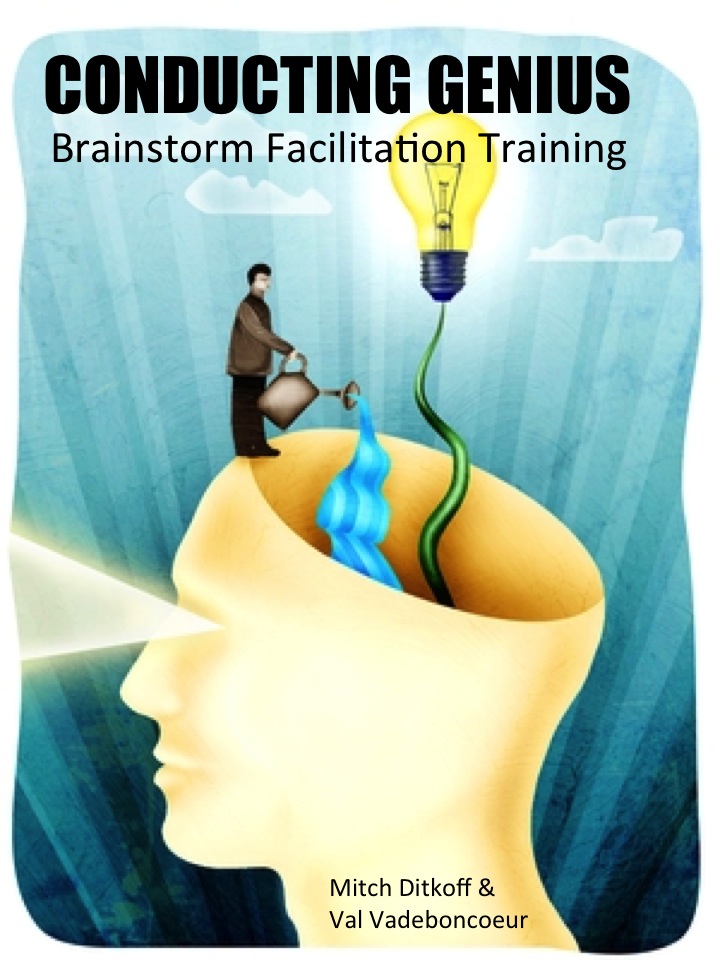
3. Brainstorm Technique Practice: Conducting Genius participants learn and practice 8 - 20 idea generation techniques. Each technique is applied to a specific "How can we?" or "How can I?" question participants will have identified, pre-training.
4. Experiential Challenges: Time allowing, we engage participants in hands-on action learning activities to challenge assumptions, spark new insights, and move them deeper into the learning mode. These challenges renew, refresh, and reveal new topics to explore.
5. In-Training Brainstorm Practice Sessions: Participants get multiple opportunities to lead the group through ideation processes of their own choosing, applying newly learned skills and techniques to business-specific challenges.
6. Intake Interview Greenhouses: In the advanced version of the training, participants take a deeper dive into the pre-brainstorm session prep process, practicing their client intake and needs assessment skills with real clients, real-time.
7. Guest Group Brainstorming Sessions: In the advanced version of the training, participants lead real-time brainstorming sessions, on the third day, with pre-selected in-house teams. Each session is debriefed and guest teams share their feedback.
8. Review of Facilitator Guidebook: Since there is significantly more material included in the 140-page Facilitator Guidebook than can be covered in the training, we review the book at the end of the course, alerting participants to sections most relevant for them to study, on their own, post-training.
Conducting Genius
What our clients say
Tell us what you need
Posted by Mitch Ditkoff at 10:01 AM | Comments (0)
June 22, 2014Blue State Digital in the House!

We're psyched!
Blue State Digital -- a new media strategy and technology firm that specializes in online fundraising, advocacy, social networking, and constituency development has invited Idea Champions to custom design and lead a three-day brainstorm facilitation training for some of their movers and shakers in September.
We're honored and are very much looking forward to working with these fine folks to see how they can make their brainstorm sessions even more engaging and effective.
How did they find us? By googling "brainstorm facilitation."
See possible covers for their facilitator's guidebook
Take our "why brainstorm?" poll
What is YOUR big idea?
Posted by Mitch Ditkoff at 12:55 PM | Comments (0)
June 11, 2014Brainstorming Website Coming Soon!
Posted by Mitch Ditkoff at 11:14 PM | Comments (0)
June 07, 2014Got Ideation Process?

Posted by Mitch Ditkoff at 09:53 PM | Comments (0)
May 16, 2014Strike Up the Bandwidth!

Brainstorm Facilitation Training
50 quotes on possibility
Posted by Mitch Ditkoff at 05:21 PM | Comments (0)
March 29, 2014That Big Beautiful Idea of Yours
What big, beautiful idea of yours needs just the right touch of collaboration, support, and immersion to see the light of day? Your next step? And when will you take it?
One way to get rolling
Brainstorm facilitation training
Idea Champions
Posted by Mitch Ditkoff at 10:00 AM | Comments (0)
March 19, 2014A Cool Online Creative Thinking Tool

Got a challenge? Need a big idea, insight, or breakthrough? Try Idea Champions' online creative thinking tool, The Idea Lottery. Absolutely free. You'll need a question to brainstorm and about 10 minutes.
We teach this and other innovation catalysts in this course
Posted by Mitch Ditkoff at 08:38 PM | Comments (0)
February 12, 2014When a Brainstorming Session is Not a Brainstorming Session

I finally figured out why so many brainstorming sessions fail. It's the exact same reason why so many marriages fail. The couple shouldn't have gotten married in the first place.
Many brainstorm sessions that are called never should have happened. And while some kind of meeting may have been appropriate for the invitees to attend, the form of a brainstorm session was the wrong form.
So, before you call your next brainstorming session, pause for a moment and ask yourself what the real purpose of your meeting is. If it's not the generation and development of new ideas, your meeting is not a brainstorming session, but one of the following.
1. INFORMATION SHARING MEETING: A chance for participants to update each other on projects, download knowledge, share research and other changes impacting their common project. No new ideas are really needed here -- just the real-time sharing of information.

2. TOPIC DISCUSSION MEETING: Some meetings need to be nothing more than talking head sessions. These kinds of meetings give people a chance to air out opinions, share questions, and listen to each other. There's nothing wrong with these kinds of meetings -- but they don't necessarily require brainstorming for them to be effective.
3. TEAM ALIGNMENT MEETING: Sometimes teams simply need to get together to get on the same page. While this may include the sharing of information, it may also be a time for people to connect, clarify their collective vision, and reinforce their commitments. While this may seem "soft," it's not. Unless your team is connected, it's unlikely they will be effective. Getting your ducks in a row usually requires more discussion than brainstorming.
4. FEEDBACK MEETING: Sometimes it's useful for team members to give and receive feedback to each other. This kind of meeting can be as simple as a few "report outs" and then some honorable sharing of feedback. Ideas may emerge in the process, but a feedback meeting is not a brainstorm session. Ideas are less important that the ability of participants to listen to each other and speak their truth.
5. DECISION MAKING MEETING: Sometimes the only reason for a team to get together is to make decisions. Who's doing what? Why? By when? If your team has no agreement or process in place about how it makes decisions, these kinds of meetings won't go very well -- unless, of course, it's already been established that the "boss" or "team leader" is the one with the power to make decisions on behalf of the team.
Make sense?
If you really need to call a brainstorm session
Idea Champions
Posted by Mitch Ditkoff at 10:23 PM | Comments (0)
February 08, 2014BRAINSTORMING TIP #19: First Diverge, Then Converge

If you are gearing up for a brainstorm session, allow me to offer you one piece of advice: first diverge, then converge.
Beyond the muffins, coffee, and people arriving fashionably late, brainstorm sessions are composed of the two aforementioned "erges."
Divergence is the act of "getting out there" or what Webster refers to as "an infinite sequence that does not have a limit." Go, Noah, go! Divergence is a deviation from the norm -- kind of like your brother-in-law.
Without divergence, brainstorm sessions are flat, boring, one-dimensional, and a roaring waste of time.
But if the only thing you do is "get out there," never coming back to home base, all you will have done is tease participants by temporarily stimulating their imagination.

That's why you need divergence's accountant-like cousin convergence -- the act of "coming together toward one point."
Divergence and convergence -- like day and night, hot and cold, peanut butter and jelly, are both necessary if you want your brainstorm sessions to really hum.
How to spark divergence?
Well, for starters, invite inspired people, define a compelling challenge, establish a sense of urgency, express humor, give participants permission to take risks, and make sure the facilitator knows what they're doing.
Convergence can be achieved in many ways, as well, including verbally summarizing session results, restating the most popular ideas, voting, identifying champions, action planning, and clarifying what will happen to new ideas, post-session.
For more on why most brainstorming sessions don't work (and what you can do about it), click here... or here if you don't want to click any of the aforementioned hyperlinked words, click here.
The brainstorm sessions we lead
We can teach you how to facilitate breakthrough sessions
What our clients say
Click this to tell us about your needs
Posted by Mitch Ditkoff at 11:36 PM | Comments (2)
February 01, 2014How to Prepare for Brainstorming

Aficionados of the martial arts will tell you that a competition between two opponents is determined in the bow -- the moment before the "action" begins. Savvy gardeners will tell you that if you really want to get a harvest, pay special attention to preparing the ground.
And I will tell you this: if you want your brainstorming sessions to bear fruit, be mindful of the time before anyone pitches even a single idea.
Because it's the few days before a brainstorm session begins -- the "incubation time" -- that's often the difference between brilliance and boredom.
Unfortunately, most companies don't get this.
What typically happens?
Someone with a pressing need for new ideas invites a few people -- usually the "usual suspects" -- to brainstorm. If, perchance, this idea-needing person has taken the time to write a brief and send it out, few people read it. And those who do, read it more like the back of a cereal box than anything else.

Either no one does the due diligence required to adequately prepare for the meeting or the due diligence that is done (i.e. research, articles, surveys) is ignored, under-valued, or ridiculed.
People bop into the meeting over-caffeinated and under-prepared.
Yes, ideas are generated, but they are often only a collection of pet ideas -- ones that have long-ago been generated. Game changing concepts are few and far between, not because the people in the room are incapable of game changing concepts, but because there is no common, fertile ground of understanding, no incubation, no real readiness for what is about to transpire -- or could.
Hey, if you're going to jog a few miles, warm up first. If you're going to boil an egg, heat up some water. Make sense?
The problem is this: most people equate preparing for a brainstorm session with "work" -- totally boring work -- and since they already feel overworked, the preparation for a brainstorm session is often perceived as optional -- kind of like what teenagers think when their parents ask them to clean up their room.
OK. Enough ranting. Here's the deal: If you want a meaningful return on the effort you and your team put into brainstorming, establlish a better, agreed-upon, process for what happens before people show up at one of your sessions.
And while there is no magic formula for this, there are definitely guidelines and principles that apply to most situations. Below are ten to get you started. If you see something missing, add it. If you can think of a better way to proceed, do that.
But do something. If you don't, you and your team will have accomplished little more than becoming the poster children for one of my favorite quotes: "If you always do what you've always done, you'll always get what you've always got."
BRAINSTORMING PREP GUIDELINES:
1. Be sure you have framed the right question.
2. Only invite people who really want to participate.
3. Identify the research and pre-work that needs to be done before -- and have someone actually prepare it.
4. Send the invitation and the pre-work at least three days before your session begins.
5. Set the expectation that a careful review of the pre-work is a pre-condition for attending.
6. Make sure that the facilitator has cleared their head and cleared a space for the brainstorming session to happen.
7. Begin the meeting on time. If someone shows up late, don't let them in. (And everyone stays for the duration).
8. Begin the meeting with a crisp review of the pre-work. Make sure everyone understands the basics before jumping off into never never land.
9. Eventually (sooner rather than later) make sure that everyone in your company understands and agrees to the "pre-brainstorming" protocol.
10. Keep this protocol as simple as possible (but no simpler, as Einstein liked to say). And continually refine it as you learn what works and doesn't work.
Idea Champions
The DNA of our brainstorm facilitation training
Conducting Genius
What our clients say
Tell us a little about your brainstorming needs
Contact us
Posted by Mitch Ditkoff at 06:57 AM | Comments (0)
January 13, 2014Want a Brainstorming Breakthrough? Get the Right Question!

There's a simple reason why so many brainstorm sessions are a waste of time. The problem statement being pitched to participants is the wrong one. This is not surprising -- especially when you consider how little time most facilitators put into preparing for a session.
Here's what happens: The person who calls the session is usually scrambling -- overwhelmed, over-caffeinated, and running from one meeting to the next. Out of breath, they pitch the topic to the group, but the topic is either vague or secondary to a more essential challenge that remains unspoken.
G.K. Chesterton, one of the most influential English writers of the 20th century, distilled the phenomenon down to 13 words. "It's not that they can't see the solution," he said. "They can't see the problem."
Then, of course, there's also the phenomenon of perception bias.
Pitch a challenge to an IT person, and it will be seen as a technology problem. Pitch it to a CFO, and it will be seen as a financial problem. Pitch it to a marketing person and it will be seen as a branding problem.
Or as a wise man once said, "When a pickpocket meets a saint all he sees are pockets."
If you plan on running an ideation session any time soon, don't just stumble into the room and pitch a vague topic to the group. Do your homework. Make the effort to identify the REAL issue before asking for ideas. If it's the WRONG QUESTION you present, no amount of idea generation is going to make a difference.
What question would you like to see your team brainstorm in the next week or so?
Brainstorm Facilitation Training
Brainstorming Sessions
Posted by Mitch Ditkoff at 04:06 PM | Comments (3)
November 14, 2013One Reason Why Brainstorming Fails

Advertising executive Alex Osborn, frustrated by his employees' inability to come up with novel and creative ideas, invented the concept of brainstorming in the late 1930's. His 1953 book, Applied Imagination, described how to apply the concept in very simple terms. Osborne put forth two basic principles: Defer Judgment and Focus on Quantity.
These days, people attempting to lead ideation sessions are often mindful of the first principle, but they almost never remember the second. And this, quite simply is a big reason why most brainstorm sessions fail to produce even mediocre results.
At first glance, the quantity principle seems counter-intuitive. How can people come up with quality ideas, you might ask, by not striving for quality ideas?
But there's a method to this madness -- and it has to do with how our minds work and how we are trained to think.
If you are asked to come up with "good" and "novel" ideas in response to a problem, challenge or opportunity, whether you are working alone or with others, you will tend to aim for the best ideas possible. Makes sense, right?
However, in your striving for the best idea, you will tend to dismiss ideas you consider to be less-than-terrific.
When ideas pop into our minds, we tend to judge them immediately as too small, too big, too pedestrian, too unrealistic, too obvious, too goofy, too ordinary, too expensive, or too whatever.
It's as if the Red Queen is ensconced in our brains, shouting "off with his head!" at every idea that dares to speak up.
That's because human beings are conditioned to see what's wrong with an idea before seeing its possibilities.
It's like seeing a baby bird and judging it to be inadequate because it can't fly yet.
And this process is barely conscious. We dismiss our ideas so quickly that we often don't even notice they were thought of at all. "We've got nothing" becomes our mantra.
If you are generating ideas in a group and everyone is experiencing this phenomenon at the exact same time, the great silence will inevitably head its ugly rear. No one will be willing to share any of the ideas that have popped into their heads because their ideas will be self-censored -- deemed to be inadequate or flawed.
This is why "experts" are, usually, the worst brainstormers imaginable.

Educated, experienced, and cognizant of all the ins and outs of the topic being brainstormed, experts will immediately see the flaws -- not the possibilities -- killing promising new ideas with the effectiveness of a healthy immune system killing off a germ or virus.
This is why many forward thinking focus groups bring in children or non-experts to generate new ideas -- people whose idea immune systems are not yet fully developed.
Think about it for a moment. If "ordinary" ideas can be generated, articulated, announced, and captured then an interesting thing can happen. Other people can improve the ideas. One idea will lead to another and another and another, radically increasing the odds of something truly original manifesting.
This kind of magic, however, cannot happen if Osborn's principle of striving for quantity is ignored.
Think of Osborn's dual principles as two sides of the same coin.
Defer judgment postpones the act of criticizing ideas as they are generated. Focusing on quantity helps us defer our tendency to judge our ideas as they are conceived.
Not unlike the proverbial coin, if you don't have both sides, "you've got nothing."
-- Val Vadeboncoeur
Idea Champions
Virtual Brainstorm Training
High Velocity Brainstorming
Posted by Mitch Ditkoff at 09:00 PM | Comments (1)
October 26, 2013Virtual Brainstorm Facilitation Training

We've done it! We've belled the cat. We've created the perpetual motion machine of facilitator training. We've found the Holy Grail.
More precisely, we've figured out how to virtually train people to become savvy brainstorm facilitators!
We rule!
And that means great cost savings for you and your company. No more booking hotel rooms, flights, and travel expenses. No more people losing work time by being on the road. No more full days lost to training, either.
We will come to you in a series of highly-engaging virtual online sessions to teach your people how to design and deliver breakthrough brainstorming sessions.

And these sessions will not be "off-the-shelf." They will be customized to fit the needs of your organization. Our simple needs assessment process will give us the information we need to know exactly how tailor our agenda to address the specific needs of your enterprise.
No one size fits all.
We can also adjust our schedule to match the schedules of your people. We can deliver in either one, two, three, or four-hour segments. And, depending on what type of program best suits your needs, we can schedule the training to happen quickly -- over a period of a few days -- or spread it out over six months.
With our extended program (3 - 6 months), participants get a chance to practice and incorporate each session's learnings between sessions -- held two weeks apart. In the intervening weeks, they'll have engaging assignments to do -- done individually or in teams -- to deepen and apply the learning on the job.
By the end of their time with us, they'll be ideation ninjas, ready for any challenge you throw their way.
Intrigued? Call us: 845-679-1066 -- or email Val Vadeboncoeur (val@ideachampions.com)
Our client list
What our clients say about us
Why train people to be brainstorm facilitators
Idea Champions
Posted by Mitch Ditkoff at 07:56 AM | Comments (0)
October 11, 2013The Musical Dynamics of Brainstorm Facilitation

A well-facilitated brainstorming session is like a symphony -- or, at the very least, a really good performance of any kind of music.
Embedded in its DNA are dynamics (i.e. "variation and contrast in force and intensity") -- the skillful modulation of elements that fully engages a person's attention.
The opposite? Muzak.
Next time you listen to a piece of music, be aware of dynamics -- the various ways in which the composition holds your interest (i.e. rhythm, pauses, crescendos, harmonies, solos, and multiple variations of soft and loud).
As a brainstorm facilitator, you need to do everything in your power to keep the session as dynamic as possible so participants remain fully engaged -- poised and ready to respond.
If the session is boring (or takes a "dip" after a brief period of engagement), your chances of succeeding decline exponentially.
Towards this end, think of yourself as a "conductor" -- the one who guides a group of individual contributors ("soloists") through an artful process that ensures a quality experience and a meaningful outcome.
Idea Champions
Why nothing happens after a brainstorm session
Why train people to become brainstorm facilitators
Posted by Mitch Ditkoff at 02:48 PM | Comments (0)
May 24, 2013Why Train People to Be Masterful Brainstorm Facilitators in 2014
The 8 dimensions of a brainstorm session
What our clients say
Idea Champions
Posted by Mitch Ditkoff at 09:55 PM | Comments (0)
April 20, 2013Honor Your Unusual Suspects
One thing I've noticed during the past 25 year of leading brainstorming sessions for a wide variety of Fortune 500 companies is the weird tendency many organizations have to under-value their "unusual suspects" -- people who don't show up on the "creative thinking radar screen" but have a ton of value to add.
Here's my story about one such moment at AT&T just published in the Huffington Post.
Idea Champions
High Velocity Brainstorming
What our clients say
Posted by Mitch Ditkoff at 07:30 PM | Comments (0)
January 26, 2013Why Train People to Become Masterful Brainstorm Facilitators
Idea Champions
What our clients say about us
Posted by Mitch Ditkoff at 12:58 PM | Comments (0)
December 16, 2011The Atlassian FedEx Day Goes Global

Atlassian is a very successful Australia-based software company founded in 2002. It has 400+ employees, with 125 of them in San Francisco.
It also has more than 17,000 satisfied clients including Google, Netflix, Facebook, Twitter, Skype, LinkedIn, Pixar, Adobe, Hulu, Salesforce, UPS, Nike, and Coca-Cola.
Atlassian's software helps companies organize their data, track it, collaborate about it, and detect/fix bugs in their software.
Yeah, I know... I had never heard of them before either.
But those days may soon be over. Atlassian is fast becoming famous not only for their popular software development tools, but also for their rapidly-spreading innovation creation playfully named "FedEx Day".
Very simply, FedEx Day is a 24-hour innovation immersion event that enables employees to brainstorm, prototype, and pitch their emerging innovations.
Why is it called "FedEx Day"? Because the goal of the 24-hour blitz is for participants to originate, develop, and deliver new products, new services, or business process improvements overnight.
FedEx Days typically begin on a Thursday afternoon at 2:00 pm and end with a spirited round of presentations delivered exactly 24 hours later.
The experience is energizing, empowering, and exciting -- with the company supplying pizza and beer (this DID originate in Australia, after all) for everyone on Thursday night.
The end result? Lots of useful and successful innovations that would not have materialized had employees been required to stick with their "day jobs."
Atlassian has been, internally, conducting FedEx Days (now done quarterly) since 2005. But this program is now spreading like a Charlie Sheen Twitter meme. Many other organizations, like Yahoo, Symantec, Flickr, Hasbro Toy, and the Mayo Clinic have all begun conducting their own versions of FedEx Day.
And, NOW, for the first time ever, Atlassian is offering to send their own FedExperts to one deserving company in order to help them conduct their own FedEx Day.
Explains Jonathan Nolen, one of Atlassian's FedExperts, "It's so exciting. The possibilities are endless. Everyone has great ideas and this gives them a way to unleash the power of those ideas. And it happens all over the organization. It's incredibly inspiring to see this happen in real time."
Atlassian's Annelise Reynolds agrees. "This is part of a new trend in business where companies are understanding the importance of engaging and energizing their employees. It works wonders for both the companies and their employees. The employees have fun and the companies get some great innovations."
Interested? Want to enter the contest? Click here. Or here to find out what Dan Pink, author of Drive and A Whole New Mind has to say about it.
Entering is simple. All you need to do is fill out this entry form and make a convincing case for why YOUR company or department could use a 24-hour innovation blitz.
Deadline is December 21st, 10:00 PM Pacific Time! Good luck! And good on ya, mate!
- Val Vadeboncoeur
Idea Champions
Posted by Mitch Ditkoff at 07:21 PM | Comments (0)
November 15, 2011Virtual Brainstorm Facilitation Training

Let me take a wild guess:
The brainstorming sessions you attend (or lead) leave something to be desired. You keep hoping they'll get better, but they don't. There's too much idea killing. Too much wheel spinning. Too much sound and fury, but not enough results.
You've thought about bringing in an outside training company, but they all seem a bit odd -- not to mention the fact that you can't find the budget -- or the time.
Not to worry. That's why we've created a new, flexible, virtual training program that makes it profoundly easy for you (and others) to learn the art and science of facilitating brainstorm sessions that work.
WHY HIRE US?
1. We've been facilitating brainstorming sessions since 1986.
2. We've worked with just about every industry (and mindset) on Planet Earth.
3. Our clients get tons of value.
4. We know how to bring out the best in aspiring facilitators.
5. We can customize the training for your specific needs.
6. We love what we do and are really good at it.
7. Our training materials are top-of-the-line.
8. We've created really cool online tools you can use in your sessions (live or virtual).
9. The co-designer of the training is the author of an award-winning book on the creative process.
10. Each person we train receives a lifetime subscription to Free the Genie, our highly regarded innovation-sparking app.
Intrigued? Contact us today. Or if not today, tomorrow. Or if not tomorrow, the day after.
Posted by Mitch Ditkoff at 04:41 PM | Comments (0)
December 03, 2010What You Can Learn from the Bloody Mary
In 1939, a Russian immigrant owned the rights to distribute vodka in the U.S. His efforts bombed, big time. Americans weren't interested in a colorless, odorless alcohol.
Depressed, he sold the rights to Heublein, who asked themselves: "What can we combine with Vodka to give it a distinctive taste and color?"
They came up with tomato juice and, voila, the Bloody Mary was born. Sales? Through the roof.
What most of us think of as an "innovation" is really just the elegant combination of two (or more) pre-existing elements resulting in the creation of a new, value-added product or service.
Want to try it for yourself? Click here for a cool, interactive technique.
Posted by Mitch Ditkoff at 01:39 PM | Comments (0)
November 02, 2010IDEATION 2020: Just-in-Time Brainstorm Facilitation Coaching

In honor of the year 2020 and the classic meme it represents (i.e. clear vision), Idea Champions is thrilled to announce the launch of an exciting new offering -- an elegant way for its time-crunched, Conducting Genius graduates to upgrade the quality and impact of their brainstorming sessions.
We call it Ideation 2020 -- the simplest, most time-efficient way we can think of to help our clients get the kind of results they want from their in-house, ideation sessions.
Simply put, we're offering live, online brainstorm facilitation coaching sessions in 20, 40, and 60 minute increments to help you:
-- Prepare for upcoming, high profile ideation sessions
-- Design brainstorm sessions that get results
-- Catalyze big, bold, breakthrough ideas
-- Learn and practice new creative thinking techniques
-- Sharpen your group facilitation skills
-- Better understand the fine art of emergent design
-- Quickly gain the confidence of difficult groups
-- Fully engage even the most curmudgeonly participants
-- Stay energized, focused, and on the leading edge of brilliance
-- Email your questions to us and get our responses ASAP
INTRIGUED? HERE'S THE PROCESS GOING FORWARD
1. We schedule a conversation to explore the possibilities
2. You decide on what topics you want our coaching support
3. We agree on a date for your first coaching session
4. You sign and return our Letter of Agreement
WHO ARE WE?
Idea Champions is one of the world's premiere facilitators and trainers of organizational brainstorming sessions. Ideas generated in our sessions have resulted in millions of dollars of revenue and cost savings for our clients. And we've worked with just about every industry on planet earth: high tech, insurance, transportation, education, telecommunications, pharmaceutical, manufacturing, chemical, construction, retail, health care, entertainment, public relations, marketing, consulting, and financial services.
Our story
Our clients
Client testimonials
More client testimonials
What PR firms say about our impact
A few case studies
Our 142-page brainstorm facilitation workbook
One of our online creative thinking tools
Our response to brainstorm session naysayers
Posted by Mitch Ditkoff at 03:12 PM | Comments (0)